By MARGARET BROWN features@algarveresident.com
Margaret Brown is one of the Algarve Resident’s longest standing contributors and has lived in the Algarve for more than 20 years.
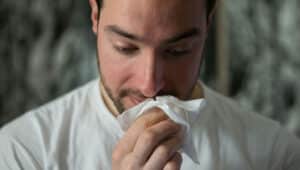
Hairy caterpillars and plant pollen: contact with these reduces those who are allergic to red-eyed, runny-nosed bundles of misery.
Mowers have been busy in our valley and the rampant growth of grasses, following a wet winter, has released clouds of pollen into the atmosphere, microscopic grains covered in spikes that lodge in eyes, noses and lungs with dire results.
An elderly Portuguese farmer and his wife had to do their own grass cutting because employees were laid low with allergies, this year being one of the worst experienced for hay fever.
While the Algarve has processionary caterpillars hanging in silk cocoons among the pine forests, a small garden plot on the Isle of Wight is heaving with caterpillars of the Brown Tailed Moth which, as they pupate, make cocoons with their larval hairs.
When an adult moth hatches, some of these barbed hairs remain on its tail and are used to protect and camouflage the next generation of eggs, the entire cycle being a potent source of trouble to humans.
Usually found in Guernsey and the Scilly Isles, it is thought that global warming has encouraged the moth to move north as far as Yorkshire and Northumberland.
Certainly several varieties of hairy caterpillars are seen over here, one of which was making a meal of my rose tree last week together with a plague of White Fly for which no treatment seems effective. Our ongoing fight with indigenous pests, and marauding wild boar, must be the penalty for setting up home on the edge of the bushy hills of Monchique.
Areas of rough ground dug over by these pigs have provided several good places to scatter wild flower seeds, which may be found on sale in many supermarkets.
Still on the subject of pigs, our next door neighbour’s Black Iberian sow has given birth to a litter of six, three male and three female.
Known in Portugal as the Alentejano Pig, the breed is thought to date back to around 900BC, when the Phoenecians migrated to the Mediterranean region bringing their animals with them.
At some stage, their domesticated sows mated with the local wild boar to create a new breed known as Mediterraneus, with its own distinctive gene pattern.
Connoisseurs prefer the rich fragrant meat to that of today’s low fat porker that has a tendency to become tough when cooked, unlike its roaming relative, which has a good layer of fat beneath the almost hairless skin.
Being free range, each of these historic animals is said to need a hectare of land on which to grub a living. An integral part of the Mediterranean ecosystem, for centuries they have been used in the management of plantations of Holm, Gall and Cork Oak as they graze among the trees.
Swine fever in the 1960s, and more recently the loss of oak forests as the result of the phythophthora fungus, has reduced the size of herds throughout the Iberian Peninsula.
Numbers are beginning to increase again in answer to the demand for tastier, more tender pork, although crossbreeding has corrupted some of the original blood lines.
Closer to home, following the sudden change from damp and cool late spring to summer, every biting insect that was not washed away by winter storms has emerged hungry for something to sting or feed upon: mostly me as I walk the local tracks.
Until a few years ago farmers grazed their goats and sheep on the hills behind our house, but times have changed.
Methods of farming have also changed and with the numbers of wild mammals depleted by the hunting fraternity, anything with warm blood in its veins is a prime target.
Removal of ticks from one’s person is fraught with difficulty. None of the suggested remedies works but a handy little tool shaped like a bent fork may do the trick.
Gently slipped beneath the horrid parasite and hard shield that covers its sucking device, a quick upward flick may, with a little luck, extract body and beak.
Not good news if any parts are left in place as happened with both the Boss and me. With all the protection on offer for dogs surely medical research could find something similar for humans, but without side effects.
The best news in the Brown family is that the Boss is back on the water after a 10-month lay off due to illness.
Never one to do things by half, he took part in a two-day international Campeonata for dinghies in Lagos Bay.
With a brisk northerly Force 4 and flat sea he was second boat home in the first race before adjustment of handicap.
During the next race the wind piped up, became gusty and he had the misfortune to capsize as he gybed round the leeward mark. He was sailing in bare feet which is never a good idea, boats having an assortment of hazards liable to cause injury and in this case the mainsheet caught round his great toe with predictable results.
A gust took the sail and temporarily immobilised, unable to clamber on deck to sit it out Boss and dinghy went for a swim.
With a fleet of about fifty assorted small craft on the water, the sailing club always provides several rescue launches one of which came alongside to offer assistance, the boat was righted and the race completed.
Not a bad effort for a veteran of World War II.