Hotel bosses got their moment in the limelight this summer – complaining at the start of the season how the sector needs government support and immigrant labour as it “can’t find the staff it needs” – but now, after another packed high-season, hotel workers have got their own back. The words were brutal: there is no shortage of staff in the Algarve, there is only a shortage of responsible employers.
Just as our anonymous source explained in July (see story ‘Algarve hotels want immigrant labour’ at portugalresident.com), the sector is run on a basis akin to modern-day slavery.
Salaries are low, conditions almost non-existent and workers in all but the top end of the market are considered expendable.
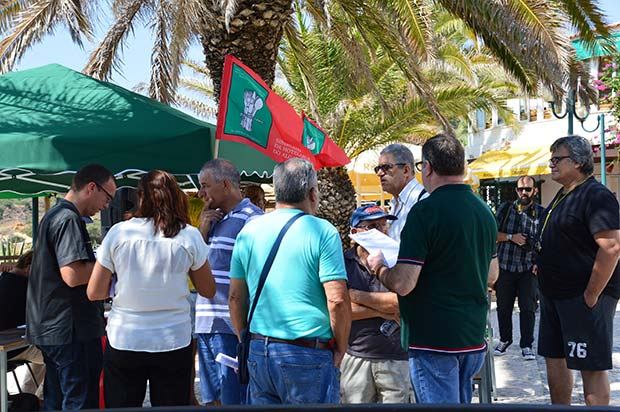
On Tuesday, syndicates joined together for a protest march in the popular Oura district of Albufeira – the capital perhaps of the Algarve’s mass-tourism sector.
It is in Albufeira that the ‘worst hotels’ vis-a-vis staff exploitation open their doors every season and demand long hours for paltry pay and pared to the bone short-term contracts.
Thus, members of the region’s hotel and catering syndicates joined together to leaflet bemused holidaymakers and give their side of the story.
As the pre-publicity press release from FESAHT – the federation of syndicates in the sector – explained, solutions are simple: for quality tourism, it is essential to value staff and their work, and to share with them the wealth created so that they (too) can benefit with improved lives and conditions.
And that’s the nub of the issue in a country where schisms between the haves and the have-nots just keep widening.
Earlier in the week, and reported on page 14, prime minister António Costa extolled the government plan to ‘lure’ recent young émigrés home with the offer of tax rebates.
Critics have since explained, the ‘carrots’ will do nothing unless salaries and employment prospects are improved.
On Tuesday in Oura, speakers reinforced this mindset, describing conditions in the jewel-in-the-crown of national tourism as “reaching the limits of slavery”.
There is a “hidden agenda” with the objective of importing labour from other countries in order to reduce salaries even further, said long-time union leader António Goulart.
One point that rams hotel workers’ plight home is that, in the last 10 years, when room and tourism prices in general have skyrocketed, salaries have stayed almost exactly where they were over a decade ago.
Indeed, Maria das Dores Gomes of the Federation of Hotel and Tourism Workers Syndicates, told Tuesday’s press conference that “pressure is so great that there are situations in which food and board are exchanged for salaries”.
Tiago Jacinto of the Algarve’s tourism industry workers union described how “hundreds of unpaid apprentices” come south every year from other parts of the country and at the end of their stints – often taken up as part of ongoing professional courses – they are not offered any kind of paid position.
The job that could have gone to a trained worker, living in the Algarve, instead has been performed by an untrained young person who very possibly has no plans to make a life in the Algarve at all.
Tiago Jacinto referred to deeper issues, like the phasing out of the need for staff to have professional status.
He explained that a “cook can leave to start work somewhere else as a gardener. There is a strategy in place to devalue work and this has led to a degradation in service”.
The press conference’s bottom line was that the national minimum wage should be increased from 2019 to value work performed within the hotel sector, particularly nighttime shifts and overtime.
Telling on Wednesday was that there was no ‘furious rebuttal’ from employers’ association AHETA – the one that had been moaning about lack of staff in July.
By coincidence, as we completed this text, Dinheiro Vivo reported nationally that “workers have confirmed that AHRESP (the association of Portuguese hoteliers and restaurant sector employers) has agreed to a 6.7% salary increase for the catering and drinks sector”.
A press communiqué from syndicates in the north of the country says the agreement covers “bar, counter, waiting staff and those working in snack-bars and self-service restaurants”.
Agreements covering the Algarve are set to follow, so that the “whole catering sector nationally” can be covered – involving “hundreds of thousands of workers”.
New talks are also scheduled for September with a view to finally tackling the issues that dissuade staff from remaining in their jobs “thus combating the alleged lack of labour”.
The ‘fight back’ has won an important round, though it may make little difference to the annual Algarve staff lay-offs over the winter season.
Ed’s note: Whilst there are many hotels operating in the Algarve – and less scrupulous operators in the mass tourism budget and mid-market are clearly to blame for this deplorable situation – there are also many that do offer good working conditions and career opportunities. Job seekers are advised to do their ‘homework” before applying for a position.
By NATASHA DONN natasha.donn@algarveresident.com
Photo: Members of the Algarve’s hotel and catering syndicates joined together for a protest march in the Oura district of Albufeira
Photo by: SARA ALVES/OPEN MEDIA GROUP