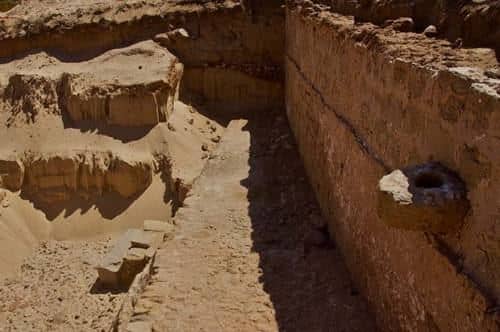
It is described as the “best preserved Roman port in Portugal” and has been discovered at Boca do Rio in Budens, Vila do Bispo.
Believed to be around 2,000 years old, the ancient port was uncovered by a Portuguese-German team from the University of Algarve and University of Marburg with the financial and logistical support of Vila do Bispo council.
Located in a now dry area near the Boca do Rio beach, the structure is 40 metres long with a pier boasting pierced stones for boats to moor, a ramp and a stairway that was used to access the water.
As the local council explains in a statement, there was an extensive lagoon in the area during the Roman period. On the right bank of the lagoon, there was an important fish-processing complex created at the end of the second century AD, served by the newly-discovered port.
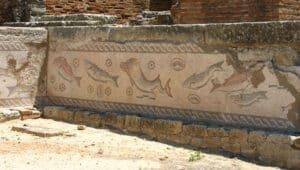
It adds that this whole industrial complex and the newly-found port have been under archaeological investigation since 2016. Also discovered was a large house facing the sea where mosaics and other objects that document the daily life of these times were found.
The site is believed to have been abandoned in the first half of the 5th century before it was once again occupied in the 16th century with tuna fishing equipment, and then once again in the 18th century after the devastating 1775 earthquake.
The council says that the Boca do Rio area is known around the world for being one of the places with the best-preserved evidence of the 1775 earthquake.
Apart from the port, there are also remains of factories that are in “exceptional condition” and where “Garum” was produced, a fish-paste product that was widely popular at the time.
The archaeological works taking place are part of the research project entitled ‘Boca do Rio – um sítio pesqueiro entre dois mares’ (Boca do Rio – a fishing site between two seas), led by João Pedro Bernardes from the Centre for Arts, Archaeology and Heritage of the University of Algarve, and Félix Teichner of the University of Marburg.