Helga and I have just seen one of the most incredible modern architectural sights in the world!
We decided to take a long weekend and go somewhere in Spain we hadn’t been before – Valencia. The drive is under 900km from Loulé, almost all on autoroutes. You can easily drive it in a day or, if you wish, break up the trip by staying in the parador in Manzanares or Albacete.
Valencia was founded by the Greeks in 138 BC and, after being occupied for several hundred years by Arabs, was reconquered by El Cid in 1094. He was made Duke of Valencia for his deeds and died there five years later. The city’s tumultuous history reached its nadir in March 1939, when, after the fall of Catalonia, it became the last refuge of the Republican forces in the Civil War.
Today, although Valencia is Spain’s third largest city, its population is under 800,000, and almost everything you might want to see is concentrated in the very compact old city (Ciudad Velha). The exception, however, is worth the trip all on its own.
We stayed in the Hotel Dimar (Gran Via Marqués del Turia, 80), right on the edge of the Old City. Parking is a huge problem in Valencia, but there is a garage right next to the Dimar, with dedicated spaces for hotel guests. Very convenient!
We walked and walked. Valencia is an elegant city of mild climate, broad avenues and lots of green spaces, but the old quarter has its fortified gateways, churches and narrow streets, with quaint, old-fashioned shop fronts and Gothic houses, and walking is the only way to see it.
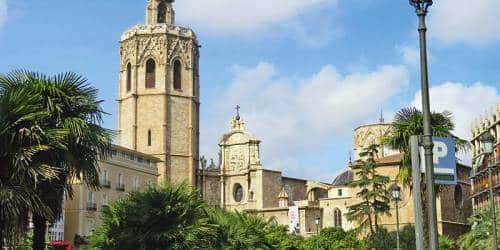
We first wandered to the Cathedral, begun in 1262 (predictably, on the site of a former mosque) but not completed until the 14th-15th centuries. Most of the building is narrowly confined by side streets, but the outstanding and most visible feature is the octagonal Miguelete Tower.
Inside, one of the unique features is in the Capilla del Santo Cáliz, which houses a magnificent 1st century carnelian agate cup, purported to be the Holy Grail (eat your heart out, Indiana Jones). According to legend, the cup was brought to Spain in the 3rd century and was presented to Valencia Cathedral in the 15th century by the crown of Aragón.
The day was so warm and lovely we stopped for a glass of good Spanish beer on the Plaza de la Reina in front of the Cathedral, where we had our romantic juices stirred by a wandering guitarist.
Our strolls took us past the Jardine de la Glorieta, with its monumental ficus trees, planted in 1852 but looking much older, the imposing statue nearby of Alfonso III (el Magnánimo) King of Valencia (1396-1458), the Museo de Cerámica, housed in the former Palacio del Marqués de Dos Aguas (the façade and the exuberantly decorated rooms are worth a look, even if you don’t like ceramics) and the little known Colegio del Patriarca, where you can find a most beautiful Spanish Renaissance cloistered patio and, in the small museum, two El Grecos and a very important copy by Caravaggio of his 1601 Crucifixion of St. Peter (the original hangs in Rome).
But as interesting as all this was, it was simply the hors d’ouvres. The main course was an easy four-stop bus ride south of our hotel and away from the old quarter – the Ciudad de las Artes y de las Ciencias. This fantastically futuristic entertainment-based cultural and architectural complex was started in 1998 and completed in 2005, at a final cost of almost €1 billion.
In 2008, the complex was voted one of the 12 Treasures of Spain. It was designed by Santiago Calatrava and Félix Candela and contains seven structures – an opera house and concert hall, L’Hemisfèric planetarium and projection hall, an interactive science museum meant to resemble a whale’s skeleton, the largest oceanographic aquarium in Europe (containing 42 million litres of sea water), the Agora, which houses sporting events and pop concerts, a 320-metre long open art gallery and sculpture garden called L’Umbracle and finally a bridge, whose 125-metre tower is the highest point in Valencia. The buildings are all surrounded by vast gardens and lakes.
Words don’t do this stupendous creation justice. One runs out of superlatives. It just has to be seen to be believed. As I noted at the beginning, it is worth a visit to Valencia all by itself.
We ended our stay in Valencia with a lovely paella in La Firma, an excellent restaurant near our hotel. Next week I will write about what we did after touring Valencia – visiting the wine areas and several outstanding wineries southwest of Valencia.
By Larry Hampton