Last month I talked about gut health, immunity and how to boost our natural defences with pre- and pro-biotic foods. From this month, I’m going to take you through a few of my favourite anti-infectious herbs, starting with antivirals.
But first, another cautionary note on antibiotics.
Viruses and antibiotics
One of the main issues with the overconsumption of antibiotics is that these drugs are often given to people with undiagnosed viral infections.
Antibiotics treat bacterial infections – they will do nothing for a viral infection. If anything, they’ll lower your defences and make you feel worse. Always ask for confirmation that you have a bacterial infection before taking antibiotics – you may need to run some tests before you can be sure.
If your doctor suspects a viral infection, you’ll be told to go home, rest and drink lots of fluids. The great news here is that there are some potent antiviral herbs in your kitchen that can really save the day.
Sage (Salvia officinalis)
Sage tea is traditionally used as a gargle to soothe sore throats, mouth ulcers and inflamed gums and tonsils, and is taken internally as a nervous system and memory ‘tonic’.
Along with its other culinary siblings – thyme, rosemary, oregano and basil – sage comes from the botanical family Lamiaceae, and they all share similar chemical properties. Rosmarinic acid is a strong antioxidant and anti-viral, while thujone and carnosol are two potent anti-microbial and anti-inflammatory compounds found in these herbs.
Sage’s strong anti-infectious properties combined with its soothing effect on the throat make it my go-to remedy for viral tonsillitis and pharyngitis (1) – but, in fact, it works just as well for bacterial infections too.
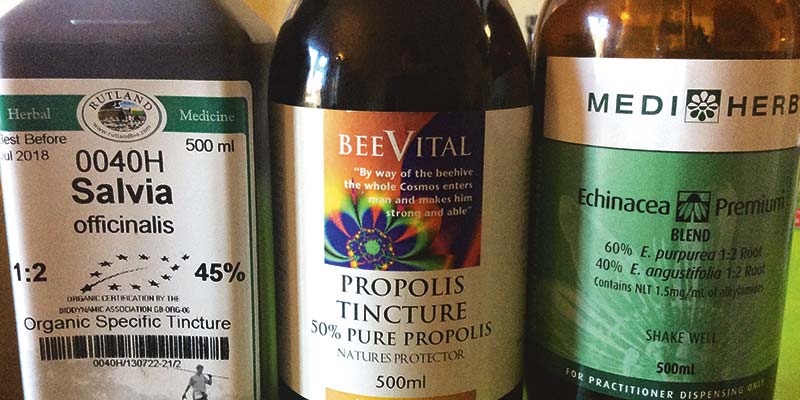
For acute viral or bacterial tonsillitis, I give my patients a mixture of sage, propolis and echinacea tinctures (more on echinacea next month), with instructions to gargle and swallow 4-5 times a day. This usually knocks things on the head pretty quickly.
The fresh herb tea is also delicious and effective. I like to make it really strong – about six leaves per cup. Lightly bruise the leaves before pouring on hot water, cover and leave for 15 minutes before drinking. For dried sage, I use about one heaped teaspoon per cup.
Ginger
(Zingiber officinalis)
The best way to treat a bad head cold is ginger tea, ginger tea and more ginger tea. Fresh ginger contains antiviral compounds called gingerols, which are converted to the more anti-inflammatory shogaols when dried. Crush whole fresh ginger pieces, add to boiling water and simmer for as long as you dare!
I use three or four good thumb-sized pieces to about three mugs of water and leave it to simmer for 10 minutes before leaving it to soak in another 15 or so. My general rule is the stronger the better.
Ginger works not only by providing antiviral compounds, but also by stimulating the circulation and recruiting more of our natural defenses. It is also a powerful anti-inflammatory, found to be as effective as ibuprofen in a recent study (2).
Garlic (Allium sativum)
Garlic alone has the potential to save the world from the threat of antibiotic resistance. Don’t believe me?
In 2015, a brilliant piece of research was conducted by Nottingham university in which they studied the effects of a medieval remedy containing onion, garlic and ox bile. They found the concoction to be more effective than standard antibiotics on a range of bacterial colonies, including MRSA (3).
And garlic is effective for all kinds of viral and fungal infections too. In my practice, I mainly use it as part of a six-week regimen for patients with chronic gut flora disturbances, along with other plant-based antimicrobials.
Fresh garlic should be crushed before being chopped into smaller pieces – this releases the enzyme alliinase, which converts the sulphurous compound aliin into its active form, allicin.
Leave the crushed, chopped garlic open to the air for a couple of minutes to allow this conversion to happen, then add to food or simply mix with some olive oil or butter and swallow.
Take half a clove of garlic a couple of times a day whenever you feel run down. In full-blown infections, take up to three cloves a day and continue for a couple of days after all symptoms have abated.
References
1. Hubbert et al (2006) Efficacy and tolerability of a spray with Salvia officinalis in the treatment of acute pharyngitis – a randomised, double-blind, placebo-controlled study with adaptive design and interim analysis. Eur J Med Res. 11(1):20-6
2. Rayati et al (2017) Comparison of anti-inflammatory and analgesic effects of Ginger powder and Ibuprofen in postsurgical pain model: A randomized, double-blind, case-control clinical trial. Dent Res J (Isfahan). 14(1):1-7.
3. Harrison et al (2015) A 1,000-Year-Old Antimicrobial Remedy with Antistaphylococcal Activity. mBio. 6(4): e01129-15.
By Poppy Burr
|| features@algarveresident.com
Poppy is a degree-qualified medical herbalist practising from Aljezur and Praia da Luz. She offers holistic consultations and personalised treatment plans using plant-based medicine. Poppy is not accepting new patients until January 2019, due to the upcoming birth of her first child. More info at poppytheherbalist.com, or call on 969 091 683..