It seems that few of us know much about Romania. When we told friends we were going to Romania this summer, we generally got a blank look, followed by something like: “Oh yeah, that’s where Dracula and the vampires come from” or, alternatively, “I know a very good builder/plumber/electrician who is Romanian.”
Having just had a lovely 10 days in Romania, we are now in a good position to spread some enlightenment. In Classical times, this area was called Dacia. It was conquered by Trajan in AD 105, as commemorated by Trajan’s Column in Rome. Today all that is left of Dacia is a Romanian car brand!
Romania was formed in 1859 through a union of the principalities of Moldavia, Transylvania and Wallachia – all part of the Austro-Hungarian Empire. Much of the country had already been populated by ethnic Germans in the Middle Ages. It was a kingdom from 1881 through to 1947, ruled by a royal family that was a branch of the Hohenzollern-Sigmaringen dynasty. After WW2, the communists grabbed the country and its significant oil reserves.
In 1965, the notorious Nicolae Ceauşescu took over. Aside from the total mismanagement of the country, with the usual personality cult, nepotism and corruption, he and his hated wife Elena are today known mainly for the colossal “palace” that they built in the heart of Bucharest. With its extensive use of marble, this white elephant is the heaviest building in the world and costs as much to run as a medium-sized city.
The Ceauşescus have the dubious honour of being the only Communist leaders to have been actually violently overthrown in the heady days of change in 1989. They tried to flee but were caught and shot on December 25, 1989. Merry Christmas Romania!
Today, while not exactly prospering, Romania is a member of NATO (2004) and the EU (January 2007), in which it has just filled the rotating six-month Presidency. It is not yet a Schengen treaty country or in the Eurozone, but soon will be. Its resident population is about 19.4 million (down 700,000 since 2011) but its overseas diaspora amounts to almost 10 million, most of whom have left to find a better life and a decent paying job, free of corruption. In spite of its historical associations, there are very few ethnic Germans remaining in Romania.
Well, what about this Dracula character? In fact, there is just a bit of truth in the myth. There was a character named Vlad III, son of Vlad II Dracul (“Dracul” means “dragon” and “Dracula” means son of Dracul). Vlad III lived from 1429 until 1476 and was, on three different occasions, ruler of Wallachia. Although he is often considered a national hero of Romania, his reputation for extreme cruelty earned him the sobriquet “Impaler”, reflecting the way he killed thousands of his enemies.
Quite separately, in 1897 Bram Stoker, an Irishman who never set foot in Romania, published his novel “Dracula”, borrowing only Vlad’s family name but relying heavily on pervasive Central European mythology about vampires. And thus, a huge cinematic industry was born. Present day Romanian entrepreneurs knew a good thing when they saw one and have given the totally fictional Count Dracula and his vampire buddies the full Disney/Marvel Comics treatment, culminating in “Dracula’s Castle” in Bran (a real castle dating from 1388, which we visited, but which dear old Vlad never even saw).
Having put Count Dracula to bed, so to speak, are there some Romanians you might have heard of? Well, there are not too many that spring readily to mind, but we can mention Gheorghe Hagi, Nadia Comăneci, Ilie Năstase and the current Wimbledon champion Simona Halep in sports, Radu Lupu, Angela Gheorghiu, Gheorghe Zamfir and George Enesco in serious music, the playwright Eugène Ionesco, the architect Constantin Brancusi and the Nobel Laureate Elie Wiesel.
Our visit to Romania started and ended in Bucharest, but we didn’t stay there very long because, after the massive totalitarian kitsch Palace of the Parliament and the copycat Arcul de Triumf (a miniature Arc de Triomphe inaugurated in its present form in 1936), there frankly is not a lot of interest there. We headed north as soon as we could.
Romania is known for its many unique monasteries, orthodox cathedrals and churches and for some very well-preserved medieval villages, many of which are World Heritage sites. We started in the northerly area of Bucovina in Moldavia province. In our first day, we visited two of the region’s eight magnificent World Heritage churches – at Suceviţa and then Voroneţ. The former is an Eastern Orthodox convent built in 1585 while the latter is a monastery built in 1488 whose main feature is the Church of St George. Both have their exterior and interior walls completely covered in mural paintings of intense brilliance and great artistic value.
On to Cluj, Romania’s second largest city (pop about 325,000) and the unofficial capital of Transylvania. Like many Romanian cities, Cluj is built around a huge main square whose key feature is St Michael’s church fronted by a huge statue of Mathias Corvinus, a Hungarian king, surrounded by his four main generals.
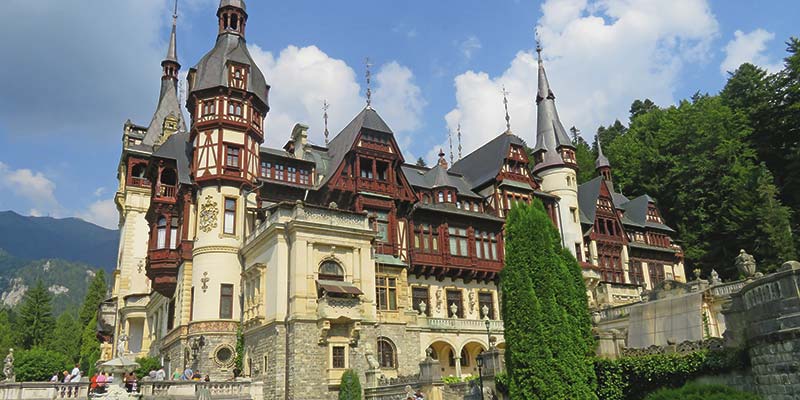
The smaller Transylvanian cities and villages are all uniformly attractive, very clean and often left largely untouched for many years, if not centuries. In this category, we saw Alba Iulia, Sibiu, Sighişoara, Braşov, Sinaia and Bran. Each, in its own way, was absolutely stunning for its situation (usually in the gentle Carpathian Mountains), its simple architectural beauty and its medieval atmosphere.
At the same time, it was clear to us that Romanians are struggling economically, victims of a long history of mismanagement and corruption. No country can lose a third (and usually the most energetic and dynamic third) of its population to emigration and expect to thrive. The EU’s “open borders” policy made that emigration possible. Now Romania’s government must make the country attractive and viable enough to retain its citizens. We are optimists. We think it will.
By Larry Hampton

A World Heritage site.


dating from 1247-91. A World Heritage site.