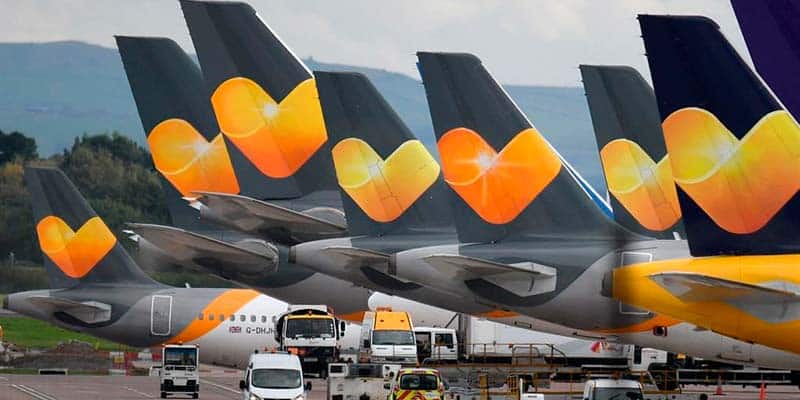
Thomas Cook, one of the world’s oldest and most well-known tour operators, went bust last weekend, sparking what has been described as the UK’s largest repatriation in peacetime history. Although some hotels in the Algarve are reporting “terrible losses”, the impact of the collapse is expected to be “minimal” with Thomas Cook clients representing only 0.2% of Faro Airport’s total passenger influx, explained João Fernandes, president of the Algarve Tourism Board (RTA).
While the Algarve tourism boss does not believe the impact will be significant in a wider context, the RTA is however “already looking for alternatives” to help fill the void left by Thomas Cook’s collapse.
João Fernandes told the Resident on Monday: “The greatest battle that we face now is making sure that those hotels affected are compensated for their losses.” However, he stressed that Thomas Cook was not the Algarve’s main tour operator.
“Thomas Cook used to own hotels in the Algarve, but recently it focused only on selling package holidays which included accommodation and flights to the Algarve.”
As he explained, the company accounted for around 10,000 passengers a year, around 0.2% of Faro Airport’s total passenger influx.
“Thus, we cannot say that the impact will be very significant,” Fernandes said.
Nonetheless, he confirmed that the regional tourism board is already working with Faro Airport and other tourism and hotel associations to find solutions and ensure that the people who would normally travel to the Algarve through Thomas Cook will have other means of coming here.
The strategy will be to “intensify negotiations with other tour operators”, who can fill the gap left by Thomas Cook and carry out joint marketing campaigns to promote the Algarve and increase the region’s sales.
“We hope that many of Thomas Cook’s current clients can, very soon, find alternatives in other tour companies and airlines,” he said.
João Fernandes also revealed that the tourism board is helping the 500 people who were affected by the collapse in the Algarve make it home hassle-free – a number which has since dropped to 450.
“We believe it won’t be a complicated operation, as the Algarve has many airlines that offer direct links to the main airports in the UK, Germany and Netherlands (the main markets that this operator worked with),” he said.
Taking a completely different stance is Elidérico Viegas, president of the Algarve hoteliers association (AHETA), who says hotels face “terrible losses” and fears they won’t receive the sums they are owed.
“July and August represent 50% of hotels’ annual invoicing. These are terrible losses for companies which won’t be recovered. We are still counting the losses; we cannot quantify them yet,” said the president of AHETA.
Viegas also explained that “this isn’t just any bankruptcy” and that Thomas Cook was an important operator especially in markets such as the UK, Germany, Netherlands and Belgium.
“The impact in these countries is huge,” he said.
The issue is that Thomas Cook had established a practice of paying a hotel’s bills only 90 days after the departure of the guest.
In other words, huge sums racked up over the summer have not been paid to hotels all over the world – the Algarve included.
It was even reported that Thomas Cook holidaymakers were “being held hostage” in Tunisia until they paid the amount that hotels were owed.
The UK’s Civil Aviation Authority says that it has already brought back “95% of the people who were originally due back on this day with Thomas Cook; 14,700 people in total.”
It has also scheduled four repatriation flights from Faro Airport, the first of which departed on Tuesday while the others are scheduled for Saturday, September 28 and October 1 and 5.
Meantime, other local tourism leaders also reacted to the news with mixed opinion.
Albufeira mayor José Carlos Rolo says that Thomas Cook’s collapse is “very worrying” and “incredibly negative” for a region that depends on the tourism sector.
“Following the bankruptcy of other companies, such as Monarch and Air Berlin, this is another complex problem to add to Brexit,” Rolo told Barlavento newspaper.
He said that local councils should try to help counteract the effects of the company’s collapse although he says that the responsibility is ultimately in the hands of the regional tourism board (RTA), “which should, together with local councils, look at possible solutions”.
Pedro Costa Ferreira, president of Portugal’s travel and tourism agencies association (APAVT), was more measured in the way he reacted to the news, mirroring the opinion of RTA boss João Fernandes and saying that the impact of Thomas Cook’s collapse “would be minimal”.
He also explained that Thomas Cook did not operate its own flights in the Algarve and that its holiday packages included flights with other airlines, which is why he believes the impact regarding the repatriation of holidaymakers in the region would be minimal.
How did Thomas Cook go under?
The confirmation that Thomas Cook had collapsed came last weekend after last-minute negotiations aimed at saving the 178-year-old holiday firm failed.
It was hoped that Thomas Cook would be able to secure a £900 million (over €1 billion) rescue deal led by its largest shareholder Chinese firm Fosun.
But the deal started to fall through following a demand from its banks to raise a further £200 million (around €226 million) in contingency funding.
Thomas Cook has blamed the collapse on a series of issues, including political unrest in destinations such as Turkey, the prolonged heatwave of last summer and the uncertainty surrounding Brexit which led holidaymakers to delay booking their holidays.
But some feel that the travel firm was unable to ‘keep up with the times’.
“Thomas Cook revolutionised travel, they did amazing things, they democratised it, they industrialised travel, they really invented the package holiday,” Simon Calder, travel editor at the Independent newspaper, told Euronews.
“But then in the late stages of the 20th century, and particularly in the 21st century, they took their eye off the ball. They didn’t quite sort of realise that people — largely a lot of younger people — aren’t using high street travel agents.
“They were slow with the internet and they simply didn’t take much notice of the big low-cost airlines such as easyJet and Ryanair,” he added.
Ryanair strikes deal to keep Faro base open
In slightly more positive news, last week Irish low-cost airline Ryanair announced that it had reached a deal with national airport authority ANA to keep its base at Faro Airport open.
The closure of the base was announced in August and saw tourism authorities in the region scrambling to make sure that the airport maintained all the routes managed by the airline.
But in an unexpected turn of events, the airline sent out a statement to newsrooms last week saying that the base will not close although the number of planes stationed at Faro Airport will be reduced from three to two.
Around 80 people could still lose their jobs, however. Ryanair boss Michael O’Leary said in the statement that the number could be reduced to 50 if some of the employees are willing to fill the airline’s vacancies at other bases around Europe.
He also explained that the decision to keep the base open was only possible as employees agreed to new “seasonal contracts” to reflect the “seasonal nature of air traffic to and from the Algarve”.
Ryanair’s Faro base was inaugurated on March 2010, just two months after the airline launched its first base in Portugal in Porto.