A few weeks ago, a group of 12 of us, Algarveans all, travelled to Georgia in the Caucasus. We were interested in being amongst the first to “discover” the country (in a tourist sense) and last week I wrote about that. But, as we are all wine enthusiasts, we also wanted to learn about Georgian winemaking and taste Georgia’s wines.
There has been wine in Georgia almost as long as there have been Georgians. Very recent archaeological discoveries about 50km south of Tbilisi (reported in scientific journals in 2017) have found qvevri fragments with traces of wine tartrates and surrounded by grape pips dating from ca. 8,000 years ago – or, as the Georgian Wine Board prefers to put it, 8,000 vintages. In fact, it seems that the word “wine” is derived from the Georgian word ghvino.
Clay qvevri (first cousins of amphorae, which were used to transport, but not to produce, wine) are still widely used today in Georgia to make wine, although there remain only a few artisan families in Georgia that make it. We visited one, Zaza Kbilashvili, at his primitive factory in the Khaketi village of Vardisubani. Although made from a very special clay, only the pointed base of the vessel is thrown on a potter’s wheel. The rest is made from “sausages” of clay applied one on top of the other and smoothed by hand. No measuring or other instruments are used, everything being done by hand and eye. Typically, qvevri sizes range from several hundred to about 3,000 litres.
When they are built, and completely dry, the qvevri are fired for seven days in a brick kiln and then, while still warm, the inside is treated with beeswax. In use, the qvevri are buried together, with only their openings exposed, to create a marani, or wine cellar. In 2013, UNESCO added the traditional Georgian winemaking method, using qvevri, to its Intangible Cultural Heritage lists.
Usually qvevri are buried in the ground, but, to our surprise, in Tbilisi we visited an eighth-floor apartment (with restaurant) that had 43 200-400 litre qvevri buried in sand and pebbles on the terrace. The grapes are trucked in from Kakheti but are pressed, fermented and aged on the terrace. The restaurant at Bina 37 was hands down the most unique and romantic place we could have had dinner. The wines were excellent!
Certainly, a majority, and perhaps as much as 70-80%, of Georgia’s wines come from the Kakheti region about 100km east southeast of Tbilisi, and we tasted a number of excellent ones. But really good wines are also made in several other Georgian regions, all west of Tbilisi. Georgian wines are made from 30-40 different varietals, and they vary by region, but only a few have an important share of the total. Saperavi, termed “a great grape” by Jancis Robinson, is far and away the most important red varietal. It is hardy and produces very deep red wines that can age for a long time.
The most important white varietal is Rkatsiteli, but there are several other widely used white varietals – Chinuri, Kisi, Mtsvane … Most Georgian wine is single varietal; there is relatively little blending of varietals. There is almost no use of any of the internationally known grapes (Cabernet Sauvignon, Merlot, Shiraz, Pinot Noir, Chardonnay, etc).
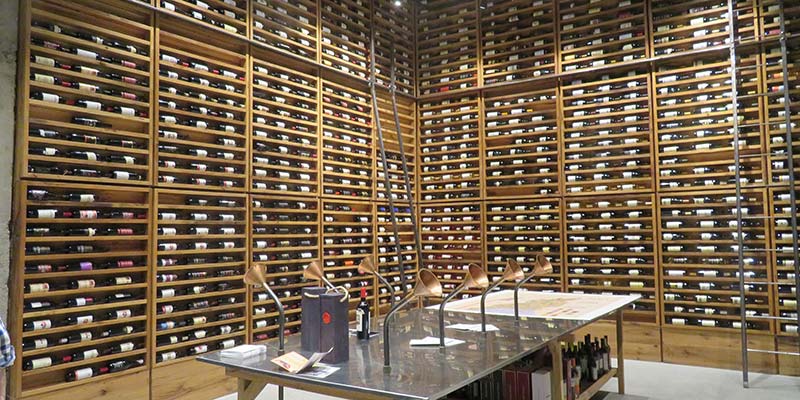
There are a few relatively large winery operations (mainly left over from the Soviet era and producing high volumes of low-quality sweet or semi-sweet plonk for export to Russia) but most are very small, family-run producers who will probably also serve meals and perhaps have a few hotel rooms. Seven of the 11 producers we visited were making less than 8,000 bottles a year. While tasting their output, which was uniformly excellent, we had a wonderful meal at each of those family establishments.
In 2018, Georgia produced about 270 million bottles, about 0.7% of world wine production. Of this, about 30%, or 83 million bottles, were exported, mainly plonk to Russia and Ukraine, with only about 3% (the good stuff) going to the EU. At home, the Georgians drink only 20-25 litres per person per year (the Portuguese drink twice as much), and they usually only drink wine with a meal rather than on its own.
Georgia has a real eating culture and is rightly famed for its supra, a group feast (lunch or dinner, doesn’t matter) during which the table is laden with lots of different dishes, some cold and some warm, all served at once and to be shared around. The popular western custom of “wine pairing” is impossible with this melange!
There will always be a tomato and cucumber salad (and the tomatoes were the best I’ve ever tasted) and khachapuri (literally a delicious cheese-filled bread – but every region has its own version, with some using spinach or mashed potato with the cheese).
There is liberal use of garlic, walnuts, cumin, coriander and, in season, mushrooms. There will always be some meat dishes using lamb or pork (beef less so). Very often the meat will be in special dumplings, called khinkali. The trick with these is to pinch the dumpling by the topknot (called the kudi or kuchi), bite a hole in it to suck out the herby broth containing garlic, parsley and mushrooms, leaving the meat filling to be eaten separately. Dessert usually consists of nothing more than fruit, because by then everyone is groaning and satiated. There will always be lots of food left on the table, too – Georgians are very generous!
You really can eat and drink very well indeed in Georgia. So, let’s raise a glass and offer the Georgian toast gaumarjos (pronounced gow.MA.gio), in the hope that we will return some day to this fascinating land.
By Larry Hampton

of Georgian winemaking.

(two million bottles of the good stuff a year) and a lovely hotel to boot


(3K bottles a year) family-run marani