Region braces for toughest water-saving measures yet
The Algarve is waiting for the Portuguese government to officially announce some of the toughest water-saving measures ever implemented in Portugal to tackle its near-catastrophic drought situation.
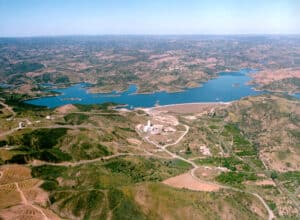
With dams at historically low levels and not nearly enough rain forecast in the near future to bring them back up, the Algarve is facing one of its biggest challenges in recent history.
The region’s drought is being universally recognised as its “worst ever”, as the amount of water stored at reservoirs is unlikely to be enough to last the region until this summer if no significant rain falls until then.
António Pina, president of the Algarve Municipalities Association (AMAL) and Mayor of Olhão, has summed up the situation: “The time to start seriously saving water is now. The situation is becoming catastrophic.”
As the government puts the finishing touches on its drought contingency plan for the Algarve, which is expected to be announced today (Wednesday), some of the biggest measures have already been publicly discussed and, in some cases, criticised.
70% cuts in agriculture
Farmers have lambasted the planned cuts of up to 70% in agriculture as “unfair” and potentially “unsustainable”, considering that for urban consumption (tourism and domestic) cuts stand at “just 15%”.
“The water supply cuts for the sector are unsustainable and cannot be compared with the cuts announced for other sectors,” said José Oliveira, from AlgarOrange, the largest Portuguese association of citrus producers.
“The measures for the agriculture sector are measures of calamity. Therefore, we do not understand how the situation is almost normal for some and close to calamity for others,” he told Lusa news agency.
Meanwhile, environment minister Duarte Cordeiro has already said that authorities are also considering reducing water pressure across the Algarve and cutting off ‘second meters’ (generally used for garden irrigation and replenishing swimming pools) in some properties.
One project viewed by the government as vital towards tackling the Algarve’s drought in the long-term is the construction of a desalination plant (which turns saltwater into drinking water) in Albufeira, a tender for which is expected to be launched this month.
Due to be built using funds from Portugal’s Recovery and Resilience Plan (RRP), the desalination plant is, however, far from a consensual solution. Sustainable water platform PAS (Plataforma Água Sustentável) has been highlighting several reasons why it believes a desalination plant is not the answer, from its potentially “devastating environmental effects” to the fact that it will essentially provide the same amount of water that is already being lost through leaks and poor maintenance in the region’s public water supply network.
Other initiatives involve capturing water from the Guadiana River in Pomarão, setting up “portable desalination plants” and the construction of more wastewater treatment plants, particularly at golf courses.
Algarve tourism confident it can cut water consumption by 15%
In the meantime, the Algarve’s tourism boss has expressed confidence that the sector will be able to cut its water consumption by 15% in line with the government’s contingency plan.
“I’m convinced that the (Algarve tourism) sector will respond in a way that will fulfil the goals set by the government,” André Gomes told Lusa news agency last week.
According to André Gomes, who heads the region’s tourism board (RTA) and association (ATA), the many subsectors linked to tourism “have been doing their job in the last few years and will continue taking measures to reduce their water consumption”.
He gave the example of golf courses, which in July had already experienced a 40% cut and have been investing in water treatment infrastructure. Four golf courses in the Algarve are already connected to water reuse systems, Gomes said, adding that it is expected that the number will increase to 12 by 2027 and 32 by 2030.
Golf courses are also incorporating plants that do not need as much water and implementing irrigation systems that only water the courses when “strictly necessary and with the necessary amount of water”. Courses are also only being irrigated at night, he added.
Other businesses, such as hotels or holiday rental (AL) establishments, have also been “doing their homework”, such as installing tap aerators to reduce water flow and reducing the areas that need to be irrigated.
Tourists are also becoming aware of the drought situation in the Algarve, with more holidaymakers in the region “aware of the need to save water”, Gomes told Lusa.
The Algarve’s struggle with drought is a “reality that the region has been dealing with for a long time”, the tourism boss said, praising the fact that the matter counts on the involvement of all sectors and entities in the region.
Water parks implement water-saving projects
Some of the Algarve’s biggest theme parks have also been working hard to reduce their water consumption.
Zoomarine in Guia says that water sustainability has been a key issue at the theme park for years.
“The (government’s) legislative measures are not yet fully known; however, we can ensure that Zoomarine has always been committed to adopting strategies that effectively reduce its environmental impact and promote resource sustainability,” Hugo Brites, Zoomarine’s marketing and communication director, told the Resident.
From taking water from the nearby Salgados lagoon to installing its own water recycling system, Zoomarine says it has been doing its part to make sure its activities are as sustainable as possible.
“These measures currently enable savings of approximately 85,000 cubic metres of water from the Algarve’s supply network, meeting about 90% of Zoomarine’s water needs for maintaining green spaces, zoo habitats, and water attractions,” Brites explained, adding that the theme park only uses the public water network for its kitchens, food preparation areas and changing rooms.
Lagoa waterslide park Slide & Splash has also told the Resident it has made the “optimisation of water consumption a top priority in recent years”.
Cláudia Correia, the park’s head of communications and public relations, said that the park is currently developing a “highly-sustainable project” which will allow Slide & Splash to “almost reach self-sufficiency”.
Without going into too much detail, the spokesperson explained that the project involves water desalination using water from the mouth of the Arade River which will then be used at the park.
Slide & Splash also has a treatment plant since 2008 that recycles water to supply its pools, toilets and gardens, and a reverse osmosis desalination system since 2011 which was installed to transform “highly saline water” extracted from a well into pool water or irrigation water. The park has also installed flow reducers at taps, sinks and showers in order to reduce its water consumption, the spokesperson added.
Waterwise gardening for times of drought
While some might think that times of drought spell ruin for gardens, this is far from the case.
Rosie Peddle, a founding member of the Mediterranean Gardening Association Potrtugal (MGAP) who writes a monthly gardening column for the Resident, says that “dry climates offer extraordinary gardening possibilities.
“It is often the misguided use of irrigation that limits the range of plants in Mediterranean gardens, as opposed to drought,” Rosie explains.
“We feel instinctively that water brings luxuriance and variety, and that dryness restricts our gardening possibilities. Yet exactly the opposite is true. Most gardeners are unaware that the natural flora of Mediterranean-climate regions is a lot richer than that of temperate regions,” she says.
Rosie adds that a wealth of information (available in English, Portuguese, French and German) on how to create a drought-resistant garden can be found on MGAP’s website.
By MICHAEL BRUXO