Spain outlaws company scanning people’s irises in exchange for crypto currency
The net is tightening around Worldcoin – a company that is harvesting people’s biometric data (by scanning their irises) in exchange for crypto currency.
Yesterday Spain’s data protection agency APED ‘shut Worldcoin down’, prohibiting it from its activity and demanding that it stop using the data it has gathered.
But in Portugal, for the time being at least, people are still selling their biometric data – even without knowing what it will be used for.
According to a recent article in Expresso, as many as 4,000 people are ‘selling’ their irises every day.
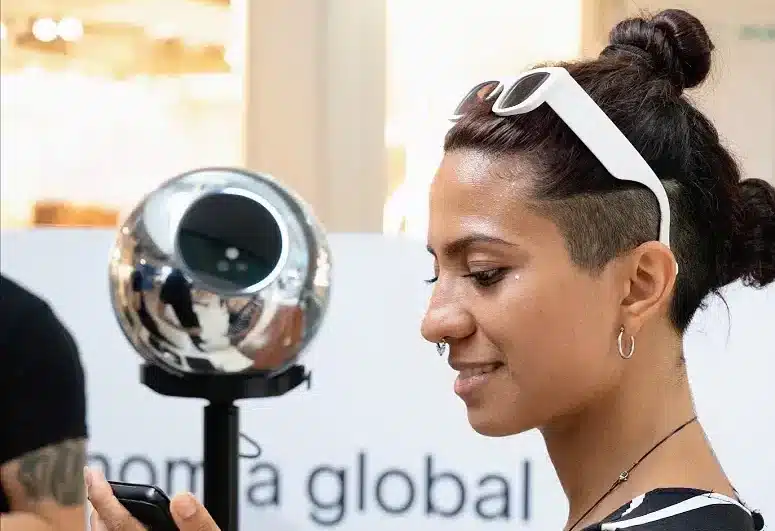
SIC Notícias also reports that in Lisbon’s Gare do Oriente railway station its journalists found a “long queue. The objective was to reach the silver sphere – one of the 20 collection points of Worldcoin installed in Portugal”.
The silver sphere scans people’s irises in exchange for “compensation in crypto currency, in the value of various tens of euros”, writes SIC.
Some people in the queue did not appear to know why they were there.
Said one: “My son set this up. He put the application in and that was it, basically. Now it is up to him. I don’t know anything else… I think it has something to do with money, but I really don’t know”.
This particular individual “preferred not to be identified”, says SIC.
Also in the line was Maria Pinheiro, who had not only registered her iris, but brought her parents along to do the same. She told SIC: “It will end up helping, it’s a bit extra, it compensates” (she was presumably referring to the ‘exchange of biometric data’ for crypto currency).
According to SIC, Helena Machado, a Worldcoin supervisor, assures that “preservation of privacy is guaranteed.
“Our project is much more than cryptocurrencies. We make a passport here, our Word ID, a digital passport that is proof of the humanity of all our customers.“
SIC adds that “in a statement, World ID says that it was created precisely to give people online access, privacy and protection in the age of artificial intelligence”.
At the moment, Worldcoin has more than three million users in 35 countries.
In Portugal, it has collected data from 300,000 people, says SIC – with authorities far from comfortable with what is going on.
Data protection entities in Europe and elsewhere are ‘investigating’ Worldcoin, to try and discover if the law is being violated, in terms of the treatment of biometric data, “as the iris is unique, like a form of digital fingerprint”, says SIC.
According to other reports, Worldcoin’s ‘objective’ is to combat bots – programmes that pretend they are real people. Any people registering at the various stands throughout the country right now (in the main, in shopping malls and railway stations) receive 10 cryptocurrency ‘tokens’ (each token being worth around €6) for allowing their irises to be scanned.
Worldcoin has been created by the co-founders of OpenAI, Sam Altman, Alex Blania and Max Novendstern.
Four million people from 120 countries have already registered with the company, which – until yesterday at least – was active in Europe in Spain, Germany and Portugal.
As to the Spanish data protection regulator’s suspension of Worldcoin, Reuters reports that the company believes Spain is “circumventing EU law” and “spreading inaccurate and misleading claims about our technology”.
Reuters text adds that “(Sam) Altman says Worldcoin’s ID will allow users to, among other things, prove online that they are human, notably in a future world dominated by artificial intelligence”.
natasha.donn@portugalresident.com
ENDS