Situation akin to “condemning people to a ghetto”
Lisbon Municipal Assembly (AML) has heard today of the “insecurity of Islamic places of worship in the capital”, urging the City Council to find a solution.
At an extraordinary joint meeting of the AML’s 3rd and 6th Standing Committees, with the sole aim of taking stock of hearings on the possible construction of a new mosque in Lisbon, councillor Angélique da Teresa, of Liberal Initiative, pointed out that “people have the right to pray in safety”.
In recent months, varios city councillors have visited Muslim places of worship in and have been struck by the lack of conditions.
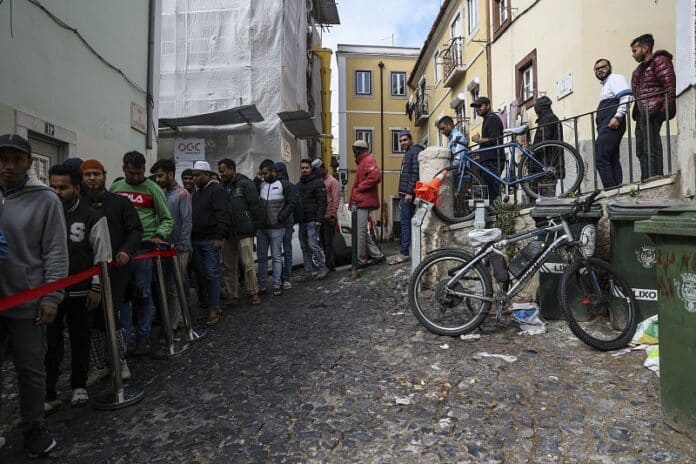
Lusa published a report last month explaining that mosques in Mouraria – home these days to a significant South Asian community, mostly from Bangladesh, India, Nepal and Pakistan – are unable to accommodate all the worshippers that want to use them.
“People can’t all fit inside and have to pray in the street,” Miguel Coelho, president of the Santa Maria Maior Parish Council (PS), told reporters.
Today, Angélique da Teresa returned to situation saying that “it is not good integration, it is condemning people to a ghetto” (…) “there has to be a solution”.
Elected by the PS, Councillor Irene Lopes agreed: “I don’t want to be seen as colluding with a disgrace that could happen“, she warned.
Rui Figueiredo, president of the 3rd Standing Committee (Urbanism, Rehabilitation and Urban Planning), recalled that “in terms of accountability”, the AML has already warned the city council to “take necessary measures, regardless of the process” concerning the new mosque.
“We have called on the council to intervene. There are risk situations there, in terms of civil protection, which must be safeguarded urgently,” he told Lusa today
The project to build a new mosque in Mouraria, which began in 2012, has been mired in protests and delays.
Initially, it was planned to demolish buildings to create a square that would allow access to the mosque via a pedestrianised passage between Rua da Palma and Rua do Benformoso.
In 2015, the matter was again discussed by Lisbon City Council, which asked the Municipal Assembly to approve a declaration of public utility for the expropriation of buildings needed to carry out the project – a proposal that was unanimously approved.
Since then, nothing has moved forwards, and the AML is currently producing a new opinion on the matter.
“We have to be much quicker,” urged Angélique de Figueiredo, considering that “we have to speed up this opinion, take it to the AML plenary and put pressure on the city council so that (the problem) is resolved once and for all.”
The AML undertook to finalise its final report and submit it to the plenary session in April.
It will “expedite steps” approved at the meeting “as quickly as possible”, assured Rui Figueiredo.
These “steps” include hearing Miguel Coelho, as well as representatives of Lisbon’s Islamic community.
The AML is also going to ask the city council to appoint a representative to be heard before proceeding to hear António Barroso – the owner of the land to be expropriated – who has contested the matter in court (due to the compensation), which has delayed the whole process and seen the city council reformulate the project.
Source material: LUSA