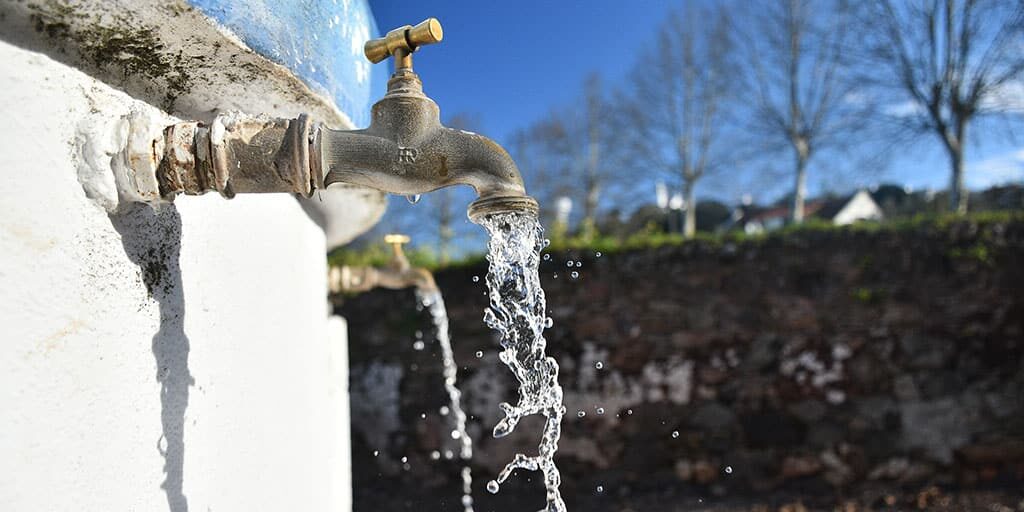
Water restrictions imposed exclusively in Algarve; businesses fear “disastrous consequences”
Strict water restrictions imposed by a Council of Ministers resolution in February, which prevent the watering of gardens or the pressure-washing of houses before painting, are to be followed by everyone in the Algarve until the end of September, no matter the potentially “disastrous” consequences they are having on businesses.
António Pina, president of the Algarve Municipalities Association (AMAL), and also Olhão Mayor, has put it simply: “The available water is for drinking”.
“People have to realise that if we don’t implement measures, water will run out,” António Pina told the Resident this week.
But what about the painters and gardeners who fear their livelihood may be at risk if they are not allowed to use water until the end of September?

“The water we have right now is for drinking,” Pina said, insisting that there is no other way of looking at the matter. In other words, businesses that rely on water in the Algarve have to find ways to adapt if they are to survive.
For context, a series of restrictions on water consumption were imposed by the resolution (nº26/A) approved by the Council of Ministers in February and were applied to the entire Algarve starting from the date of the resolution’s publication (February 20).
Not much was reported about this resolution at the time, despite the strict restrictions that it enforces in the Algarve.
A few examples include the “prohibition of the use of water from the public network or potable water extracted from other natural water sources for watering gardens and lawns located on private property, with the exception of necessary exemptions to ensure the survival of trees with unique or monumental characteristics”, or the “prohibition of washing pavements, public spaces, walls, and roofs with water from the public network or water extracted from other natural sources”.
Another measure involves the “suspension, between June and September 30, 2024, of the use of public water supply for washing vehicles (light or heavy), motorcycles, quad bikes, scooters, or similar vehicles, except if carried out in establishments licensed for commercial activity and equipped with water recirculation systems or if a sponge and bucket are used outside commercial premises.”
The only area where these measures seem to have raised concerns so far is Lagoa, where the local council sent out a statement to citizens along with their water bills informing them of these restrictions. In the case of Lagoa, the only municipality in the Algarve to provide this information, fines for non-compliance can range from €400 to €4,000 for individuals and from €6,000 to €36,000 for businesses.

The announcement shocked several local business owners, from painters to gardening companies, who warn they are effectively banned from working until the resolution’s end (September 30, apart from certain restrictions which may end sooner or later).
“What this means for me is that I can’t powerwash (pressure washing which is necessary before any painting job), which is an essential part of our work,” Dax Gomez, who runs DSG Painting & Decorating and employs six people in Carvoeiro, told the Resident.
“This is disastrous for me, and lots of people are in the same situation,” the local business owner said.
Orlando Vieira, a local self-employed painter, also fears the impact of the restrictions on his line of work. Without being able to powerwash, painters will have to resort to old techniques such as brushes and other tools to attempt to clean walls, roofs and other structures before painting, he explained.
“This will seriously delay our work and strongly hinder our activity,” he added.
The painter also questioned whether authorities will be able to truly monitor whether citizens and businesses are respecting these restrictions.
“Just the other day, I saw someone using water to wash an entire building. Unless someone is reported, I don’t see how authorities will be able to monitor this,” he said.
Meanwhile, Rosa Silva, manager of the Lufada Primaveril nursery in Lagoa, says that these restrictions have created a feeling of uncertainty among businesses and clients.
As she explained, the nursery is not connected to the municipal water network and uses a well that collects rainwater. “We have nothing else here, just the well,” which during the summer is supplied by the irrigation perimetre of the Association of Irrigators and Beneficiaries of Silves, Lagoa, and Portimão.
She has considered the option of watering her plants with recycled water, for example, from the wastewater treatment plant (ETAR) in Companheira, Portimão, but she doesn’t have a tanker truck to collect it, if needed.
Her customers, most of them foreigners, are also upset and worried. “Can you imagine the money they have invested in villas and gardens,” she ponders.

“If customers stop buying, we also stop selling,” Rosa Silva said, explaining that’s why fellow nursery owners, “especially those who export plants”, participated in the slow march on the EN125 road on March 8, which urged the government to take measures to increase water storage in the region.
With the peak of the company’s workload usually occurring during spring, Rosa Silva is nonetheless considering not stocking up on plants because “we are still waiting to see what will happen” with the arrival of the summer heat.
At the Pina Garden Centre in Lagoa, the situation is not so dire.
“We have a reservoir which collects rainwater for use in the nursery,” manager Nuno Pina told us.
He acknowledged that “we are in a moment of change”, which “always implies creating new habits,” although he believes authorities may be going about it the wrong way. “I think the way of communicating this water shortage situation and the way of leading people to a new process may not be the best, in my opinion,” he said.
“People were used to managing green spaces in a way that they will have to change from now on. This always leads to some discomfort,” Nuno Pina said.
While he recognises that the restrictions affect “everyone who depends on water”, Pina Garden Centre was not caught off-guard.
“We have been preparing ourselves. This year we made a very large investment in flood irrigation that will allow us to save a lot of water. It is a big investment for the company at this stage, but it is important. And we have drip irrigation, to optimise water consumption as much as possible,” he said.
In commercial terms, “we have been adapting the products we sell. We have been trying to have more and more plants that do not need water, and advising people on planting seasons,” he said.
According to Nuna Pina, the restrictions may not be as impactful “if there is proper management by everyone of the water we have.
“There is a period of adaptation that naturally will bring us difficulties, but then I think things have everything to continue the normal path. But it is indeed necessary to adapt and have a new way of looking at green spaces. Perhaps we have too much lawn area, in my opinion,” he said.
Nuno Pina agrees that a possible solution for irrigation could be for the municipality to invest in a cistern that would collect recycled water from the Companheira wastewater treatment station of Águas do Algarve, to be distributed among various consumers.
Restrictions to be assessed by June 1
According to the Council of Ministers resolution, the Portuguese Environmental Agency (APA), the Regional Development and Coordination Commission (CCDR Algarve) and the Algarve Municipalities Association (AMAL) have been tasked with presenting a report on the “implementation and effectiveness of the measures listed in the resolution” by June 1.
The report should include “recommendations for the extension of the measures until December 31”, as well as “additional measures to be taken if the minimum reserves for public supply in 2025 are not guaranteed.”
The full resolution can be found here.
By MICHAEL BRUXO & BRUNO FILIPE PIRES