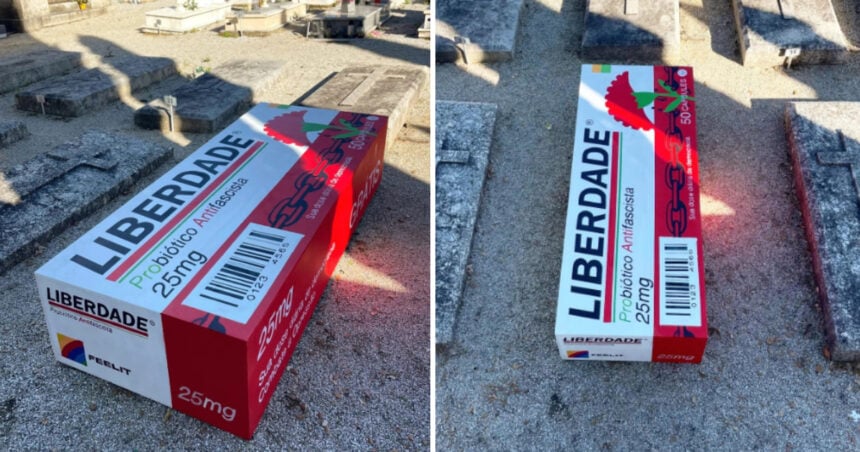
The controversial artist created an XL box of “antifascism probiotics” containing “50 capsules of 25 mg”, symbolising 50 years since the 25th of April 1974 revolution, celebrated tomorrow.
One of Portugal’s top contemporary artists, Bordalo II, has placed a giant medicine box with the inscription “Liberdade. Antifascist probiotic” on top of António de Oliveira Salazar’s grave (1889-1970) in the Vimieiro cemetery, in the municipality of Santa Comba Dão.
“Freedom is fundamental for each of us and everyone’s well-being,” the artist wrote in a post on Instagram, showing photographs of the art installation and a video of the moment it was transported to the former dictator’s grave.
António de Oliveira Salazar, a major figure in the Estado Novo dictatorship, was born on 28 April 1889 in Vimieiro (Viseu district). He passed away on July 27, 1970, nearly two years after a fall that resulted in a stroke, leading to his removal from the presidency.
The XL red and white box, with a red carnation, states that the “antifascist probiotic” contains 50 capsules of 25 mg, symbolising the 50th anniversary of the 25th of April 1974 revolution, which will be celebrated tomorrow.
“For some reason, those with tyrannical and anti-democratic ambitions begin precisely by attacking freedom – this complex concept that cuts across various fields of our lives and without which we will not have a just society,” argues Bordalo II in his Instagram post.
And because “freedom is fundamental,” the artist warns: “We can’t get distracted and take freedom for granted. On the contrary, we must defend and exercise it every day. The 25th of April also serves to remind us of this.”
Bordalo II adds that “defending freedom means respecting differences, demanding universal fundamental rights and allowing the expression of free thought and creativity”.
“Art must also be free. It must be able to question, provoke and provide a starting point for reflection,” defends the artist, who ends with the phrase “25th of April always, fascism never again.”
Artur Bordalo (Bordalo II, named after his grandfather, the artist Real Bordalo) was born in Lisbon in 1987. He started with graffiti, which laid the foundation for his renowned work: creating sculptures from rubbish and waste materials.
Political and social intervention has characterised his work, addressing topics ranging from environmental issues to sexual abuse in the church.
Last August, during World Youth Day, he created the “Walk of Shame” installation, a “red carpet” made of extra-large €500 notes, that led up to the stage of the event at Lisbon’s Parque Tejo, to criticise the “millions of public money” invested.
Recently, the artist painted the Palestinian flag on a staircase in a Lisbon train station in a work called “Guilty Steps”.
In December, he presented a 6.5-metre panda made of waste in Macau, in a former firecracker factory, again drawing attention to the ongoing waste production and destruction of the planet.
And, in March last year, he exhibited around 40 new works in São Paulo in the exhibition “Bicho Homem”, his first on Brazilian soil.
In Portugal, you can see animals created by Bordalo II in cities such as Lisbon, Estarreja, Loures, Vila Nova de Gaia, Faro, Coimbra, Águeda and Covilhã.
LUSA