Albeit not as quickly as demonstrators may want…
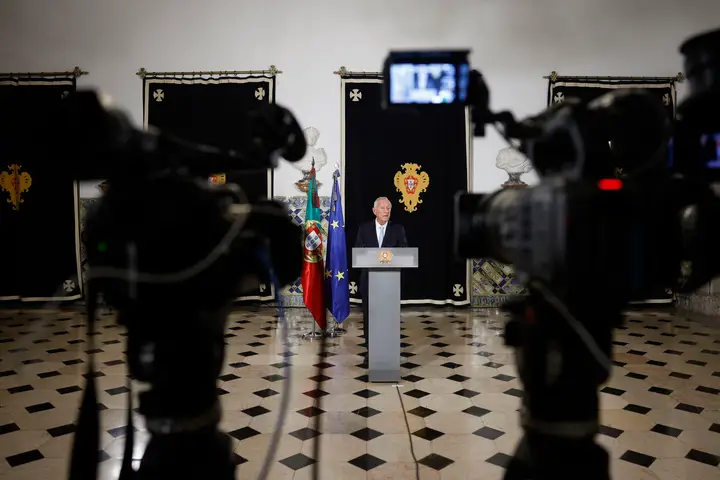
President of the Republic Marcelo Rebelo de Sousa considered today that the Portuguese government’s “reality in relation to the Palestinian question is changing”, although he admitted that promoters of demonstrations for the cause of Palestine want progress to be made more quickly.
This important position was conveyed last night by Portugal’s head of State at the University of Coimbra (UC), at the start of the centenary celebrations of the birth of Luís de Camões.
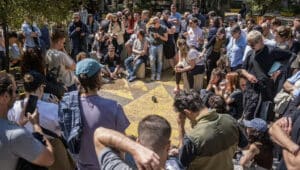
Reports stressed that Marcelo was the only public figure who reacted to demonstrators yesterday (the prime minister/ parliamentary speaker and others all passed by the young people without responding) – thus journalists asked afterwards what had been said.
Writes Lusa: “From the head of State’s perspective, ‘a reality is underway’, which, ‘naturally’, the promoters of the protests against Israeli military intervention in Gaza and for the recognition of the Palestinian State want to see ‘go further and faster’.
“We have to admit that reality is changing and has already changed the position of the Portuguese government”, he said.
Marcelo Rebelo de Sousa added that he told the students ‘two important things’, the first of which was ‘that Portugal had recently taken a position, for the first time, in support of Palestine’s entry as a full member of the United Nations’.
This “has never happened before (…) And Portugal (voted for this), with an overwhelming majority (of countries)”.
According to Marcelo, “as a full member, (Palestine) now has a seat alongside member States that are part of the United Nations”.
“I also said that Portugal recently signed a declaration in favour of a ceasefire’ (in Gaza)”, he went on.
According to Lusa, Marcelo spent five minutes with protestors – something that will have been completely ‘off script’.
“He began by listening to one of the organisers of the demonstration demand Portugal’s immediate diplomatic recognition of the Palestinian state and an ‘end to the complicity of the University of Coimbra’ with the State of Israel and the ‘massacre’ of the Palestinian people.
“After listening to this message, the President of the Republic then borrowed the microphone from demonstrators and conveyed his position on the current Palestinian reality in less than a minute”.
Coimbra’s students have been camped out near the Faculty of Arts since May 21, demanding an ‘end to the ongoing genocide in occupied Palestine’, adds Lusa.
In a press release sent to the State news agency at the end of May, protesters demanded that the university take a ‘stand for an immediate, unconditional and permanent ceasefire throughout occupied Palestinian territory’. They also called for the raising of the Palestinian flag on the institution’s tower and an end to all programmes, agreements and protocols with Israeli companies, institutions and universities, “as well as the refusal of any funding in academic curriculum by the State of Israel”.
Following this stance, the Coimbra Students for Palestine movement has accused the university of increasing the number of private security guards in the area, preventing student access to university spaces and ‘intimidation and harassment’ by security guards.
Marcelo’s insistence to speak with the protestors, and his admission that government thinking is changing, is hugely relevant considering the comments he made shortly after the October 7 atrocities to the Palestinian representative in Lisbon.
The former government of António Costa equally had a positive approach to the Palestinian question, with former minister of foreign affairs João Gomes Cravinho repeatedly showing his understanding of the conflict.
Source material: LUSA