“This has to be investigated. There are too many doubts”
Saturday’s late afternoon debate on plans for a desalination plant daily disgorging endless tons of brine off one of Albufeira’s most iconic beaches heard that there are so many ‘downsides’ to the project that the platform of entities opposing it is formulating a complaint to the Public Prosecutor.
PAS – the Platform for Sustainable Water – has long been explaining why a desalination plant is not the answer to the Algarve’s decrease in rainfall. But no matter how succinctly the 13 organisations and entities spell out the negatives, the stock response from the government (both this one and the last) has been that this is the way forwards to ensure the region’s supply of water.
Yesterday’s debate however benefited from a presentation by biological engineer Cláudia Sil, attached to CCMAR (the Algarve university’s centre for marine sciences).
Engineer Sil gave a ‘no holds’ barred’ assessment of the project that began with a cost of just over €50 million, and has since risen to one close to doubling that. It is “a decision created with the PRR funding”, she told her audience. “Before the PRR (the plan for recovery and resilience, giving countries varying degrees of European billions), desalination was simply an option, to be evaluated…”
In 2020, all that changed. Documents on the regional plan for water efficiency suddenly saw the words ‘desalination’ added, under ‘medium to long-term options’ – and very quickly this skipped up to being ‘a matter of urgency’.
Cláudia Sil’s presentation underscored all the negative consequences previously highlighted by PAS, but reinforced the message that the Algarve is not, in fact, short on water, or rather ‘as short of water’ as authorities like to impress: there is AMPLE water for domestic/ urban use, it is simply the heavy demands of ‘industrialised agriculture’ (the water-intensive projects favoured in recent years that have brought multinationals flocking) that have depleted underground reserves.
And here’s the thing, stressed Engineer Sil: Those multinationals will continue draining the region’s underground reserves (paying no one for the privilege), while everyday families and local businesses will be ‘tied into’ the water boosted by desalination, and see their water bills soar.
“This is all about ‘agribusiness’; about extractive farming”, she said – the presentation outlining the 75% share of subterranean water taken by agriculture.
In other words, the Algarve – just as PAS has been saying since this project started gaining traction – does not ‘need’ a desalination plant. But a combination of ‘bad communication’ – and the habitual apathy endemic in most populations – risks seeing the region sleepwalk into a scenario of irreversible environmental damage and harm.
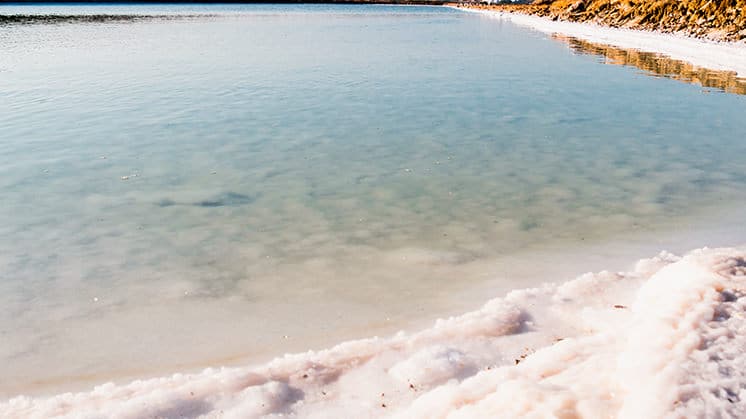
Cláudia Sil amplified concerns already voiced about the tons of untreated brine, and chemical sludge (dubbed grey waters), that will be channeled back into the sea 24/7 through a series of pipelines, adding that even the risks to the cliffs – through which at least one pipeline will pass – are ‘unknown’.
No-one knows what could happen in the event of an earth tremor, for example, to the cliffs – which at best are unstable, due to long-term erosion, and which will become even more vulnerable under the weight of tons of brine passing through them every day. Nor of what might happen if there was a spill, or a pipe burst.
Engineer Sil’s presentation also gave an idea how depleted fish stocks could become, due to the effects of the desalination process intake on their sources of food and reproductive structures, namely, ichthyoplankton.
Quarpesca, the local fishing community, has already decried the desalination plan, saying it spells “tragedy” for the sector – but Cláudia Sil drilled down into the science, explaining that by reducing ‘planktonic mass’, the plant would, in effect, help create a veritable marine desert in an area (that for now at least) is the absolute opposite.
There are even ‘better technologies’ available for desalination than the reverse osmosis model that the project will be following.
Ms Sil’s anguish was patent – but the big question in the room was ‘is there time to stop this project’ before it is allowed to happen, and cause ‘irreversible environmental damage’?
This is where PAS’ Rosa Guedes (sitting in the audience) came in, with the information that the platform is preparing a complaint to the Public Prosecutor’s Office, in the hope that it will investigate all the 116 ‘issues of concern’ highlighted in the initial environmental impact study/ exercise in public participation, which nonetheless saw Portuguese environmental agency APA give a favourable opinion.
“All these concerns go against the perspective of EU directives”, stressed Rosa Guedes.
PAS’ Nídia Bráz, giving a presentation after Cláudia Sil, summed the situation up in one sentence: “This is an investment of high risk, with irreversible consequences, and it seems there will be little in the way of control involved”.
Considering the number of landowners affected by this plan (with compulsory purchase orders causing anguish and distress), the meeting was not particularly well-attended. There were no other journalists, for instance, to hear the arguments reinforced by slides and diagrams; not enough people to pass on the message that “we need to say that we will not accept this”.
Cláudia Sil gave her opinion, following the debate: “This whole exercise is an opportunity to make money. The Algarve is not a desert. It is being treated as if it will be by the agri-multinationals, because this suits them – and it will increase all our water bills. They will become enormous… and this of course will suit Águas de Portugal…”
natasha.donn@portugalresident.com