Association extolls importance of “dignified space”
The Portuguese Renovar a Mouraria (Renew Mouraria) Association said today that it “sees no disadvantages” to the building of a mosque planned for the neighbourhood, pointing out that the problems in the area are not related to religion, but to drug use.
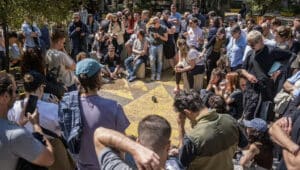
Head of the association Filipa Bolotinha heard today at Lisbon city council about the possible construction of the mosque, which has been ‘talked about’ for well over a decade.
She stressed the various positives:”One of them is the creation of a dignified space, which doesn’t entail security risks, which accommodates all the people who say their Friday prayers, for example, and a space where there is also room for women to leave their homes”.
Bolotinha recalled that the project could not be said to be related to recent migration flows. This is “an old need in an area that has had an Islamic community living there for several decades”, with second generations already living there.
At the moment, Muslim devotees worship in small, temporary spaces, with no conditions for separating men and women, as provided for in this religion, so the (women) have to stay at home.
“The mosque will bring these women out into the open and for us, from the point of view of the work we do, this is a very positive point” for the process of integrating these communities into Portuguese society, namely by learning the Portuguese language, said Bolotinha.
Another advantage, for the association, is “greatly improving the organisation” of the area, especially “opening up Rua do Benformoso” to Rua da Palma, reducing “the stigmatisation and marginalisation” of the street, “which has its own dynamic”, where “public space is used in an almost self-organised way”.
Filipa Bolotinha pointed out that the Mouraria neighbourhood is currently facing major challenges, namely conflicts that have to do “not with the existence of immigrant communities that have a different culture and religion (…), but with drug use”.
“There are conflicts, but none of them are based on religion, but, I repeat, drug use in that area. This is what is currently creating tension and pressure in the area. Redeveloping the area, creating a mosque, which is a beautiful, dignified architectural building that opens up the two streets, will only regulate the use of public space,” she said.
Lisbon city council is listening to local organisations and officials about the possible construction of the mosque, namely about the social, urban and public space impacts, since existing places of worship currently have poor conditions.
In October 2015, Lisbon city council unanimously approved the construction of a new mosque – a project budgeted at €3 million – to serve the Muslim community, but it has taken this long to start to move forwards.
Soure material: LUSA