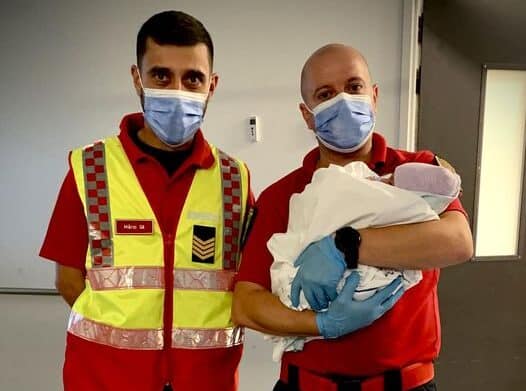
Birth on motorway access roundabout ‘saves mum and baby 120 km trip’
A birth in an ambulance on a motorway access roundabout ‘saved’ a young woman in labour a 120 km journey yesterday morning – and is being cited today as further evidence that the ministry of health is not interested in solving the problem of rising chaos in the country’s maternity units.
“They would rather women gave birth in ambulances, than in hospitals”, António Nunes, president of the League of Portuguese Firefighters, railed.
As tabloid Correio da Manhã stressed, the fact that mother and baby were safely delivered in the ambulance meant that the pair were ‘saved’ a long journey, and the prospect of spending days in a hospital far from family and friends.
The nearest maternity units (Vila Franca de Xira, Beatriz Ângelo and Santarém) were all ‘closed’ due to the lack of available obstetric teams – and once again a pregnant woman was faced with the ‘last thing’ she will have imagined for her child’s birth, a journey at breakneck speed along a motorway to a town where a hospital she probably had never set foot in was the only destination prepared to receive her.
The week before, another newborn was delivered in an ambulance, this time on a bridge leading into Lisbon.
For a country that is meant to be ‘developed’, the situation is seen as ‘chaos’/ undignified and completely wrong.
Fortunately, “the time was short and everything worked out for the best“, said Nunes, but the right place for a woman in childbirth is a bed, not the back of an ambulance.
Also last weekend, a 34-week pregnant woman hemorrhaging had to travel 60 kms from Moita to Cascais hospital before she could receive treatment.
“These are all cases that shouldn’t happen”, Nunes insists. “It would be much better and there would be much less risk if deliveries took place in a general emergency room”.
And while the firefighter chief concedes that his teams are prepared for these kind of eventualities, pressure on them to safely deliver babies, deal with miscarriages, is intense. Too intense.
“They’re not paying us”, he said (referring to the millions in passenger transport still owing to firefighting corporations) and they’re asking for even more effort.
“We know that the Ministry of Health is new, that the SNS is new, that the government is new, but this is a borderline situation for which the firefighters cannot be held responsible.
As he explained, all these ‘extra journeys’, driving kms out of their way to find an open maternity unit, means ambulance services in their normal area of action are compromised. Firefighters are no longer “providing a service to the community” for hours on end, he said.
“We cannot accept this situation as it is. The ministry needs to sit down with us and see how we can be less affected. They don’t want to create chaos in the area of emergency response. We’ve been insisting on a meeting. The Ministry of Health must meet with us quickly,” he told reporters today.
Pressure on the health ministry to come up with better solutions than simply transporting birthing women across the country was not helped by the recent story of a hospital allegedly refusing to treat a woman suffering a miscarriage (because their maternity unit was closed). In this situation, had it not been for the insistence of local firefighters, the woman would have been obliged to travel 130 kms to an ‘open’ maternity unit – and her own life could have been put in jeopardy.
It is little wonder that pressure for solutions is building. However, as commentators have stressed, this is a problem that has been evident for years without being effectively addressed: Portugal only has 2,000 obstetricians, and over half this number do not work in the public ‘SNS’ health system.
The fact that less than 1,000 obstetricians have to be spread across the country, in numbers considered ‘sufficient’ for a maternity/ gynecological department to be open, is an issue of management, which analyst Paulo Baldaia has told SIC is simply not being conducted efficiently.
There are many issues, not least the Order of Physicians’ refusal to train-up more doctors. But one of the first stumbling blocks is the fact that an obstetrician in the private sector will earn between three and five times more than one working for the SNS.
“There is a basic problem to solve here”, Baldaia tells SIC: “You have to make the career in the SNS attractive and this has to be solved – whether by a PS government or a PSD government (…) Either they solve the problem of making careers in the SNS more attractive in order to compete with the private sector, because the solution isn’t the one we’ve seen. It happened last year, it’s happening this year, and in some cases it is pushing pregnant women into the private sector.
“If the state is able to pay the private sector to solve some specific problems, why isn’t it able to meet with health professionals – not just doctors, but above all doctors – and solve some of these problems?”
It is the salient question of this summer’s brand of health service chaos, and with a new government, it has become a red-hot potato that has to find a solution before opposition parties talk it up to a full-blown drama, or before someone dies (as happened under the Socialists in 2022).