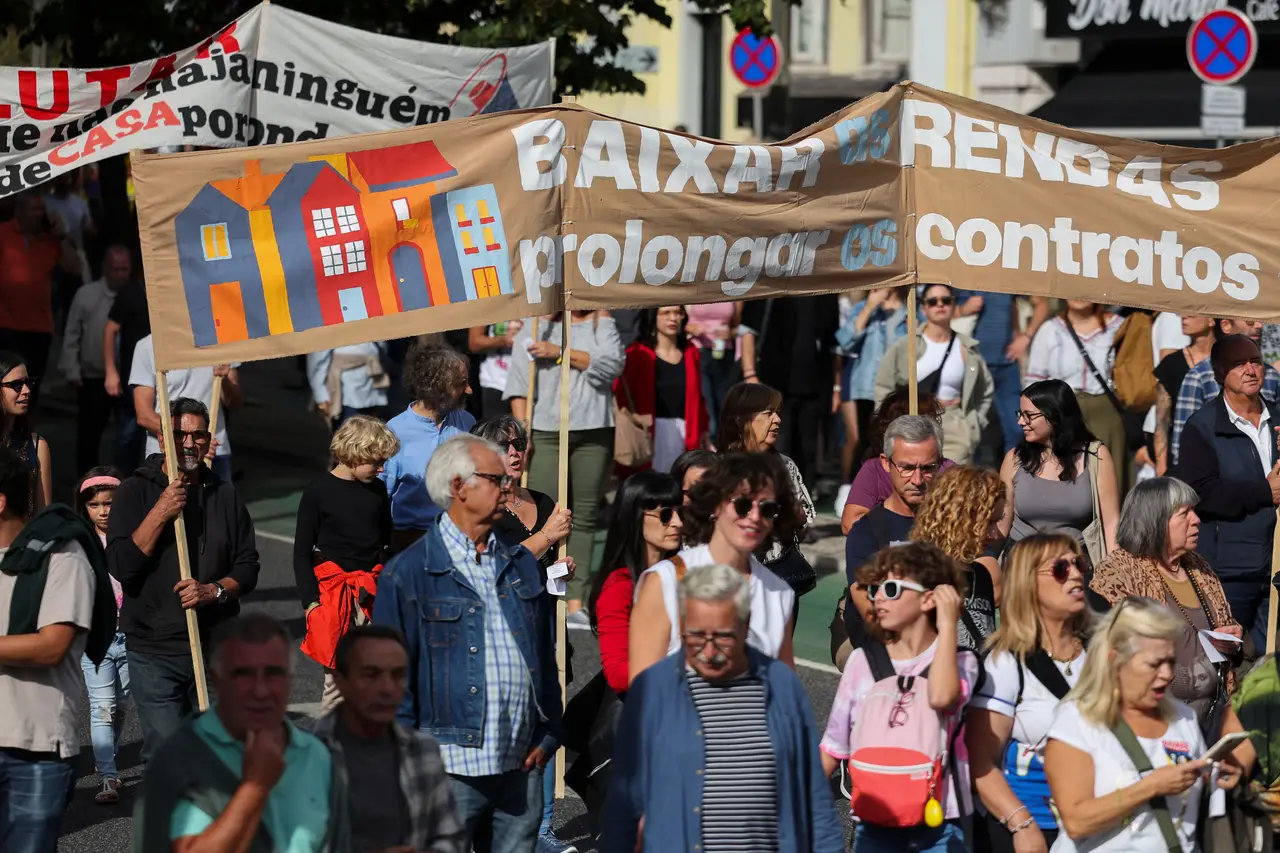
Fourth demo in space of year shows housing crisis “just getting worse”
Thousands of people have gathered today in various parts of the country to demand ‘a house to live in’ and the fulfilment of the constitutionally enshrined right to housing.
As political leaders argue about the State Budget, people on the streets showed that parliamentary power play is the last thing on their minds: they want policies; they want change; they want to be able to move on with their lives (instead of living with their parents, or in overpriced lodgings because they cannot afford a home of their own).
Since acknowledging the ‘housing crisis’ in this country, politicians have succeeded in achieving comparatively little: house prices are still increasing; rental costs are still increasing (and of course house building projects are taking their time).
In Lisbon, the councillor for housing Filipa Roseta turned up at the demonstration in Alameda Dom Afonoso Henriques, to highlight the work of the current executive, saying ”much more has been done than in the last decade” to respond to the housing crisis in the city – but many of those taking part were unimpressed, and claimed she was simply trying to make political capital out of the event.
André Escoval, from the Porta a Porta movement involved in the organisation of these protests, accused the current government of being “hostage” to the interests of landlords and banks and not doing enough to help people.
While the Lisbon event marched through the city, ending with a form of ‘party’ with musicians, other demonstrations took place in Porto, Faro, Setúbal, Azores, Madeira – up to 22 different locations where citizens feel this issue keenly enough to take to the streets.
The day’s protests have been orchestrated by the Casa Para Viver platform, the Porta a Porta movement, Referendo pela Habitação, Projecto Ruído, Vida Justa and 1º Esquerdo – admittedly all groups with a strong left-wing bias.
Exhortations include “bringing an end to evictions, and demolitions for those who have no alternative decent housing” and reducing mortgage instalments: “making bank profits pay”.
The fight against property speculation is another of the priorities, reinforcing the need for ‘social prices’, for vacant properties owned by the state to be used for social housing, and, of course, for an increase public housing.
As Lusa explains, “for the platform – which brings together more than a hundred organisations and has already mobilised thousands of people on the streets of various cities in three demonstrations (June and September 2023 and January this year) – the new government, led by Social Democrat Luís Montenegro, is very committed to the real estate business.
“House prices and rents continue to rise, overcrowding is increasing, as are precarious housing conditions/ homeless people and evictions. Most of our salaries, if not all are spent on paying for a home. In this way, it is inevitable that poverty will increase”, organisers told the news agency.
This was the fourth demonstration in Portugal in the space of a year and a half for the right to housing, concludes Lusa.