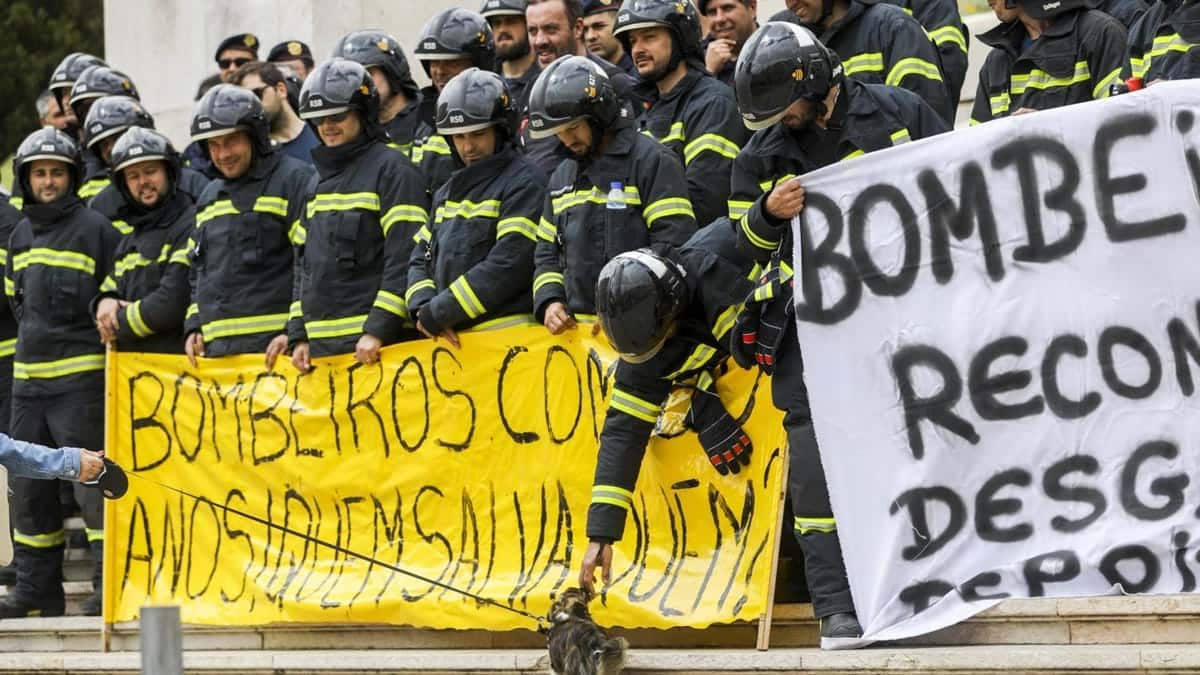
All opposition parties were ‘present’ at protest, supporting firefighters’ demands
Portugal’s minority governing – fighting to stay in place – has criticised what it calls the “political instrumentalisation” of the sapper firefighters’ protest outside parliament yesterday – an event that would have taken centre stage in all news bulletins were it not for a triple murder, in broad daylight, in a complicated Lisbon neighbourhood.
Minister for the Presidency António Leitão Amaro made a point of telling journalists clamouring for ‘reactions’ over the firefighters’ rage – which saw tyres burnt in a dramatic pile, and dozens of firecrackers let off – that this is a situation that has persisted over decades – and the relatively new AD government is “trying to solve it”.
He fell back on the argument (deeply criticised from many quarters) by minister of internal affairs Margarida Blasco that sapper firefighters “are employees of the local authorities”, not of the government.
As Porto mayor Rui Moreira has since stressed, this is spurious, as everyone is aware that local authorities are reliant on the government for the portion of their budget that ensures the payment of sapper firefighters…
But, at the point where he was facing microphones, Leitão Amaro used the line, stressing that the government’s role in this situation is “to legislate. So any move that happens in this area is a move with a tripartite dimension (meaning support for change will have to come also from PS Socialists and CHEGA). We, the legislative bodies, have the power to legislate, and the local authorities decide what resources they have and how to manage and organise working conditions”.
Leitão Amaro also implicitly criticised previous PS governments, saying that – as in other matters – this ‘is a decades-old problem’ that the current PSD/CDS-PP government is trying to solve.
“This is a clear hallmark of the government: We receive many problems, many situations to resolve (…) We are here to resolve them. Since the employer is the municipalities, the town councils, we have a more withdrawn role here”, he insisted, saying that the executive will guide its legislative intervention taking into account the position of the National Association of Municipalities.
The minister considered that sappers, like many other professional groups, have “legitimate aspirations”, but the “political instrumentalisation of (these) legitimate aspirations (…) serves no purpose and counts for nothing. The instrumentalisation, the agitation of a few, the exploitation of a few, serves no purpose,” he repeated. “The way to solve the country’s problems is with dialogue at the negotiating table, with compromise and loyalty”.
According to the National Union of Sapper Firefighters, at the root of the protest is the lack of salary increase for non-revised civil service careers – and a 2023 commitment by the previous government to make this increase retroactive to January 2023, which has not been fulfilled and which the current government has also failed to implement.
The Minister of Internal Affairs expressed her confidence that negotiations taking place with firefighters will reach “a good conclusion”, but emphasised firefighters’ “dependence” on local authorities and “not on the state”.
“The firefighters who are demonstrating in front of the Assembly of the Republic are firefighters whose employer is not the state; they are firefighters who depend on the local authorities,” Margarida Blasco told journalists at the Palácio de São Bento, refusing to allow any questions.
Ms Blasco emphasised that the demands of sapper firefighters have been going on for 22 years and that “they are trying and will succeed in getting a firefighter’s statute”.
Indeed, she said that negotiations are currently underway – and progressing at “a good pace” – with the last meeting having taken place last Friday.
Source: LUSA