Icon of Portugal’s April 25 revolution “dies alone” in hospital waiting room
National news media has been reporting on the death, at the age of 91, of one of the icon’s of Portugal’s Carnation Revolution – in fact the reason why the revolution is associated with carnations at all.
But this morning Correio da Manhã has explained a little more of how Celeste Caeiro died – and that is perhaps the saddest part of this heroic story: the diminutive woman who handed soldiers carnations on the day of the revolution (because she didn’t have the cigarettes they were asking for) died waiting for an x-ray in hospital, in the hope also of seeing a cardiologist.
She was “alone”, says the paper – “sadly without the daughter and granddaughter who had never left her side in recent years”.
The local health unit in Leiria where she died, has now ordered an autopsy, to establish exactly why she died – but the fact that she died in a hospital waiting room (with no one around her, it seems – or certainly no one around her aware of what was happening until it was too late) is incredibly tragic.
According to her granddaughter Carolina Fontela, Celeste began feeling unwell on Thursday afternoon at home in Alcobaça.
“She was breathless and taken to Alcobaça Hospital”, Carolina Fontela tells CM, where her grandmother was ‘submitted to analysis and an electrocardiogram’.
“Given that there is no x-ray in Alcobaça Hospital at nighttime, the doctor decided to transfer her to Leiria Hospital”, CM takes up the story – which is what happened, with the 91-year-old “already receiving oxygen.
“She entered on a yellow wristband (yellow meaning ‘urgent’, but not as urgent as ‘orange’ or ‘red’), and will have waited, according to what has been transmitted to the family, for an x-ray and a cardiologist.
“She was alone in the A&E waiting room where people with yellow wristbands wait”, the paper adds.
By this time it was already 7.09am on Friday – in other words, the frail nonagenarian will have been ‘up all night’ at this point, and left to wait still further.
“Sadly, during this period, the patient went into cardiorespiratory arrest”, a hospital source has explained. “She was immediately assisted in the emergency room, but, unfortunately, efforts to revert the situation did not have success”.
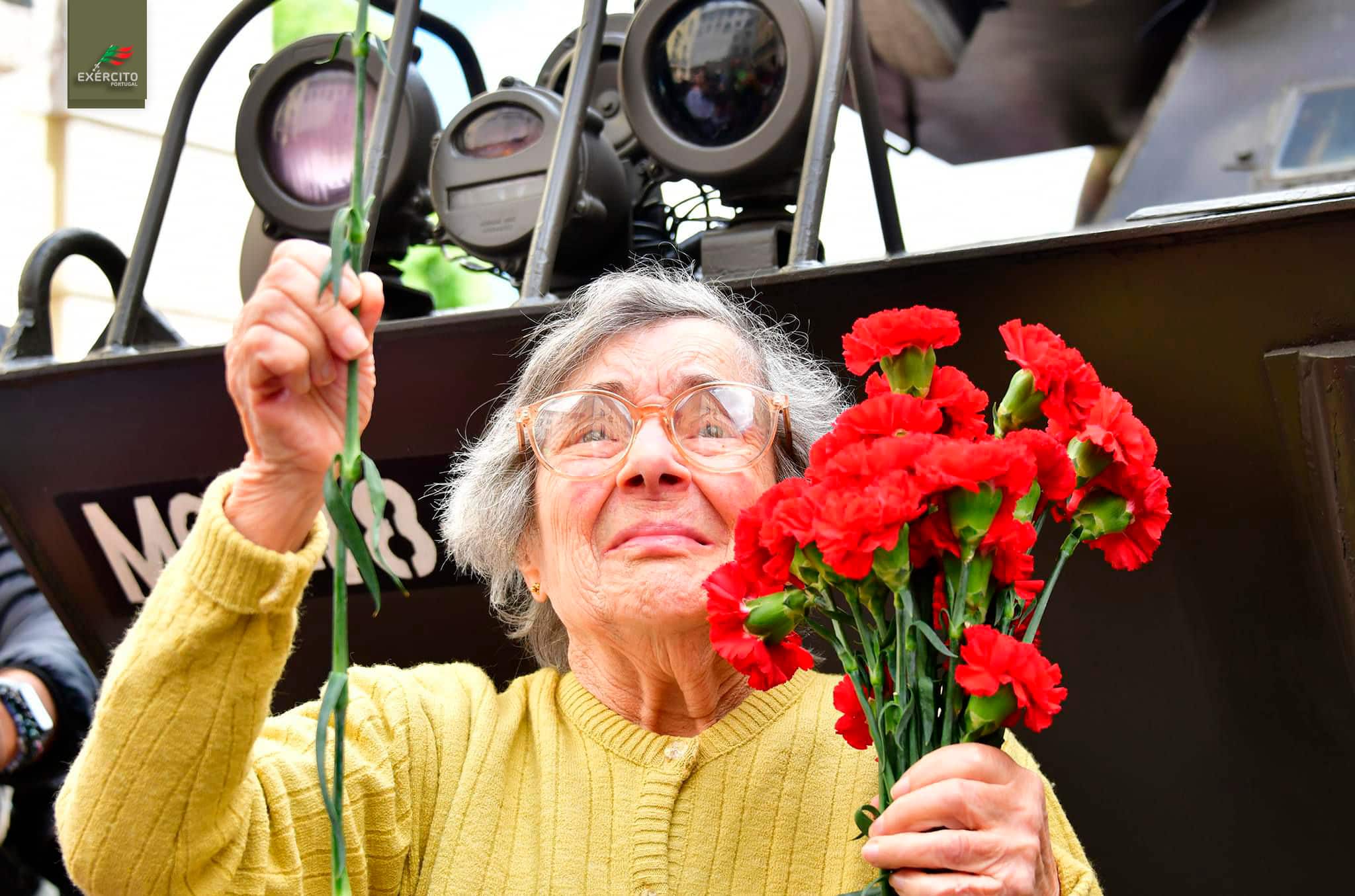
Aged 40 at the time of the revolution, Celeste was working as a waitress in a restaurant. As the story goes, the restaurant had stocked up with carnations to give clients to celebrate the fact that it had been in business for a year – but with the revolution taking place, the owner decided to close the doors. He apparently gave his waitress what was left of the carnations to take home with her, “so that they didn’t go to waste”.
On her way home, crossing paths with some of the soldiers, Celeste offered her carnations because she didn’t have the cigarettes they asked her for – completely unaware that this simple gesture would mark an entire era.
As one of the hundreds of tributes to Celeste Caeiro has summed up: “Celeste leaves a legacy of simplicity and strength, reminding everyone that, even in the most difficult times, small gestures can change the course of history. The same history that never paid tribute to Celeste Caeiro in her lifetime…!”