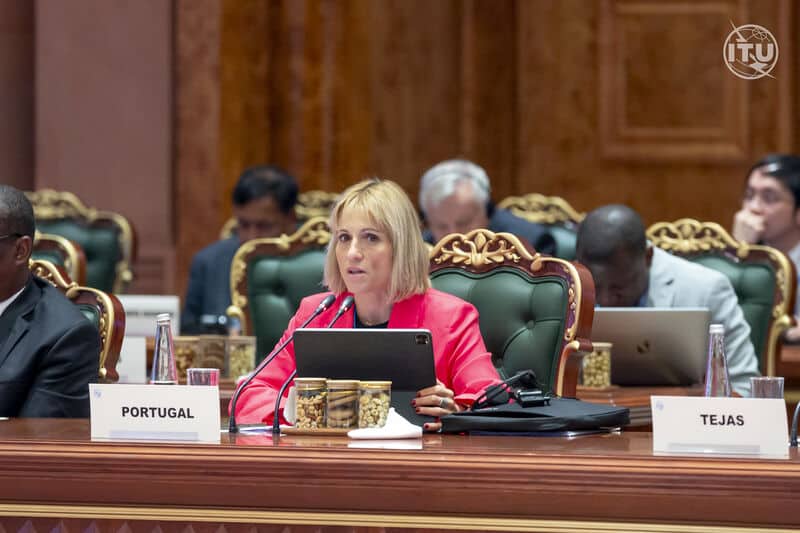
Sandra Maximiano is co-chair of the International Advisory Body for Submarine Cable Resilience
The International Telecommunication Union (ITU) announced the creation today, together with another UN agency, of a body to strengthen the protection of submarine cables, to be chaired by Portuguese Sandra Maximiano.
The so-called Advisory Body on Submarine Cable Resilience, made up of around 40 experts from various governments, companies and other institutions, will try to find “good practices and responses” to combat the 150 to 200 incidents that these structures record each year, ITU deputy secretary-general Tomas Lamanauskas has said at a press conference.
The new organisation will be co-chaired by Sandra Maximiano, chair of the board of directors of national communications entity ANACOM and Nigeria’s minister for telecommunications, Bosun Tijani.
Lamanauskas assured, however, that the new body will not investigate cases such as the recent ones in the Baltic Sea – one of which raised suspicions that a Chinese cargo ship may have caused a fibre optic cable between Finland and Germany to break, and another that is believed to have been sabotaged when a cable between Sweden and Lithuania was broken.
“This will remain the responsibility of specific national authorities,” he said.
Nigeria, which is located in an area particularly affected in recent times by this type of disruption to underwater communications, will host the organisation’s inaugural summit next February, Lamanauskas added.
The ITU recalls that 99% of international data travels through these submarine cables, which are damaged both by natural causes (tsunamis) and by human activities, from fishing to commercial shipping, to damage caused for strategic reasons.
In recent days, the authorities in Finland, Sweden and Lithuania have been investigating damage to their submarine cables almost simultaneously.
The main suspicion is that the damage was caused by the anchor of the Chinese cargo ship ‘Yi Peng 3’, not least because maritime traffic data shows the ship in the vicinity of both cables at the time the breaks were detected.
The ‘Yi Peng 3’ has been anchored for days in the Kattegat Strait, in international waters between Denmark and Sweden, surrounded by several Danish, Swedish and German patrol ships to prevent it from sailing any further and leaving the Baltic.
Tying in with all this is the uptick in the number of Russian vessels passing through several territorial waters, not least those of Portugal.
The most incident, involving the spyship Yantar which has been tracked ‘loitering’ off various coastlines, prompting constant surveillance by the relevant authorities.
Yantar was only recently ‘accompanied for days’ in Portuguese territorial waters, before finally exiting and making for the Mediterranean. Equipped with submersible remotely operated vehicles, it is widely believed to be ‘seeking undersea cables belonging to NATO and its allies’.
Source material: LUSA/ Newsweek/