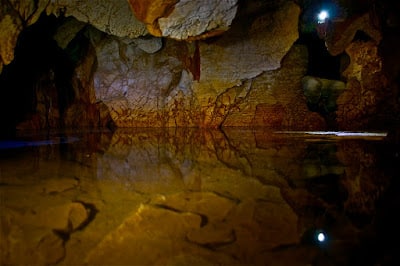
The classification procedures for the Ibn Ammar and Algarão do Remexido Caves, located in the municipalities of Lagoa and Silves, are currently under public consultation.
The Regional Coordination and Development Commission (CCDR) of the Algarve announced the public opening of procedures for classifying two Algarve caves – Ibn Ammar and Algarão do Remexido – as places of “relevant natural and cultural interest”.
“The Ibn Ammar Caves are located between Tapadinha and Vale Crevo in Mexilhoeira da Carregação, in the municipality of Lagoa. It is a series of conspicuous karst openings, arranged along the left bank of the Arade River, which are part of a complex system of natural underground galleries with prehistoric and historical human use”, explained the CCDR.
The Algarão do Remexido cave, located in São Bartolomeu de Messines, Silves, is also “a natural karst cave with archaeological interest popularly believed to have been the place of prolonged refuge of a famous Miguelista guerrilla, known as Remexido”, during the Liberal Wars of the 1930s.
The Ibn Ammar caves
The Algarve CCDR highlighted the historical, archaeological, scientific, paleontological and ethnographic values of the Ibn Ammar caves, which attest to the “antiquity, memory, authenticity, uniqueness and exemplarity” of the location.
“These caves, also known as Mexilhoeirinha Caves, are the largest south of the Tagus” and were named after Abû Bacr Muhammad Ibn Ammâr (1031-1084), an Arab poet and politician who ruled Silves during the Muslim occupation of the Iberian Peninsula.
The caves comprise “two sets of galleries, 120 metres apart, with no known connection from one to the other, with an underground lake, springs and narrow labyrinthine passages”.
Although the public cannot visit them due to the presence of an “important and fragile colony of bats of legally protected species” and for security reasons, the location is of “high scientific interest.”
The Algarão do Remexido cave
The Algarão do Remexido in Silves is a “karst cave with different periods of anthropic use” that contains “lithic remains attributed to the Neolithic-Chalcolithic” close to the cave entrance. Large Handmade ceramic containers dating back to the Bronze Age were also found inside it, proving its prehistoric use.
“A more contemporary application included a substantial transformation of the initial room by extensively rearranging stones and large blocks. This clear human involvement aligns with the widely held notion that the cave acted as a long-term sanctuary for the renowned Miguelista fighter José Joaquim de Sousa Reis, famously referred to as Remexido,” added the CCDR.
The Algarão do Remexido caves are also off-limits to the public due to safety concerns and the need to protect the delicate biodiversity within the caves.
Those interested in expressing themselves in the public consultation can do so until October 29. Details of the process can be consulted at www.patrimoniocultural.gov.pt
Lusa