On the other hand, urban water use fell just 0.5%
The Algarve’s agricultural and golf sectors cut their water consumption by 69% in February compared to the same month last year, the vice-president of the Portuguese Environment Agency (APA) told Lusa news agency.
Farmers and golf courses in the region used 90,000 fewer cubic metres of water, a reduction described by José Pimenta Machado as “very significant for water reserves and a sign that everyone is making an effort to cope with the worst drought ever in the region.”
The urban sector also reduced its water consumption by 0.5% in February, but still short of the 15% goal set out in the contingency measures proposed by the Drought Commission and approved by the government.
“This slight reduction is a positive sign that people are using less water and shows a significant trend in the measures that are being implemented, both in the urban sector and in tourism and agriculture,” he emphasised.
Even so, he said, the reduction “is far from the desired 15%” to guarantee water sustainability in the Algarve, according to the guidelines of the Drought Commission.
For agricultural irrigation, the commission defined a 25% reduction in consumption and 18% for golf course irrigation.
Pimenta Machado is confident that “the measures are working, in an effort that is being made by all” the sectors together.
“It’s true that there’s no irrigation in January and February, but even so, there’s been a great effort, which is a very encouraging and very important percentage,” he emphasised.
For Pimenta Machado, the consumption in February in all sectors – urban, tourism and agriculture – reflects “the great cooperation, teamwork and commitment to face this great challenge,” he added.
“It’s true that some measures are in the implementation phase, but we need to reorganise, plan, because there are others that have some technical complexity and that require a greater effort to implement,” he pointed out.
In order to take stock of the measures currently in force and define others to be implemented, a general coordination meeting between the APA, the Regional Coordination and Development Commission (CCDR) and the Algarve Intermunicipal Community (AMAL) is scheduled for mid-March.
The meeting also aims to define the governance model for the five specialised technical working groups (WGs): WG1 – agriculture and golf; WG2 – tourism; WG3 – low water management; WG4 – awareness campaigns and WG5 – inspection.
New ‘drought portal’ to be unveiled
Considering the extreme drought affecting the Algarve and in order to raise public awareness of the importance of saving water, the Portuguese Environment Agency will soon be launching the drought portal, a computer application.
“It’s an application that aims to inform all citizens about the water reserves in the reservoirs and consumption in the various sectors and to alert them to more sustainable behaviour,” he noted.
Through the app, citizens can monitor and follow the current evolution of consumption in the various municipalities, as well as reservoir and groundwater reserves.
“Basically, it allows us to monitor consumption and realise whether or not we are achieving the goal of reducing water consumption,” he concluded.
The Algarve has been on alert due to the drought since February 5. In addition to the goals to reduce water consumption, there are other measures being implemented such as tackling losses in the supply networks, using treated water to irrigate green spaces, streets and golf courses and suspending the granting of water use licences.
The government has already admitted to raising the level of restrictions, declaring a state of environmental emergency or calamity if the measures now in place are insufficient to deal with the water shortage in the region.
Which Algarve municipalities reduced their water consumption?
According to data provided by APA, only seven of the 16 municipalities in the Algarve have seen a reduction in consumption: Albufeira (-0.85%), Alcoutim (-26.91%), Castro Marim (-16.04%), Lagoa (-2.26%), Loulé (-0.49%), Silves (-9.14%) and Vila do Bispo (-5.23%).
Three municipal companies in the borough of Loulé have also registered decreases: Infralobo (-20.07%), Inframoura (-11.97%) and Infraquinta (-17.18%).
On the other side of the spectrum, the municipalities of Aljezur (+4.19%), Lagos (+9.24%), Monchique (+18.36%) and São Brás de Alportel (+7.39%) consumed more water in Februay.
Other increase were also registered in municipal companies: Águas de Vila Real de Santo António (+9.98%), AmbiOlhão (+0.23%) EMARP in Portimão (+1.79%), Fagar in Faro (+5.73%) and Tavira Verde (+1.61%).
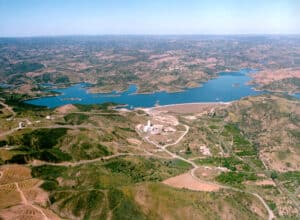
The six reservoirs – Bravura, Odelouca, Arade, Funcho, Odeleite and Beliche – that supply the Algarve region have a total volume of around 151 cubic hectometres (hm3), which corresponds to 34% of their total storage capacity.
In the last week of January there was an increase of around 0.01 hm3 in the storage of the main surface reserves, but there is an overall decrease of 50 hm3 compared to the same period in 2023.
According to the vice-president of the APA, the Algarve is going through “the worst drought ever, with the lowest levels of water reserves ever in all six reservoirs”.
“Despite the recent rains, which have allowed water levels to rise from 25% to 34%, the situation of extreme drought remains and is worrying, and it is essential to reduce consumption for sustainability,” warned Pimenta Machado.
Source: LUSA