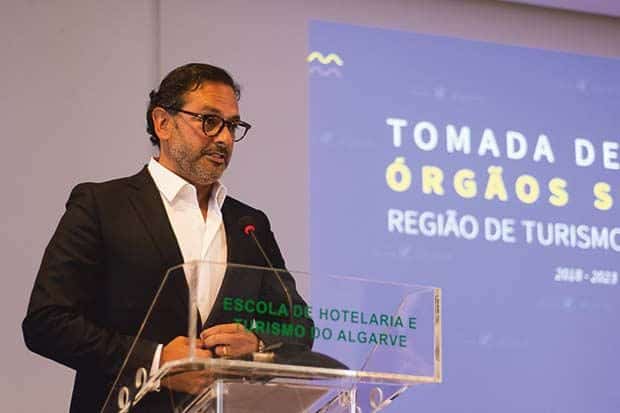
“Tourism is what will make the region sustainable, not oil,” says the Algarve’s new tourism boss. A new marketing strategy, a renewed focus on promoting the region as a quality destination – and not just as a “cheap destination” -, and new incentives to bring more holidaymakers to the region are some of the main goals announced by João Fernandes for the next five years.
João Fernandes has this week highlighted the untapped potential that can be explored by the Algarve in modern technologies such as the internet and social networks.
“In terms of promotion, we have to find the middle ground between investing in the traditional means and understanding that there is a lot of room (to grow) in social networks, which bring us closer to people and are in line with the current reality of demand,” he told Dinheiro Vivo website.
Earlier this month, he had already declared that “promotion campaigns should be aimed at the final consumer”.
But marketing was not the only thing Fernandes highlighted. The new tourism chief also delivered a resounding ‘no’ to oil in the Algarve, saying that tourism is the region’s “black gold”.
João Fernandes also commented on the decline of the British market in the Algarve, explaining that it is due to a series of factors that aligned at the same time (see box below).
“Besides Brexit, the fall of the pound and the uncertainty that this breeds around Britons’ spending power, we know that Turkey and Egypt have returned in force and there are other markets that have grown, such as Bulgaria and Croatia,” Fernandes said, stressing that the Algarve is facing more competition from rival destinations than it has in recent years.
Making matters worse is the fact that the weather was unpleasant during the first weeks of summer, which kept many holidaymakers away. The World Cup in Russia and the bankruptcy of Monarch, which brought many Britons to the Algarve, also contributed to a decrease in the number of tourists.
But as Fernandes pointed out, it’s not all bad news.
“We’re still doing better than in 2016 which was a record-breaking year at the time,” he said, explaining that while bookings at hotels are down, business volume is increasing.
“We want the Algarve to be known for the quality it offers and not its price,” the tourism chief stressed.
An issue that has been heavily debated in recent years is the introduction of a tourist tax in the Algarve, an idea that Fernandes supports but “must be well-planned and tailored to the region”.
“We need to make sure that these municipal tourist taxes take into account the characteristics of the region which are different from Lisbon and Porto,” he said, adding that their introduction will also have to be well-timed so as not to affect the influx of tourists.
“It can be a way of increasing the quality of public spaces, improving entertainment agendas and investing in sustainability. But nothing is decided yet.”
Fernandes also commented on a project being developed with the help of the national association of real estate professionals (APEMIP) to identify rundown properties and buildings around the Algarve which could be given new life.
The idea is to create a ‘portfolio’ and then showcase these properties through ‘roadshows’ around Europe to potential investors.
Decline of British market worries Algarve
Meantime, the plunging number of British tourists who are choosing Portugal as their holiday destination is worrying tourism authorities in the country, especially in the Algarve and Madeira. Hotels are also demanding “more effective promotion” to make sure the UK remains the country’s main tourism market.
Data from the Algarve’s hoteliers association AHETA shows that the number of bookings at Algarve hotels fell 3.9% in July compared to the same month last year due mostly to the sharp decrease of British and Irish holidaymakers (-10.3% and -11.2%, respectively).
On a national level, the number of Brits staying in Portugal dropped 6.1% in the first five months of the year.
Ana Mendes Godinho, Secretary of State for Tourism, says the British market is a concern for the government as it is “one of our main markets”.
In June, a plan to counteract this tendency was announced and described by Godinho as a “very tactical marketing campaign” with two goals – to reinforce Portugal’s promotion in the UK as well as other markets.
Elidérico Viegas from AHETA says that hoteliers are “extremely worried” about the dwindling numbers, stressing that the number of Brits staying at regional hotels dropped 8.5% in 2017 and could drop 10% by the end of this year, which would mean a drop of 120,000 Brits.
Cristina Siza from the national hotels association (AHP) says “the UK is the main market for the Algarve and the second most important for Madeira Island”. Thus, she is calling on authorities to find new air links between the two countries to bring ticket prices down again and offer more variety to holidaymakers.
Dora Coelho from the Algarve tourism association (ATA) says the Algarve has to act now by working on new promotion strategies and reverse this tendency.
Ana Mendes Godinho has also focused on the importance of attracting visitors from other markets with a lot of untapped potential that have been registering “very interesting increases”, such as France, Belgium, Denmark, Sweden, Poland, Italy, Switzerland and Canada.
Elidérico Viegas agrees and says it is “only logical to develop promotional campaigns directed at these markets in order to consolidate their growth”.
But while he is more pessimistic and says the forecasts do not indicate that Portugal’s tourism sector will be growing in the coming years, Dora Coelho says ATA is working on making the Algarve an attractive place for more people to visit year-round and a competitive destination that can keep tourists coming back.
But it may take a few more months before the Algarve starts to turn a new leaf, she admitted.
Holidaymakers are “fed up” with the tolls
A British reader has written to the Resident explaining why he believes many Britons are looking to other destinations instead of the Algarve.
“Portugal is no longer the cheap destination it used to be (in Euros terms; never mind the exchange rate) as local businesses have significantly increased prices. Only by searching out the restaurants and coffee shops popular with the local Portuguese do we still get good value,” said Paul Savage.
“The second serious irritant is the tolls on the A22 road. Most people I know hire a car and we are all absolutely fed up with having to trail along to the post office in Vila do Bispo every few days to pay our tolls because we have used the A22. We also need to make arrangements with friends to pay our toll after we have driven back to the airport to depart at the end of our holiday.
“We do not mind paying the toll but, for goodness sake, make it easy! If there were toll booths on the road where we could pay cash it would not be a problem.”
“I will be returning to the Algarve this October, however if the A22 tolls continue, it may be my last visit for a few years, which would be a pity as we do enjoy our visits.”
easyJet reports increase in British demand
British low-cost airline easyJet is not feeling the effects of a shrinking number of Brits in Portugal, saying it is actually growing at the country’s four main airports.
“We don’t feel any kind of setbacks, on the contrary,” said José Lopes, head of easyJet in Portugal. As he pointed out, the airline is launching a new flight from Faro to Manchester this winter.
He said he doesn’t believe that Brits will stop coming to Portugal and added that he believes that hotels are complaining because an important airline (Monarch) went bankrupt, which took its toll on the number of Brits travelling to the country.
“It may take some time, but the market will eventually adjust,” he concluded.
Tourism revenue up 14%
Revenue from tourism in Portugal hit €7 billion in the first half of 2018, an increase of 14% on the same period in 2017.
The results reflect higher prices charged for hotel rooms and tourism organisations given the fact that tourist numbers are down compared to last year.
According to data published by the Bank of Portugal, tourists spent €6.9 billion between January and June, +13.88% than the first half of 2017.
May was the best month of this period, with a total of €1.5 billion in tourism receipts. In June, receipts fell slightly to €1.43 billion.
michael.bruxo@algarveresident.com
Photo: BRUNO FILIPE PIRES/OPEN MEDIA GROUP