Percentage is 50% higher than WHO ‘ideal’
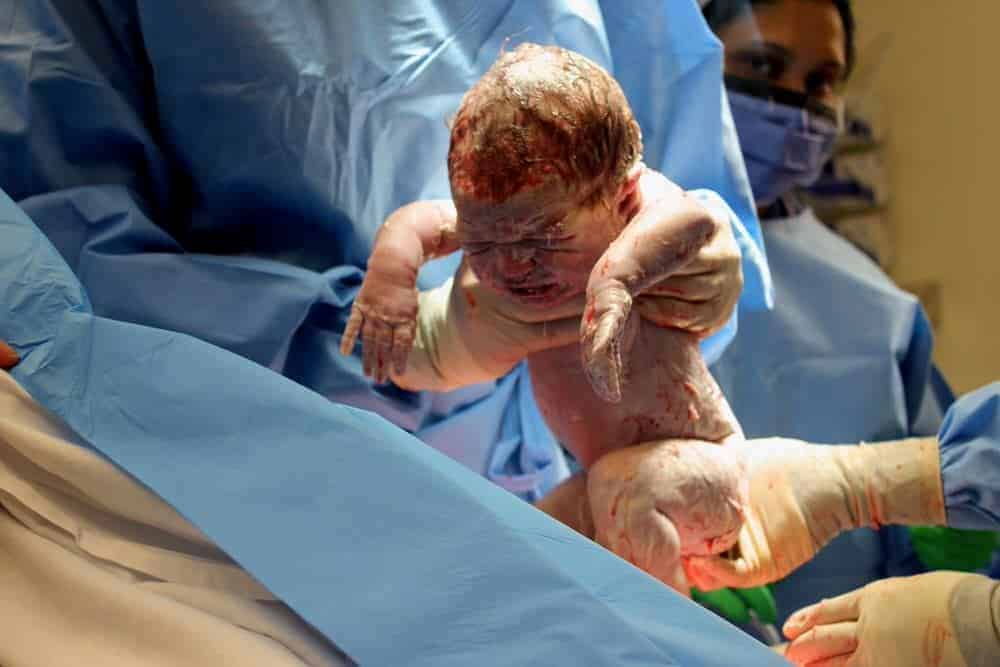
Almost 65% of births carried out in private and social sector units in Portugal are by cesarean section, writes Lusa today – a percentage that is so far (in the wrong direction) from the World Health Organisation ‘optimum’ that the mind boggles.
According to the WHO – and the practice of many countries – the ideal rate for C-section births is between 10-15%.
Portugal has invariably ‘bucked the trend’ – in 2017 seeing the SNS actually threaten to FINE hospitals that performed too many C-sections.
But today, according to data released by regulatory entity ERS, and cited by Lusa, private hospitals (to which increasing numbers of mothers are going, due to constraints within the SNS) are ‘going the other way’, performing many more C-sections than allowing women to give birth ‘naturally’.
The inherent risks of C-sections are well documented (they are not even ‘good’ for the babies, which are deprived of important bacterial immunity from having passed through the birth canal). They should, in short, be kept for emergencies (when mother and baby’s lives are in danger without them). Yet in Portugal, families actually paying to have their children are seemingly faced with a higher likelihood of being offered/ advised to have a Cesarean section birth, than being allowed to have a natural one.
ERS’ statement does not dwell on this worrying bottom line: it simply documents the discrepancies between what it calls “private and social establishments” (where people invariably pay handsomely for the care received) and the SNS health service (where they don’t). And in this comparison, SNS establishments saw a 31.9% of cesarean sections “contrasting with the reality of private and social establishments, in which the percentage of cesarean sections reached 64.8% of births carried out in these establishments” in 2022 and 2023.
Regarding the classification of cesarean sections according to urgency – scheduled, urgent or emergent – more urgent cesareans were performed, with emergent sections being the least frequent, ERS also indicates. This means scheduled c-sections came in second place when considering data from both the State health sector and private and social establishments.
Drilling down into this further: “the most representative type of cesarean section in private and social establishments was the scheduled cesarean section (54.3%), while in SNS establishments, it was the polar opposite: 65.2% of all cesareans were performed because they were considered ‘urgently required’.
Between 2022 and 2023, the number of births in mainland Portugal increased by 2.6%, due to growth recorded in the Algarve (8.2%), in the Center (5.4%), in Lisbon and Vale do Tejo (3.5 %) and in Alentejo (1.8%), with a decrease recorded in the North region.
ERS highlights that, in those two years, in Lisbon and Vale do Tejo, on average, more births were carried out in private and social establishments, when compared to the remaining regions of the country.
ERS data also includes figures on fetal and neonatal deaths – the ratios of which are well within accepted guidelines (0.46% across mainland Portugal). But the data on cesarean sections is deeply worrying and will hopefully see some form of pushback by the authorities. (It takes very little to work out that a private c-section birth will be a great deal more ‘expensive’ than a natural one – while at the same time potentially being a much ‘quicker’ for medical personnel than leaving Nature to run its course).
ERS data has not included any record of ‘home births’, which are becoming a great deal more common in Portugal today, by dint of the constraints within the SNS health service, and the inclinations of private health care.