A team of U.S. military personnel, in collaboration with several foreign and national entities, has been in Faro since September 1 on an expedition to the site where a US Navy PB4Y-1 bomber crashed in November 1943. The goal is to try to recover the possible remains of the missing airmen.
The mission is being led by Ships of Discovery, an American non-profit organisation dedicated to the discovery of shipwrecks and vessels, from the early period of European exploration up to World War II, in collaboration with the Defense POW/MIA Accounting Agency (DPAA), a U.S. Department of Defense military agency created to locate and recover prisoners of war and those missing in action.
Pedro Caleja, an underwater archaeologist, is the group’s spokesperson and the liaison with the Portuguese government.
Speaking to Barlavento newspaper, Caleja said that “the team needed someone to manage the oversight of Portuguese cultural heritage, in this case, the National Center for Nautical and Underwater Archaeology (CNANS). I handled all the logistical preparation for the campaign and submitted the work plan” for the expedition, which is underway off the coast of Faro until September 20.
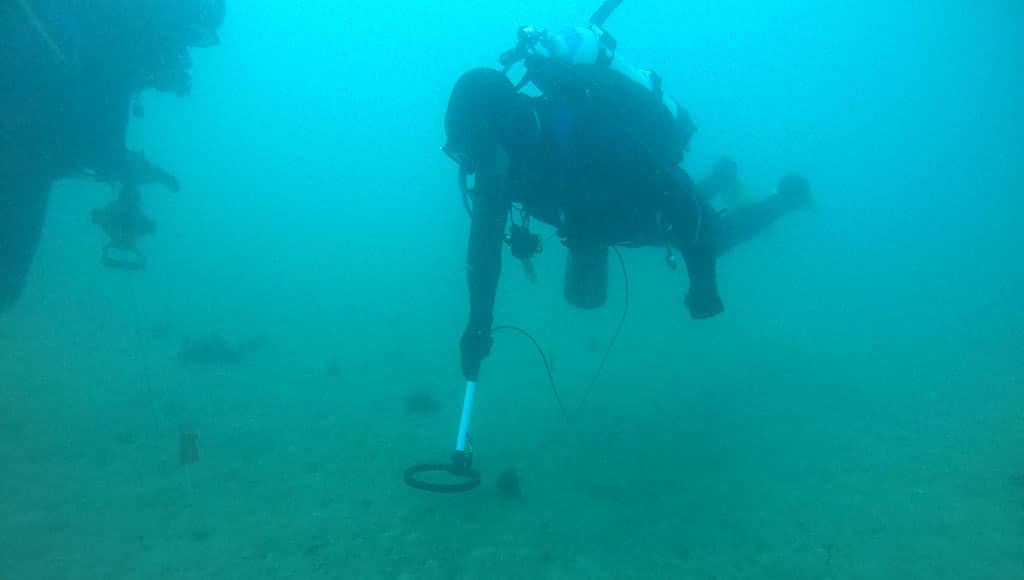
The aim has been to dive at the location where, in November 1943, during World War II, a U.S. Navy bomber crashed, to try to recover the human remains of five crew members who did not survive the crash.
The site, known as the Submerged Archaeological Site “B-24 Liberator Aircraft – Faro” (CNS 24203), is located at a depth of 18 to 21 meters, in a flat, sandy seabed, approximately 2.1 kilometres (1.3 nautical miles) off Faro Beach, on the Ancão Peninsula.
However, this is not simply a shot in the dark, as two preparatory expeditions have already taken place. The first was a reconnaissance and site recording mission, and the second, in 2022, used side-scan sonar and magnetometer technology. This last one provided many clues for the current expedition.

“The DPAA decided that, based on what was found, it would be worth excavating part of the site. That’s what we’re here to do now,” said Pedro Caleja.
The current team in Faro features volunteers from the Task Force Dagger Special Operations Foundation, an organisation that “supports war veterans suffering from post-traumatic stress, some with physical injuries, to help them overcome these challenges, by making them feel useful to society under the motto of leaving no man behind.”
Once the DPAA learned of the existence of this plane in southern Portugal, “it was placed on a waiting list. They operate at sites from World War II, the Korean War, the Vietnam War, and others. Now it’s Algarve’s turn,” explains the underwater archaeologist.
According to Pedro Caleja, “everything is proceeding as expected. I can say that we have found quite a few airplane wreckage pieces during the excavation. For most divers who visit the site, the visible parts include a wing, a propeller, and a distant engine, and little else. Now, we’ve found a lot of aeronautical material, many cables, and metal. Nothing is disturbed or removed. There is a clear objective defined. What is found is documented, as in any archaeological site. Pieces are catalogued, and photographs are taken of the layers for every 10 centimetres of sand removed from the seabed.”
Regarding the goal of recovering the remains of the missing airmen, “the DPAA never reveals whether it was successful or not. DNA tests are conducted, and if positive identification is made, the families are contacted.”
It has been 80 years since the plane crash, which is considered a relatively short time in the field of this kind of work.
“One of the people from Ships of Discovery, who came to Faro, excavated a 17th-century shipwreck, La Belle, where the remains of a sailor were found in surprisingly good condition. Sand and mud are anaerobic environments, where under the right circumstances, if a body is trapped and quickly covered, it may remain preserved.”
“There is also the possibility of finding personal belongings, such as a ring, a watch, or objects that may be cherished by the families,” he explained.
The expedition also includes partnerships with the ECU Program in Maritime Studies from East Carolina University, RECON Offshore, HistArc from the University of Lisbon, and the Maritime Museum. Locally, the team has received support from the Marine Science Center (CCMAR) at the University of Algarve (UAlg).
Faro to host conference
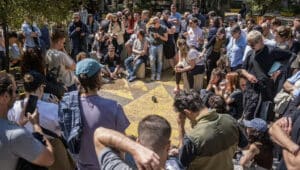
On the morning of Saturday, September 21, at 10.30am, Faro town hall will host a public conference, where expedition participants, DPAA officials, and relatives of the airmen will be present.
“This aircraft is quite well-known within the Portuguese diving community. Among all the identified planes, this one is in relatively good condition. Furthermore, in this specific case, the DPAA authorised the conference because they recognise the connection Faro has maintained with this historical event over the years,” said Caleja. As such, the conference is an exception to the usual protocols of this U.S. agency.
“We’re not just going to talk about the site but also about history and the Faro fishermen who saved the airmen. That’s why the surviving airmen’s families, as well as the fishermen’s families, have been invited,” Caleja explained.
The plan is to end the conference with a visit to the memorial at Largo de São Francisco in Faro which in honour of the fishermen who bravely rescued six surviving American aviators from the sea in 1943.
Original article written by Bruno Filipe Pires for Barlavento newspaper