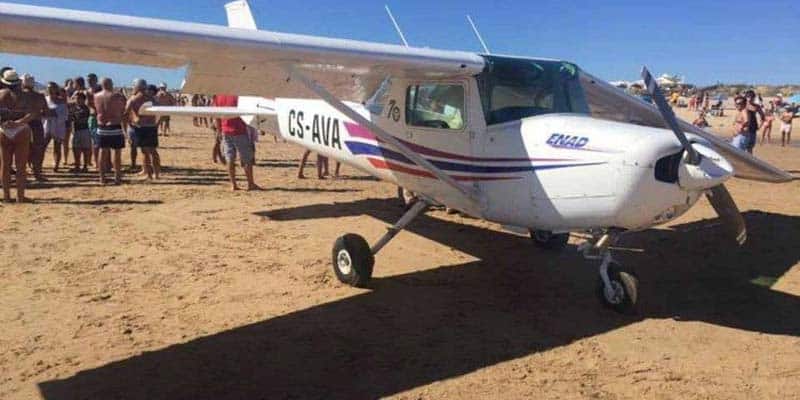
Pilot chose to land on beach as ‘ditching’ into sea would almost certainly have killed him and his passenger
The pilot accused of two counts of negligent homicide during an emergency landing on a Caparica beach in August 2017 was acquitted today by Almada Court.
Pilot instructor Carlos Conde de Almeida – the only defendant in the case – was charged with dangerous ‘driving’ of a means of transport by air and two counts of negligent homicide
The emergency landing of the Cessna 152 light training aircraft carrying him and a student on August 2, 2017 caused the death of beachgoers Sófia António, aged eight, and reserve Air Force sergeant José Lima, 56.
The court’s panel considered that it had not been proven at the trial that the sole defendant had not complied with emergency procedures, despite the death of two innocent people.
“The court played ‘devil’s advocate’, confronting various pilot examiners and instructors about what could have been done differently – but nothing was proven in this regard,” said Judge Céline Borges who read out the panel’s decision.
The judge also said that Conde de Almeida controlled the aircraft as well as he could, and that the landing could have had more serious consequences if he hadn’t.
The court considered the defendant, as soon as engine failure was detected, realised that he wouldn’t be able to return to Cascais aerodrome (west of Lisbon) or land on Cova do Vapor beach (also on Costa da Caparica) – where there would be far fewer people – and that ditching (into the sea) was not an option (as it would have almost certainly caused his death and that of his pupil) so he was forced to make an emergency landing on São João da Caparica beach.
In his closing arguments on March 7, Carlos Conde de Almeida’s defence had asked for an acquittal. The Public Prosecutor’s Office however argued that the pilot should be convicted, as he had traded the dangers for himself and his pupil, for the “safe death of others“, on a beach thronging with hundreds of people.
According to the Public Prosecutor’s allegations, the pilot should have chosen an emergency landing site as soon as the malfunction occurred. Instead he wasted time in successive attempts to reactivate the aircraft’s engine, and then ran out of options.
Lawyer Bárbara Marinho Pinto, who represents the family of Sofia António, had asked for a “jail term” but acknowledged that this could be replaced by a “flying ban”.
Today’s reports about the result of the trial make no reference to the findings of GPIAAF, the office for the prevention and investigation of air and rail accidents, which alerted to the maintenance practice and procedures at Portuguese flying schools.
Source: LUSA