PM outlines government’s Media Action Plan
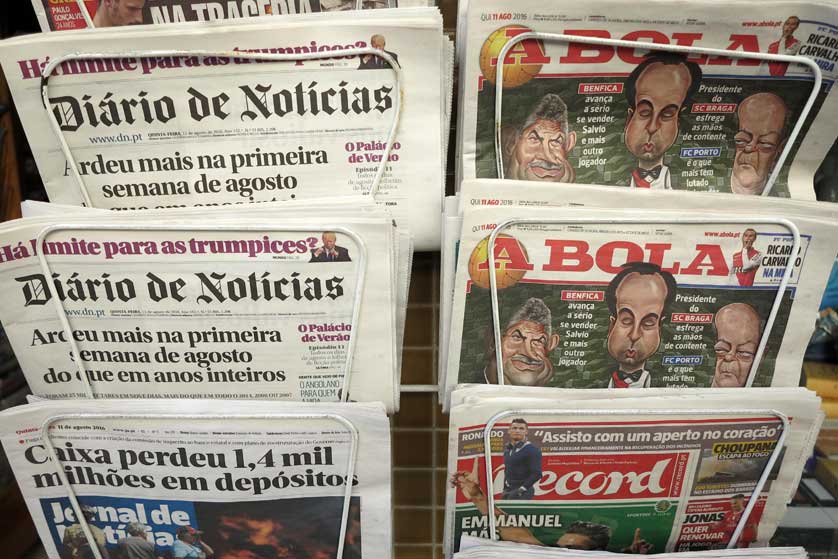
Prime minister Luís Montenegro has succeeded in wrestling media attentions away from the State Budget this afternoon by honing in on what his government intends to do with the media itself…
Following on from the government’s Migration Plan, its Emergency Health Plan, its Housing Plan, its Mobility Plan, its Energy and Climate Plan, we now have the Media Action Plan, and it’s a lulu:
Top of the list is reducing advertising on state broadcaster RTP (this has been met with absolute dismay by RTP boss Nicolau Santos), drafting a Media Code, renegotiating the public service concession contract with RTP, fighting disinformation and fact-checking, creating a new ‘governance model’ at state news agency Lusa (clarifying its shareholder structure), providing business training to regional and local media – and generally bringing things into the 21st century, not least the conditions of hiring and training journalists.
It is a massively wide-ranging plan and appears to have its roots in the PM’s own belief that there is much too much “breathlessness” in the media, with “too much dependency between the journalist and certain objectives that guarantee their work, instead of guaranteeing their independence, and the way in which they exercise their profession individually”.
“The prime minister said today he wants free journalism in Portugal, without the interference of powers, sustainable from a financial point of view, but calmer, less breathless, with guarantees of quality and without being ‘manipulated’”, writes Lusa
“I tell you this with concern for quality guarantees in what is effectively a very important profession,” he told his audience at the opening of the conference “The future of the media” in Lisbon today.
Mr Montenegro completely rejected that his plan intends “any kind of intrusion into the space that is the stronghold of journalism.
“But we have an obligation to have a legislative edifice and to build the foundations for the financial sustainability of this sector so that it can then be translated into a greater degree of freedom and the pursuit of the public interest in informing,” he said – stressing that good journalists, as much as good politicians, are important for democracy to work.
This is where he alluded to the ‘dizziness’ at play nationally, where news is often presented as life or death (viz the ad infinitum reporting on the ups and downs of the state budget…) “when in the end, things are working”, and should, in all fairness, be left to work.
As an example, he pointed to the times when journalists try to “catch him at the door of an event, or at the exit of an event”, to ask him “if the PS has already replied or I don’t know what, or if I’ve already replied to the PS” – often making that part of ‘the event’, the news – and thus ignoring totally what the event may have been about.
He also referred to the (countless) times he has been facing a barrage of cameras, only to see reporters being guided through earpieces as to what questions they should ask (frequently asking questions that have already been fielded).
It’s all a nonsense, he suggests: “‘The journalist’s career must be valued, the journalist’s job must be valued”.
There is a lot more involved in the Media Action Plan, but it is already sending shockwaves through state broadcasting circles, with the syndicate of journalists already saying that it is worried about redundancies, and RTP’s president suggesting the loss of advertising (to be phased over the next three years) will result in RTP losing its relevance.
Will it result in the media ‘calming down’ a little more? That is the question. Will it become a little less “he said, she said, they said…” and a little more ‘thought through’ and ultimately useful for those who receive it?