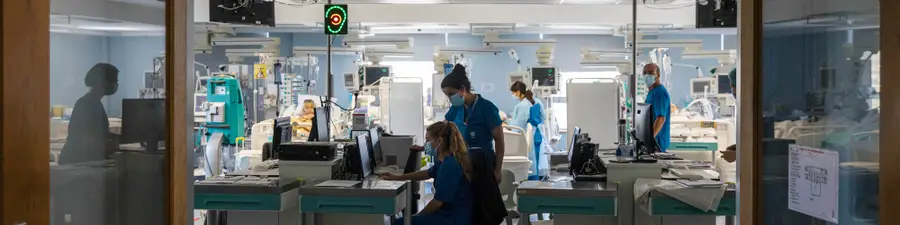
Strike begins at 0.00 hours tomorrow
From midnight tonight SNS (state health service) doctors and nurses will be on strike – not all of them (SIM, the more centre-right independent syndicate of doctors is not taking part in the strike scheduled by FNAM, the national federation of doctors).
According to Lusa, the strike days will be marked by a demonstration by doctors on the first day and a sit-in by nurses on the second – both in front of the Ministry of Health in Lisbon.
Presidents of the Portuguese Nurses’ Union (SEP), José Carlos Martins, and FNAM, Joana Bordalo e Sá, have explained the reasons behind the protest, suggesting that the strike taking place on the same days is “a coincidence”, although they did not rule out the possibility of future protests involving “all health unions”.
“We are totally independent structures (…) but the fact that both unions have called a strike at the same time only demonstrates the discontent that exists in this area and how there has been no competence on the part of this Ministry of Health, of (health minister) Ana Paula Martins, to resolve the situation”, said Bordalo e Sá, whose criticism of Ana Paula Martins has been constant, and indeed strident, almost since the minister took office in April.
For his part, José Carlos Martins said that there had been no articulation with FNAM when it came to scheduling SEP’s strike – announced on August 9 – but pointed out “the need and importance of all health unions having to decide one of these days to carry out forms of struggle” to demand “the reinforcement of investment in the NHS’ and ‘the valorisation of all health professionals”.
In other words, if there was a choice by any syndicate to create ‘extra turmoil’ as a result of two strikes on the same days, it will have been FNAM’s
oana Bordalo e Sá added to this possibility by telling Lusa that FNAM “has been discussing” a joint protest involving “a union of all professionals – doctors, nurses, pharmacists, senior health technicians, psychologists, all those involved in healthcare”.
“This is possible and will depend, above all, on what this Ministry of Health, led by Ana Paula Martins, does. Who knows if we won’t have to escalate, harden the fight even more, and the appeal that remains is for the whole of health to unite”, she emphasised.
Asked whether the doctors‘ and nurses’ strike could lead to a greater paralysis of the SNS, the president of SEP said he couldn’t “be that clear’”, but that he expects “good adherence” by his members.
Regarding SEP’s demands, José Carlos Martins pointed to the ‘fair valorisation’ of all the remunerative positions of all the categories of the nursing career.
But in addition to salary scales, SEP also wants “mechanisms to be negotiated to compensate for the risk of hardship inherent in the profession, through earlier retirement”, the correction of “situations of injustice regarding the counting of points and career progression”, and the hiring of more professionals.
The president of FNAM, for her part, said that the doctors were pushed to strike because of a lack of response from the government.
“We don’t have any serious negotiations underway, there are only negotiations that are a façade. And when it comes to doctors specifically, there is nothing at the moment that can resolve the issue and attract more doctors to the SNS, which is why FNAM has also declared this strike”, she elaborated.
For Bordalo e Sã, it is not just a question of demanding fair salaries and decent working conditions: “It is also a question of defending the SNS, which is public, universal and of quality to serve the entire population, whether in primary health care, hospitals or public health. We believe that this is an emergency”, she added.
Bordalo e Sá has made no bones of the ‘extreme importance’ for FNAM’s salary scales, etc., to have been discussed and decided on by the end of September so that they could have been included in the 2025 State Budget. She has shown her ‘regret’ that there was not “this sensitivity on the part of this Minister of Health” – hence her unrelenting criticism.
FNAM’s arguments also refer to salaries of Portuguese state health care doctors being “among the lowest in Europe” – which is why so many of them decamp from the state health sector (if they choose it at all after qualifying).
For FNAM, it is also a priority to return to a 35-hour working week and a 12-hour emergency service, the reintegration of internship in the medical career and the creation of an exclusive dedication regime, optional for all doctors and duly increased.
“We never tire of saying that we demand a minister who understands health – and we hope that on Tuesday, in front of the Ministry of Health, we will have the doctors, but also other health professionals, health service users, the population in general, to defend, above all, the SNS”, Bordalo e Sã told Lusa.
For everyone else, tomorrow and Wednesday will not be days to visit hospitals/ health centres unless absolutely necessary – and even then there could be serious constraints to normal service.
Source material: LUSA