It is not hard to imagine that the history of airplane food goes way back to the time when flying was invented and, as many things of that era, it all started with glamour.
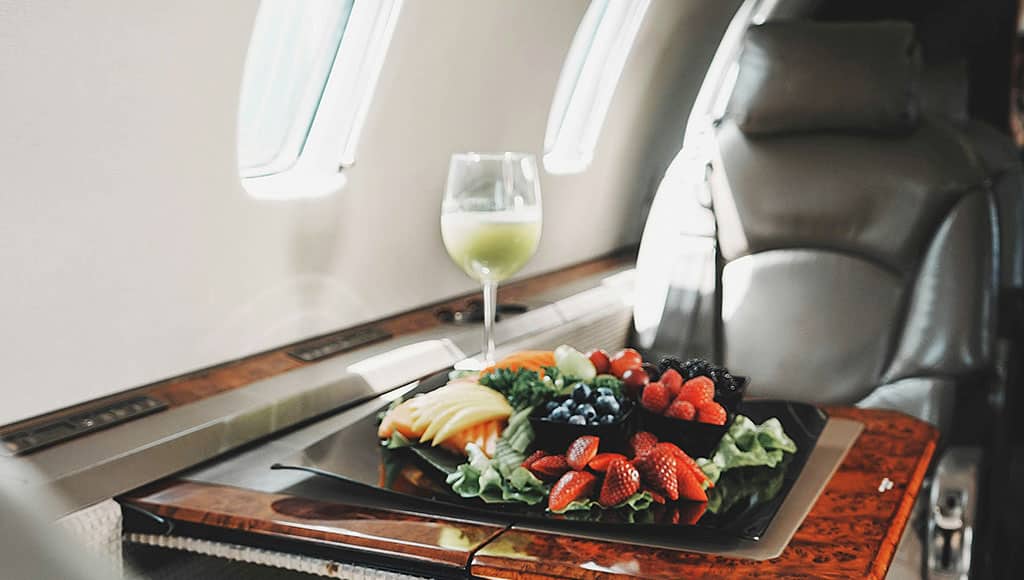
During the early 1900s, the zeppelins served luxurious meals in a relaxed and extravagant environment. Having an open fire oven in a hydrogen-fuelled zeppelin was not the best idea, so the majority of meals were pre-prepared, carrying the style and elegance in a cold fashion. Things like cold meats, sandwiches, pastries, pates and fruits were served in company of luxury drinks.
Cooking in the air remained a problem until a series of innovations took place. The first one concerns a well-known Birds Eye Frozen Food Company that in the 1930s pioneered frozen foods. Meats, fish, vegetables, and fruits could now be successfully frozen, which made them capable of travelling over long distances and extended periods of time. The second and third innovations have the name of William L. Maxson imprinted on them. Both made it possible to actually serve these frozen foods in the sky.
Using the funding from US Naval Air Transport Service circa 1945, this visionary inventor conjured an aluminium tray with multiple compartments that he called a Sky Plate. The Sky Plate was easily stackable and fit into an insulated container that was blowing the hot air around.
The container was called the Whirlwind Oven, and it was nothing less than an old-school version of a convection oven. Hot meals were pre-cooked, flash-frozen, packaged into a Sky Plate only to be finished inflight in the Whirlwind Oven and served to a customer. Interestingly, the Sky Plate served as a prototype for what would become a staple in postwar American kitchens: TV dinners.
In addition to food, the drinks cart has also seen some improvements. As stewardesses were getting ready to confiscate flasks and bottles brought on board during the times of Prohibition, the airlines were looking at how to prevent these very stewardesses from helping themselves to the on-board liquor.
The airline mini-bottle came as a solution, and the invention was triggered by an executive who, when attending a wedding, recognised the large bottles that had been served on board.
In the early days, United Airlines was known for the best food in the sky. Their food focus was an intentional marketing move to compensate for an untimely purchasing decision made earlier. The airline placed a huge order for small Boeing 247s right before the game-changing large DC-3 aircraft was launched. To stay in business, all they could do was to serve better food.
Alitalia found itself in a similar situation. Having inherited World War II leftover planes, they turned them into flying Italian restaurants. In the late 50s, early 60s, Scandinavian Airlines was hailed for its food, so much so that people were flying through Stockholm in February to get to Greece or Africa. In similar vein, Singapore Airlines elevated Singapore to an international powerhouse through its impeccable inflight catering services.
The types of food served on board at the time can speak for themselves. An economy passenger could enjoy stuffed guinea hen, while those in first class were treated to caviar and eggs made to order. Other choices included roast beef au jus, carved a la minute, and a Golden Samovar service that included dishes such as tartlets Odessa and Veal Orloff, an homage to Eastern European culinary heritage.
The most peculiar of them all, perhaps, was a United Airlines service that could only be regarded as a Don Draper’s gentlemen’s club with wings. The airline ran executive flights between Los Angeles and San Francisco, as well as between Chicago and New York, where stewardesses were beautiful and single, and martinis were cold and plenty.
The flamboyancy of it all came to a halt when airfares got deregulated, paving the way for pricing strategies dictating the customer choice. That, in combination with the frequent flyer programmes, became the Holy Grail of flying. It transformed flying from an extraordinary adventure to an everyday affair, causing the particularly rapid descent of inflight catering. However, I do believe that this is about to change.