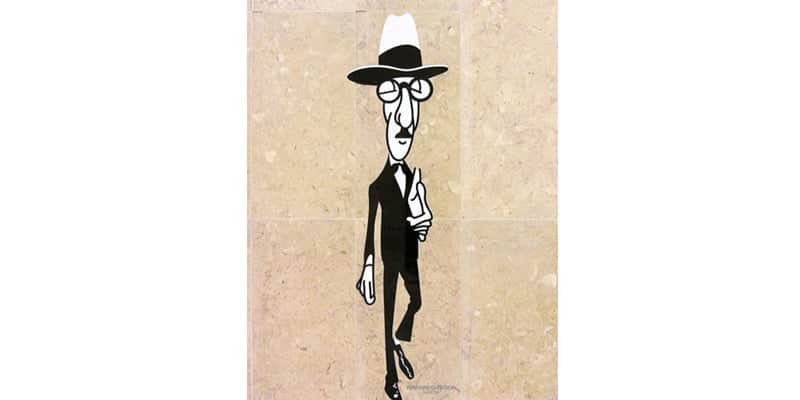
My favourite art gallery in Portugal is on the walls of the stations of the Lisbon Metro and I am nearly half way through the journey of visiting all 56 stations. A recent journey to the airport station revealed a series of cartoons done in “azulejo”. They were executed by António Moreira Antunes, who has been the cartoonist of Expresso since 1974, in which paper he uses the name António.
His most famous cartoon published in 1993 depicts Pope John Paul II with a condom on his nose. At the height of the AIDS scare, António satirised the interdiction of the Catholic church on the use of condoms, which are both contraceptive and prophylactic. The picture provoked a public outcry and 20,000 people signed a petition to demand a debate in parliament on the subject of this execrable caricature, which gave gratuitous and gross offence. The present President of Portugal, Marcelo Rebelo de Sousa, once referred to António as “the best political caricaturist in the still young Portuguese democracy”.
António’s cartoon must have been vindicated, for he was invited to represent Lisbon faces in cartoon form in “azulejos” to decorate the walls of the airport Metro station in Lisbon. When it opened on July 17, 2012, there were 53 cartoon portraits.
António had chosen 13 writers, eight actors, eight artists, six musicians, four politicians, a number of athletes, a surgeon, airmen and a philanthropist. The criterion used by António in his choice of subjects for his cartoons is not explicit, but a very great number of these Portuguese were outspoken critics of Salazar’s Estado Novo regime.
There are only seven women in this group, one of whom is the writer Sophia de Mello Breyner Andresen (1919-2004). She was a writer of children’s books and is the iconic poet of the Carnation Revolution and is now at rest in the National Pantheon at Santa Engrácia in Lisbon.
Perhaps the most famous Portuguese poet, Fernando Pessoa (1888-1935), is remarkable for his use of heteronyms. He wrote in a different style for each of the dozens of personalities that he created, the main ones being Álvaro de Campos, Ricardo Reis and Alberto Caeiro. In the early 1930s, Pessoa criticised the Estado Novo and his work was immediately banned by the state. His remains were translated to the Mosteiro dos Jerónimos in 1985, 50 years after his death.
Rafael Bordalo Pinheiro (1846-1905), cartoonist and designer of ceramics, in 1885 founded a ceramics factory in Caldas da Rainha, and the factory is still in existence. Rafael’s most famous cartoon creation was “Zé Povinho”, who symbolises the working man. This cartoon character still appears in contemporary cartoons and was a major contribution to Portuguese identity (in a similar way to John Bull for the British).
A supporter of the Salazar regime as Minister of Public Works, Duarte José Pacheco (1899-1943) was Salazar’s right-hand man in the reconstruction of Lisbon. He was responsible for the design of the airport, the national football stadium, numerous social housing projects, the Marginal road, the Parque de Monsanto and Portugal’s World Expo, among many other projects. Without his contribution, both Lisbon and Portugal would appear quite different today, and his memorial stands apparently unfinished in Loulé in allegory to his unfinished life’s work.
Calouste Gulbenkian (1869-1955) is the only foreigner to be depicted in this set. Originally Armenian, he was educated in London and took British nationality in 1902. He played the major role in making available to Western nations the oil of the Middle East and thus became the world’s wealthiest individual and, in his will, he bequeathed most of his fortune to provide for the foundation of the Gulbenkian Foundation in Lisbon.
The concert pianist Maria João Pires (1944- ) was an international star in the late 20th century for her clear and crisp performances. She began a project in Portugal to help disadvantaged children but was so angered by false news in Portuguese newspapers that in 2008 she abandoned Portugal to live in Brazil.
Amália Rodrigues (1920-1999) is the most famous of Portugal’s fadistas, and has a street named after her in Tavira and possibly elsewhere too. She too now rests in the National Pantheon of Santa Engrácia.
The artist Paula Rego (1935-) studied at the Slade in London, and worked with David Hockney. She was the first artist in residence at London’s National Gallery, and her main work is in portraying folk tales. She had seven solo shows in Portugal (1971-1978) and just as many in Britain. The Casa das Histórias Paula Rego in central Cascais dates from 2009. When we visited a few years ago, although the gallery was open, there was no exhibition.
These three artists were critical of the regime: João Abel Manta (1928-) is an architect, painter, illustrator and cartoonist (particularly of the Carnation Revolution); Júlio Pomar (1926-2018) was regarded as the greatest painter of his generation. He was sacked in 1949 for his political opposition to Salazar and he left Portugal to live in Paris; Maria Helena Vieira da Silva (1908-1992) left Portugal in 1929 and took French citizenship, where she was highly honoured. There is now a museum in Lisbon dedicated to her work.
Politicians featuring in the Metro Gallery include Álvaro Cunhal (1913-2005), the hardline Communist leader who earned a law degree in prison and later famously escaped from Peniche prison in 1960; Diogo Freitas do Amaral (1941-), a Law Professor and Centre Party Leader; Francisco de Sá Carneiro (1934-1980), founder of the PSD in Portugal, Prime Minister in 1980, and who lost his life in an air crash; and Mário Soares (1924-2017), the social democrat who became Prime Minister after the Revolution and later President of the Republic.
By Lynne Booker
|| features@algarveresident.com
Lynne Booker, along with her husband Peter, founded the Algarve History Association. lynnebooker@sapo.pt
www.algarvehistoryassociation.com