As we all know, last year seemed to be the year of Portugal. Every travel show on TV and all the travel columns of our various newspapers were touting Portugal, Lisbon, Porto and the Algarve. Well, this year the “in” country is Georgia.
Helga and I have just returned from an eight-day trip to that country, leading a group of 12 Algarveans, and we were all mightily impressed. When we told people where we were going, the response was either “Oh, you’re going to the States” or, alternatively, “Yes, Georgia is part of Russia and is a dangerous place. Be careful”.
In fact, although Georgia was part of the USSR from 1920 until 1991, it is a very old country and, being located at the crossroads of Europe and Asia, it has seen some very turbulent times. As recently as 2008, Russia invaded Georgia and, after five days of heavy fighting, the result was the loss to Georgia of Abkhazia in the northwest and South Ossetia in the north central, two territories making up 18% of the country and still considered by Georgians to be part of Georgia, although they need special visas to enter either.
We found the Georgians to be lovely, warm, friendly, cultured people but, clearly, underneath their smiling exterior, most thoroughly dislike Russia. In fact, one wine label (pictured) states boldly that “20% of Georgia is occupied by Russia” and the illustration depicts the country as a bunch of grapes, with the two occupied territories represented by stems only, from which the grapes have been picked! An interesting and typically Georgian way to protest.
When you consider that Joe Stalin, born in Gori in 1878, and Lavrentij Beria, born in Merkheuli in 1899 and head of the Soviet secret police under Stalin, were both Georgians, you begin to understand today’s antipathy. On a more positive note, Boris Akunin, George Balanchine and Alexander Borodin were also Georgian.
Georgia has often expressed an interest in joining the EU and, in 2016, an Association Agreement negotiated several years earlier, came into effect. The country would also like to join NATO and, since 2011, has been designated an “aspirant country”. The presence of Russian troops in the two occupied territories complicates this, however, and, of course, Russia strongly opposes closer rapprochement of Georgia with the West.
Georgia is a very old country indeed and can be said to be located in the cradle of civilisation. Georgians claim descent from Noah and remains of protohumans about 1.75 million years old and humans 200,000 years old have been found. It is believed that Medea lived on Georgia’s Black Sea Coast between the 14th and 13th century BC, which ties in with the myth of Jason, Medea’s lover, and the Golden Fleece.
Beginning 8,000 years ago, Georgians were the first to be making wine. More recently, the famous Silk Road linking east and west from the first century ran right through Georgia.
In fact, today Georgia is quite a small country. Not counting the occupied territories, Georgia covers only 56,900km², which makes it about 60% the size of Portugal, and it has only 3.4 million people (of which 1.2 million are in Tbilisi, the capital city).
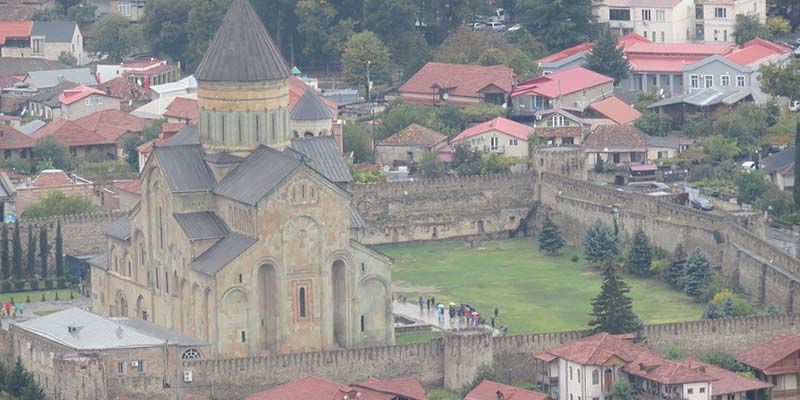
Georgia was converted to Christianity in AD 337, making it the world’s third Christian nation. Although St. George is the patron saint of Georgia (and England and Portugal), he has nothing to do with the country’s name. “Georgia” comes from the ancient Arabic and Persian name of the country: Gurj. About 83% of Georgians are Eastern Orthodox Christian and 11% are Muslim (almost entirely Sunni, gathered along the Turkish border), while less than 1% are Catholic. We saw a number of very old and very beautiful Orthodox cathedrals – they top the list of Georgia’s main attractions.
We started our tour in Tbilisi and, by way of introduction, visited the National Museum, also known as the Simon Janashia History Museum. For anyone interested in Georgia’s history, this museum is a must. With limited time, we concentrated on the Treasury, where we saw a fabulous collection of pre-Christian gold jewellery, much of it dating from several millennia BC. It was a very large collection and showed exquisite workmanship.
Georgia features some striking modern architecture, much of it commissioned by Mikheil Saakashvili, President of Georgia from 2004 until 2013, but unfortunately a great many of the dull and featureless Soviet buildings remain, presenting a bizarre contrast and reminder of the bad old times.
As a major reason for our trip was to discover and taste Georgia’s famous wines, we soon left the capital and drove southeast into the Khaketi region. I will be writing about Georgian food and wine next week. This week I want to tell you about the beautiful countryside, the picturesque churches and monasteries and some of the Georgian idiosyncrasies we came across.
From Khaketi we drove back through Tbilisi to the west, where we based first in Kutaisi, Georgia’s second city (pop 150,000), and then Borjomi, a resort town in south central Georgia famed for its mineral water sources.
Although distances are not very long, driving time can be much longer than expected, thanks to bad roads, very bad drivers (most of whom either learned to drive in go-karts or bought their licence on eBay), livestock in the middle of the road (the Georgians don’t fence their fields, so cows, pigs etc can roam freely) or, in the cities, big traffic jams. Fortunately, we had an excellent driver and a very comfortable bus.
Georgia is located right in the middle of the Caucasus Mountains, and boasts several peaks over 5,000m. Most of the landscape is rugged and great for walking or mountain biking, although we were too busy eating and tasting wine to indulge in those activities. We did, however, get our exercise by climbing up many hillsides to access various churches or cave cities. And one morning we went boating in small rubber dinghies, on the Abasha River in the Martvili Canyon Natural Monument.
As our trip ended, we agreed that we felt like early-bird explorer adventurers, discovering a beautiful country, with a fascinating history and a lovely people – ahead of the hoards of tourists that will surely come.
By Larry Hampton


World Heritage Site.
– the Church of the Dormition, which dates back to the 1180s

near the town of Kaspi