Environmental NGOs call for re-forestation with “strategic vision”
With firefighters patrolling the perimeter of the largest wildfire so far this year, the inflammatory debate on the sense in having so many thousands of hectares of eucalyptus plantations has returned – with environmental NGOs advocating “strategic vision” to reduce the country’s perennial fire risks.
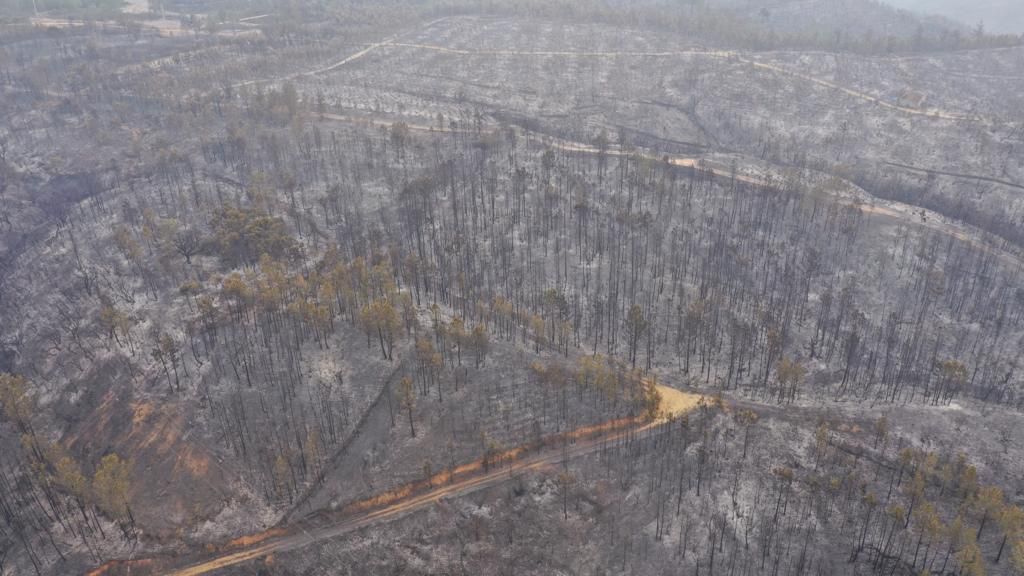
Quercus – one of Portugal’s oldest environmental associations – and Acréscimo “have released a statement today to stress that the fire that broke out on Saturday in Odemira has affected areas of Mediterranean forest near the Monchique mountain range and is destroying part of the special conservation area of the Natura 2000 Network, which also includes an area of special protection for birdlife”, writes Lusa.
“Concerned, therefore, about the impact of the fire on forest ecosystems and the impact of environmental services, (both) point out that the fire has also affected vast areas of eucalyptus trees owned by the Navigator paper and pulp manufacturer, which they call on to be re-evaluated.
“It is essential to reduce the risk of spreading fires due to projections of incandescent materials over a long distance, which disperse secondary foci of fire and, therefore, make it difficult to control and extinguish fire as is happening in several areas, namely in Odemira, Aljezur and Monchique”, said the statement (released when the fire was still active).
Specifically, the associations advocate the re-forestation of former eucalyptus groves, planted in Mediterranean forest areas, with “species more resilient to fire, which is essential for a structural response.
“Maintaining eucalyptus shows a lack of strategic vision by compromising the future of the land and the rural economy itself due to the greater vulnerability to fires, the loss of ecosystem services and the impact of tourism activity in this area of the Alentejo and Algarve coast,” the NGOs affirm.
All of this makes sense to people who have long advocated that country’s laissez-faire attitude to eucalyptus is helping no-one. No-one that is except, possibly, the pulping companies like Navigator which only weeks ago declared they need to be allowed to plant MORE eucalyptus plantations “in order to be sustainable”.
This is where the debate ‘comes alight’: one side believes eucalyptus power forest fires, another that this is all a conspiracy theory, or certainly a sign of people’s ignorance.
In a speech commemorating the 70th anniversary of Navigator’s factory in Aveiro last month, CEO António Redondo referred to the necessity to “demystify what people do not know about the species and condemn it for ignorance”, calling for help in this endeavour to “promote a unique species that Portugal can and should be proud of “.
Elsewhere, experts have referred to the fact that proliferation of eucalyptus plantations can prejudice natural water cycles. In fact, a pilot project in Monchique has proved that by removing an intensive eucalyptus plantation, more (rain)water ended up finding its way into aquifers used by the municipality.
But very little appears to be said on this score.
Thus Quercus and Acréscimo’s statement could end up going the same way. Or the issue of eucalyptus plantations could be picked up (again) by political parties when parliament returns in September.
However the situation plays out, the tragedy unfolding in Odemira promises to increase by the day. Mayor Hélder Guerreiro is appealing to the government to step in with funding for farmers and businesses that have ‘lost the summer’ – which in many cases means the income they would be relying on to get through the winter.
Agriculture is worst affected, with television interviews being run and re-run of people who ‘did everything to save their animals and homestead’, but now have nothing in the way of produce to sustain either.
It is a drama that will go on for weeks and months – and needs answers.
Meantime, the burnt eucalyptus will be sprouting green shoots within a very short time. If there is to be strategic vision, it will have to come quickly.