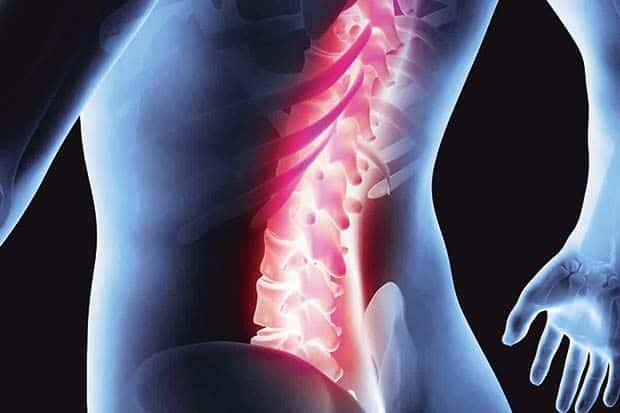
Back pain is the most frequent complaint of the human species. Worldwide, cervical, upper and lower back pain are the most common causes for medical consultations and absenteeism from work. It is estimated that, at some point in their life, 85% of the population will suffer from back pain.
Pain is a central neuro-physical and psychological event with a sensory and emotional component only perceived by the sufferer. Therefore, physical and psychological factors are involved in their physiopathology. For the great majority of complaints of vertebral pain, it is a case of nociceptive pain, which is a much less significant neuropathy.
Consequently, stimuli provoked by toxic, mechanical, thermal, chemical and inflammatory agents cause a nerve response mediated by nerve fibres of the pain, following stimulation of tissue receptors. Lower back pain can be grouped in well defined clinical conditions – degenerative, infectious, vertebral fractures, neoplasms – or, in most cases, nonspecific groups. These poorly defined groups of axial pain are what we refer to as mechanical lumbagos.
Mechanical lumbagos can be classified as acute or chronic – more than six months – according to the evolution over time. There are multiple risk factors, attributable to certain professions (heavy, repetitive work), posture, overweight, genetic and psycho-social factors. These have a strong influence on chronic and incapacitating back pain. The diagnosis is made by clinical assessment of the patient and studies of images, of which magnetic resonance is particularly important.
These are self-limiting situations, 90% of which are resolved through conservative treatment and 2%-7% of which become chronic. They can also be recurrent. The goal of the treatment is to alleviate the pain, recuperate functionality and prevent recurrence and chronicity.
The majority of patients with lower back pain recover without surgery, which can add an additional complexity and cost to the treatment without adding long-term advantages compared to the conservative treatments. Consequently, early surgery should be considered in cases of chronic motor deficiencies but can be postponed or not indicated in other circumstances.
Minimally invasive percutaneous intervention techniques, guided by image – Computerised Tomography, Fluoroscope and Ultrasounds – allow the anatomic structures involved in the genesis of nonspecific lumbagos, which we classify as mechanical, to be identified in a considerable percentage of cases. Vertebral discs, joint facets and sacroiliac joints are the preponderant structures.
Neural Blockades or similar injections are procedures that consist of locally injecting anaesthetics or corticosteroids for therapeutic, diagnostic and prognostic effects. These therapeutic blockades alleviate acute pain, particularly in situations which are self-limiting, and the severity of chronic pains, particularly of an inflammatory nature.
Radiofrequency is an electromagnetic wave that is applied through a small calibre electrode, inserted by a special needle, with only the most distal part remaining exposed. When the radiofrequency current is released, it produces heat and an electrical field.
Nucleoplasty/Percutaneous Discectomy/Intradiscal Electrothermal Therapy are techniques aimed at treating discogenic pain caused by disc protrusion (slipped disc). Theoretically, this is aimed at lessening intradiscal pressure, which can improve the pain caused by the slipped disc and reduce the bulging.
Ozone therapy – due to its potent oxidant characteristics, ozone is often called “active oxygen”, and is thus a potent anti-inflammatory. Ozone is a gas obtained through an energy generator and can be administered in various forms: local, intravenous, intra-articular, discal, among others.
Neuromodulation or medullar stimulation is a symptomatic pain treatment, which does not, however, influence the cause or progression of the illness. It is indicated especially when all other methods of pain control, including surgery, have failed.
By Dra. Alexandra Adams
|| features@algarveresident.com
Dra. Alexandra Adams is a neurosurgeon working at the HPA Health Group.