Oslo and Bergen
Oslo is Norway’s capital city, enjoys an unsurpassed location on Oslo Fjord and is home to many museums and art galleries, a royal palace, peaceful parks and a thriving shopping centre. The long scenic walkway around Oslo’s lovely harbour conveniently joins the different parts of the city and is a popular promenade for the locals.
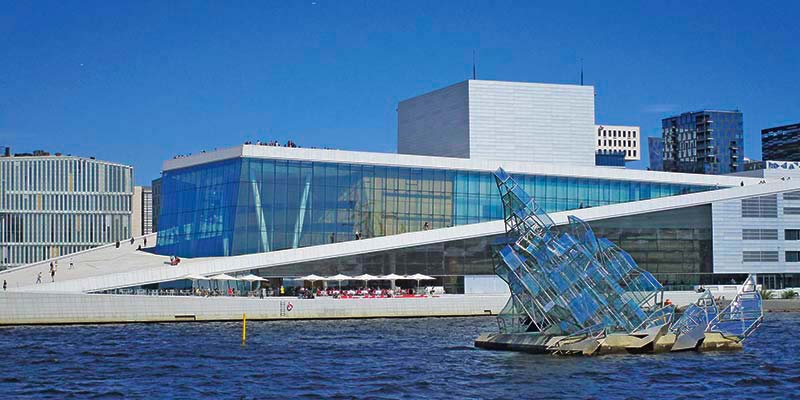
The varied architecture around the waterfront includes a 14th century castle, the Nobel Peace Centre, the modernist City Hall and a ‘wacky’ Opera House that looks like a ski slope!
The Nobel Peace Centre was created in Oslo’s old railway station and has thought-provoking exhibits about resolution of conflict and the tireless work of past and present Peace Prize winners. It also has an inspiring display about the dangers of climate change, based on the inspirational leadership of the young Swedish girl, Greta Thunberg.
Oslo has four maritime museums situated on the nearby Bygdøy Peninsula. They are best reached by a pleasant boat trip across the harbour. The Viking Ship Museum is the most popular and a magnet for all those in awe of the exploits of Norse seafarers over a thousand years ago. It contains three graceful ships that were once ocean-going vessels before being hauled on to land to be used in burial rituals.
Archaeologists have unearthed skeletons, woodcarvings and a wide range of everyday artifacts from these fascinating burial sites. However, we thought that the breathtaking exhibits of the Fram Museum, with its two beautiful ships, were Oslo’s premier attraction.
As a child, I loved to read about the polar adventures of the Norwegian adventurer, Roald Amundsen. In the heroic age of Arctic and Antarctic exploration at the beginning of the 20th century, he flew to the North Pole in an airship, was the first to navigate the fabled North West Passage and, in 1911, the first person to reach the South Pole. Now, some 60 years later, I at last realized one of my childhood dreams – to explore the interior of both the ships that had carried Amundsen on his famous expeditions.
First, we admired the Gjøa, a tiny fishing vessel that survived two winters battling with the sea ice of the North West Passage before eventually carrying Amundsen’s team into the Pacific Ocean.
Whilst marooned in the ice of Northern Canada’s snowy wilderness, Amundsen learned much about survival from the local Inuits, techniques that would later prove invaluable on his South Pole trek. To reach Antarctica, Amundsen used the Fram, a much larger boat constructed with enormous oak beams. It was the strongest wooden ship ever built. As well as being able to view inside these two celebrated vessels, visitors to this world-class museum can learn about the history of polar exploration and just how these brave men and their dogs survived the coldest places on earth.
Unquestionably, the best way to travel to Bergen from Oslo is by train. This spectacular seven-hour journey crosses some of Europe’s most inhospitable terrain, through picturesque valleys and above fast-flowing rivers, before it climbs high into the mountains to reach 1222m at the summit station of Finse. The train then traverses a wild plateau of snow, ice and glaciers before descending to Bergen alongside some of the dramatic fjords of Norway’s west coast. This stunning 500km railway line, with its 218 tunnels, was built in the late 19th century and is a civil engineering masterpiece. It is often billed as Europe’s best train journey and we would agree!
Bergen is a large city, packed with small-town charm and atmosphere, all focused around its picturesque harbour. Originally granted town status in 1070, Bergen was then the largest population centre in the country and capital of a region that included Iceland, Greenland and even parts of Scotland.
The two most important parts of the city have always been the Bryggen, overlooking the quay on the north side of the harbour and the Fisketorget (fish market).
Now a World Heritage Site, the Bryggen has remained basically unchanged since medieval times. Its magnificent old wooden buildings were the headquarters of the German Hanseat Merchants when they arrived in Bergen in the 13th century. These industrious gentlemen had a comprehensive trading network across many countries and transformed Bergen into one of Europe’s largest cities.
Nowadays, the scenic Bryggen waterfront is packed with ‘selfie-snapping’ foreigners, so we escaped the tourist hustle and bustle and scurried down one of its narrow alleyways. Tucked away at the rear was the fascinating Hanseat Museum containing the traders’ original assembly rooms.
The building is an ancient architectural gem and provides a unique insight into 500 years of Hanseat history – where they dined, debated and socialised. The nearby 11th century Mariakirken (St. Mary’s Church) was the Hanseats’ original place of worship. Amazingly, even though it was close to the harbour, this lovely peaceful old church was deserted.
Bergen has many other attractions, notably the Grieghallen Concert Hall, named after Edvard Grieg, Norway’s most famous composer, the Domkirken (Cathedral) and an aquarium with Europe’s largest collection of fresh and seawater fish.
After looking at the jostling queues of tourists from the visiting cruise ships, we decided against riding the funicular 320m up Bergen’s popular Fløyen Mountain and chose instead to wander through the town’s maze of old narrow streets with their funky coffee bars.
Our destination was the famous fish market with its scrupulously clean market stalls. They were selling a mouth-watering range of fresh fish and crustaceans (including the fabled King Crabs), locally grown fruit, vegetables and arctic specialties such as salmon caviar, smoked reindeer meat and the slightly sour but delicious cloudberry jam. Known locally as Molte, golden yellow cloudberries thrive in the swamps of Northern Scandinavia and are rich in Vitamin C and antioxidants.
Restaurants serving every conceivable form of seafood surround Bergen Harbour, and it is a visitor’s ‘rite of passage’ to dine on the tasty maritime offerings. We couldn’t resist, so lunched on delicious prawns, smoked Norwegian salmon and locally caught cod. It was then time to pack our bags and head for the ship that would carry us on the next step of our journey north and into the Arctic Circle.
In Part 2, we spend six days travelling north along Norway’s spectacular west coast, in Hurtigruten’s comfortable steamship, MS Polarlys. We cross the Arctic Circle, hug huskies, visit picturesque fjords, gaze at a magnificent cathedral and have difficulty standing upright in a gale at the wild and remote North Cape, the northernmost tip of Europe.
|| features@algarveresident.com
Nigel Wright and his wife Sue moved to Portugal 15 years ago and live near Guia. They lived and worked in the Far East and Middle East during the 1980s and 90s, and although now retired, still continue to travel and seek out new cultural experiences. His other interests include tennis, gardening and photography.