Crossing the Invisible Line
For 125 years, Hurtigruten has been sailing along Norway’s coast and deep into the heart of its most beautiful fjords. Their ships leave Bergen every day and follow a set timetable for the long voyage north, carrying goods, vehicles and passengers between 34 ports on route. Many of the stops are at night and the ship turns around when it reaches Kirkenes, a small town in the far NE of Norway, close to the Finnish and Russian borders. Both the outward and return journeys take six days.
Local Norwegians use the ship as a ferry service between ports on route, but most of the foreign passengers either travel all one way or make the full round trip voyage. We joined our ship, the 11,000 tonne MS Polarlys, at Bergen’s Hurtigruten terminal with around 500 other passengers of many different nationalities.
The ship had three restaurants, a shop and bakery, bar, sauna, hot tubs, lecture rooms and a gym. Whilst not luxurious, our en suite cabin was very comfortable with a large window from which we could view the magnificent Norwegian coastal scenery. After the safety demonstration and a sumptuous buffet dinner, there was an introductory talk by the ‘Expedition Team’, who were to act as our ‘University at Sea’ during the cruise.
This enhanced the travel experience as we learned much about Norway’s nature, wildlife, history and local culture. Each time the ship was in port for more than a couple of hours, the team offered a range of excursions for all ages and levels of fitness. There were city and cultural tours, hiking, kayaking, farm visits and even bird watching. Our voyage began on a balmy mid-summer evening, and we watched Bergen slip away into the distance, whilst sipping champagne to celebrate the beginning of one of the world’s most scenic sea journeys.
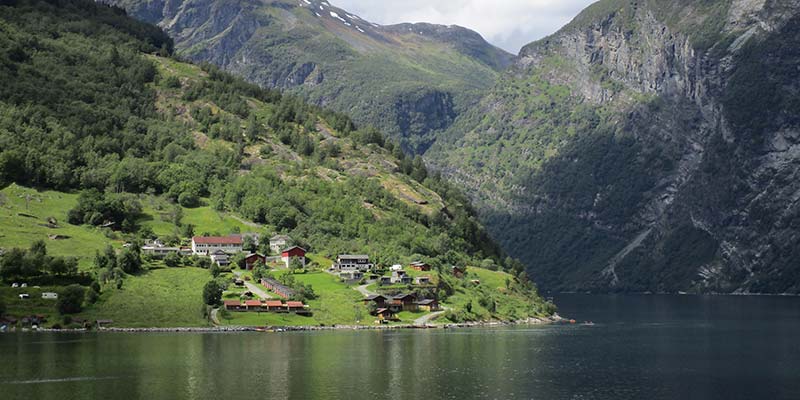
There was always something new to admire from the ship’s deck, and the highlight of our first full day at sea was the fairytale scenery of Geirangerfjord. Famed for its deep blue waters, towering mountain peaks and abundant cascading waterfalls, this astonishing 15 km-long fjord is a UNESCO World Heritage Site.
In perfect weather, we sailed serenely between the mountains up to the village at the head of the fjord, turned around and enjoyed the sublime views for a second time on the return trip. That evening we discovered that to sail with Hurtigruten was more than a cruise through amazing landscapes; it was also a culinary journey! We were pampered daily with tasty local fresh food – reindeer meat, salmon, seaweed, cheese, apples, mushrooms, salt-roasted lamb, dried salted cod and juicy arctic berries. Dinner was always a delicious surprise.
The next day we arrived in Trondheim, Norway’s old capital, attractively situated at the end of a long fjord and surrounded by tree-covered hills. It is an ancient city with colourful wooden buildings lining the wharves along its riverbanks. Trondheim is also home to the country’s national shrine, the magnificent Nidaros Cathedral, one of Europe’s finest. Dating from 1320, we were mightily impressed with its decorative west front, soaring transept and eye-catching rose window.
Later, we visited the Ringve Museum to see Norway’s National Collection for music and musical instruments. A talented music student entertainingly guided us through the country’s musical heritage. He sang and played period instruments in the charming surroundings of a 19th century rural estate – a most enjoyable treat!
As we sailed north from Trondheim, we passed the iconic Kjeungskjaer octagonal lighthouse, perched precariously on an islet, defiantly facing the Atlantic waves.
Early the following morning, the ship’s captain blasted his horn as we ‘crossed the invisible line’ into the Arctic Circle. We had arrived in the land of the midnight sun and the savage scenery of the Helgeland coast. The ship then twisted and turned through the islands of a beautiful archipelago before reaching the lovely old village of Ørnes, sheltering below dramatic mountain peaks. That afternoon we reached the Lofoten Islands, whose mighty granite mountain chain rises up like a wall from the sea. The captain sailed alongside this untamed coast and just before midnight, we experienced one of the highlights of the whole voyage, when the ship turned into the mystical 2km long Trollfjord. Only 100m wide at its entrance with incredibly steep sides, the views were unforgettable, as the rays of the midnight sun lit up the clouds above the mountains.
In charming Tromsø, Norway’s chief arctic city, we hugged huskies at the Wilderness Centre. Set above the fjord with sweeping views of mountains and sea, the centre is a thriving outdoor activity hub and home to 300 happy huskies and puppies. These adorable and well-treated canines are bred and trained for competitive dog sledding and like nothing better than a big hug from visitors. Our tour of the centre included a film that highlighted the considerable skills required by both humans and dogs when competing in long distance sled races.
Our penultimate expedition was from tiny Honningsvåg, in the Finnmark region of Norway, which is the Sámi People’s homeland. Our destination was the North Cape, the northernmost point of the European Continent. We motored through a magnificent wild landscape of rolling hills and expansive patches of snow. Reindeer, who are essential to the Sámi culture, were grazing everywhere. These gentle creatures provide everything from clothes to food and are moved long distances to the rhythm of the changing seasons.
After crossing the 71st parallel, we reached the remote North Cape itself. It was cold for a summer’s day, just 6°C, and we could barely stand up in the gale force wind. Luckily, we managed to warm our extremities in the Cape’s interpretation centre, with its wide-ranging exhibits about the life and customs of this remote polar region – but still over 2,000km from the North Pole!
We left our ship at Kirkenes, in Finnmark’s far northeast. We stayed a couple of nights here to enjoy further exploration but were disappointed by a trip to the nearby Russian border. The scenery was splendid and the Borscht soup at lunch was delicious but there was little else on offer.
Much more interesting was the town of Kirkenes itself and its superb Borderland Museum. We discovered that this remote little community was on the front line of one of the coldest, hardest and most merciless theatres of destruction of WWII. The Nazis occupied the region with the aim of invading Northern Russia, but, in 1944, the Red Army eventually liberated the town by a massive aerial bombardment. Strangely, Kirkenes has recently been nicknamed “The world’s most northerly Chinatown”!
Receding sea ice could open up shipping lanes through the Arctic Ocean, and the town could become the European entry point for a “Polar Silk Road” from China.
Welcoming this possibility, a large celebratory Chinese-style wooden gate has been erected in the town centre. Together with a potential arctic rail link to Finland, these two exciting initiatives could bring trade and prosperity to this fascinating far-away land – home to the midnight sun in summer and the northern lights in winter.
By Nigel Wright
|| features@algarveresident.com
Nigel Wright and his wife Sue moved to Portugal 15 years ago and live near Guia. They lived and worked in the Far East and Middle East during the 1980s and 90s, and although now retired, still continue to travel and seek out new cultural experiences. His other interests include tennis, gardening and photography.