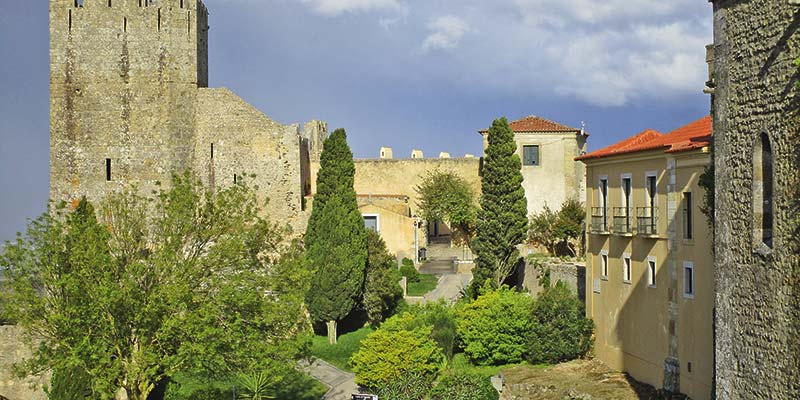
The rugged fortifications of Palmela Castle, perched on a lofty hill between the Tejo and Sado Rivers, dominate the landscape of Portugal’s Setúbal Peninsula. The castle’s origins are obscured by the mists of time, but stretch back as far as the Moors’ occupation in the 12th century. It later became the headquarters of the Order of Santiago (St. James), and the knight-friars of Santiago have been known ever since as the ‘Friars of Palmela’.
The emblem of the Order is a cross in the form of a sword, which is now one of the heraldic elements of Palmela town itself. Opened as a Pousada in 1979, this sturdy example of military architecture successfully preserves an old world atmosphere and is the ideal place to stay whilst exploring the many attractions of the Setúbal Peninsula.
There is much of interest inside the castle walls – the 15th century Church of Santiago, the old convent cloister and a museum displaying the fortress’s archaeological history. From the well-preserved battlements, there are tremendous views over Palmela town, the two river estuaries and the shapely hills of the Serra da Arrábida.
Palmela’s Baroque Parish Church of São Pedro is particularly prominent in the view over this charming town. The church has beautiful azulejos depicting the life of the Saint. The handsome Town Hall is located in the same square and, around the corner, in the Praça Duque de Palmela, is the 17th century Pillory and the Misericórdia Church.
The ancient city of Setúbal is close to Palmela and one of its major attractions is the Fortaleza de São Filipe, which sits high above the town and has panoramic views over the Sado estuary. We became hopelessly lost driving through Setúbal’s narrow streets but eventually arrived at the castle, which is now also a comfortable Pousada.
The oldest parts of the castle’s walls date from the 14th century, but the main fortress was built in 1590 on orders from Filipe II of Spain (Filipe I of Portugal). This was to thwart possible attack from the English Navy after the defeat of the Spanish Armada in 1588. The road west from Setúbal climbs up and along the ridge of the Serra da Arrábida.
Now a Natural Park, the steep hills of this beautiful landscape rise to 500m, and the whole area feels distinctly Mediterranean. The Arrábida is popular with hikers, wildlife enthusiasts and moviemakers. Some scenes from the James Bond film ‘On Her Majesty’s Secret Service’ were filmed here. Far below, on the peninsula’s south side, lies one of our favourite Portuguese seaside villages – Portinho da Arrábida. Reached by a steep winding road, it has a lovely beach, transparent waters for swimming and excellent seafood restaurants. Unfortunately, the popularity of this idyllic location means that the car park is often full to overflowing!
The likeable resort town of Sesimbra lies a little further west, and was founded around an old Moorish castle that overlooks the town. It has a port with a long fishing tradition, a beautiful sheltered beach and has become a fashionable weekend escape for Lisboetas. The palm-fringed promenade is free of parked cars and has restaurants specialising in fresh seafood – perfect for a long lazy lunch.
Just a short drive from Sesimbra is Cabo Espichel, a wild and beautiful promontory at the very extremity of the Setúbal Peninsula. The cape’s desolate cliffs have long been associated with religious miracles and, in the 15th century, the Virgin Mary allegedly ascended from the ocean here riding on a giant mule. Ever since, it has been an important pilgrimage centre.
Under the direction of King Dom Pedro II, the Santuário de Nossa Senhora do Cabo Espichal was constructed in 1701, with two symmetrical accommodation wings just outside. Sadly during our time at the cape, we were unable to access any of the sanctuary buildings. A blockbuster movie was being filmed on the site and all access to the area was closed and patrolled by a squad of very unwelcoming and burly security guards!
Further north along this dramatic coastline, the cliffs fall away to reveal glorious sandy beaches and the enchanting Lagoa de Albufeira. The waters of this picturesque lagoon are fed by a river and overflow over a sand bar into the open sea at the highest tides. It is partially surrounded by pine tree woodland, has a few cafés and restaurants, and is a magnet for bird watchers, sport fishing folk and windsurfers. Foreign tourists don’t yet appear to have discovered this remote part of the peninsula, but it is very popular with the Portuguese in summer.
This lovely part of Portugal boasts many gastronomic treats. We had already enjoyed swordfish steaks grilled with thyme and oregano, rabbit and bean stew, and pears cooked with Moscatel wine.
Anxious to seek out more local flavours, we stopped in Vila Nogueira Azeitão whilst returning to Palmela. Here we discovered Torta de Azeitão – an addictive sticky, squashy cinnamon-flavoured sponge cake with a hint of lemon. We also stocked up on delicious Azeitão ewe’s milk cheese. The flora of the local pastureland and a species of thistle used as a starter to separate the curds from the whey impart a special taste to this wonderful cheese. The famous Bacalhôa and José Maria da Fonseca wineries dominate the centre of Vila Nogueira de Azeitão and attract the many tourists who travel the Setúbal Peninsula’s popular ‘Rota de Vinhos’ (Wine Route).
We much prefer visiting smaller vineyards, so instead drove to the Quinta do Piloto, just outside Palmela. Here, the Cardoso family staunchly retains traditional manufacturing techniques to produce quality wines using local grape varieties such as Castelão (Periquita), Fernão Pires and Moscatel. These long-established wine making methods are used to minimise energy costs and reduce environmental impact, the whole process being powered by gravity. After a pleasant half-hour tasting of some of their elegant wines, we left in a cheerful frame of mind clutching bottles of the Quinta’s Vinho Tinto Reserva and a delectable aromatic Moscatel. This was a perfect end to a most fruitful exploration of the charming Setúbal Peninsula.
By Nigel Wright
|| features@algarveresident.com
Nigel Wright and his wife Sue moved to Portugal 15 years ago and live near Guia. They lived and worked in the Far East and Middle East during the 1980s and 90s, and although now retired, still continue to travel and seek out new cultural experiences. His other interests include tennis, gardening and photography.