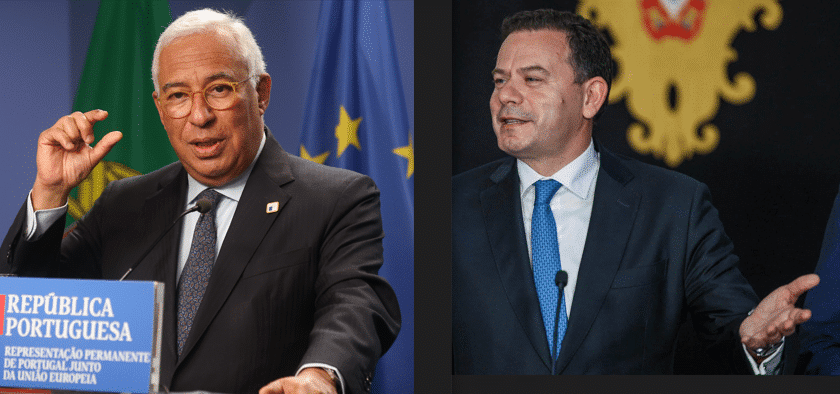
António Costa remains as what is now being described as “the ceasing prime minister of Portugal”
In one of the most uncharacteristic changeovers of power following legislative elections, AD leader and president of PSD social democrats Luís Montenegro was appointed prime minister last week, in the middle of the night – the argument being that he was due in Brussels the next day, and being recognised as the prime minister would be better than not.
He told a reduced press conference in the early hours of last Thursday morning: “It was important to do it today, in spite of the late hour, given that tomorrow I will be in a meeting with the President of the European Commission and with colleagues leading parties that make up the European Popular Party, and, therefore, I couldn’t be here in the morning…”
This would make perfect sense if the outgoing prime minister had indeed left. But he hasn’t. António Costa remains as what is now being described as “the ceasing prime minister of Portugal”. He has been in high level meetings since his successor was appointed; he has been overseeing decisions on spending/policy, giving speeches, even pledging large donations.
As we write, Mr Costa was due to give another speech on the ‘balance of eight years in government’. These speeches have been coming thick and fast since March 11 when it became clear that PS Socialists had lost their ‘absolute majority’ and now no longer have a majority of any kind at all.
But this is the crux of the matter: PS Socialists are seething over what has happened. They feel they have been ‘diddled’ out of power. António Costa said months ago that he thought President Marcelo Rebelo de Sousa should have left his government in place, with a new prime minister.
The party equally cannot understand how, after years in which they have been denouncing right-wing CHEGA as a “vile party of racists and xenophobes”, more than 1.1 million citizens ended up voting for them.
And they are wholeheartedly focused on plotting their return – sooner rather than later.
All this means Luís Montenegro and his incoming executive are facing a political minefield: parties of the left will be goading them to ‘make decisions in the interests of the country’ in the first weeks of government, but as soon as it comes to drawing up a new State Budget for 2025, they will be coming down on them like a ton of bricks.
Pedro Nuno Santos – António Costa’s replacement as leader of PS Socialists – has said he is open to “taking a step forward” in terms of valuing public sector workers (i.e. paying them higher salaries) “without partisan calculations”. But all this will change “from the summer”.
Talking in Viseu, he stressed that the PS left the country with a “good economic and financial reality”, which should be used to respond to “various wishes of the Portuguese population”.
Again, the inconvenient question remains – if this is the case, why didn’t they do it while they were in power? Perhaps the barrage of self-congratulatory speeches by the ‘ceasing prime minister’ is designed to deflect attention from this kind of scrutiny – so too the political programme through the week.
On Tuesday, “the newly-elected parliament met for the first time”, wrote Lusa. Yet, it met with the outgoing government still at the helm: President Marcelo is busy trying to decide the political future of Madeira (equally in flux following a criminal probe), and then there is Easter to get through before he can swear in Mr Montenegro’s carefully chosen executive (on April 2).
What do we know of the new government that will have waited three weeks to take power? Very little, other than its members will have had to answer satisfactorily the 36-questions brought in to weed out bad apples following all the PS debacles of recent years.
One bright thought is that the Algarve’s new PSD MP, Miguel Pinto Luz, a close ally of Luís Montenegro, is described as “certain” to have a place in government. Pinto Luz has stressed his commitment to improving the representation of the Algarve in Lisbon, so having him in the inner circle of power (depending on how long it lasts) must be a plus.
COMMENT by NATASHA DONN