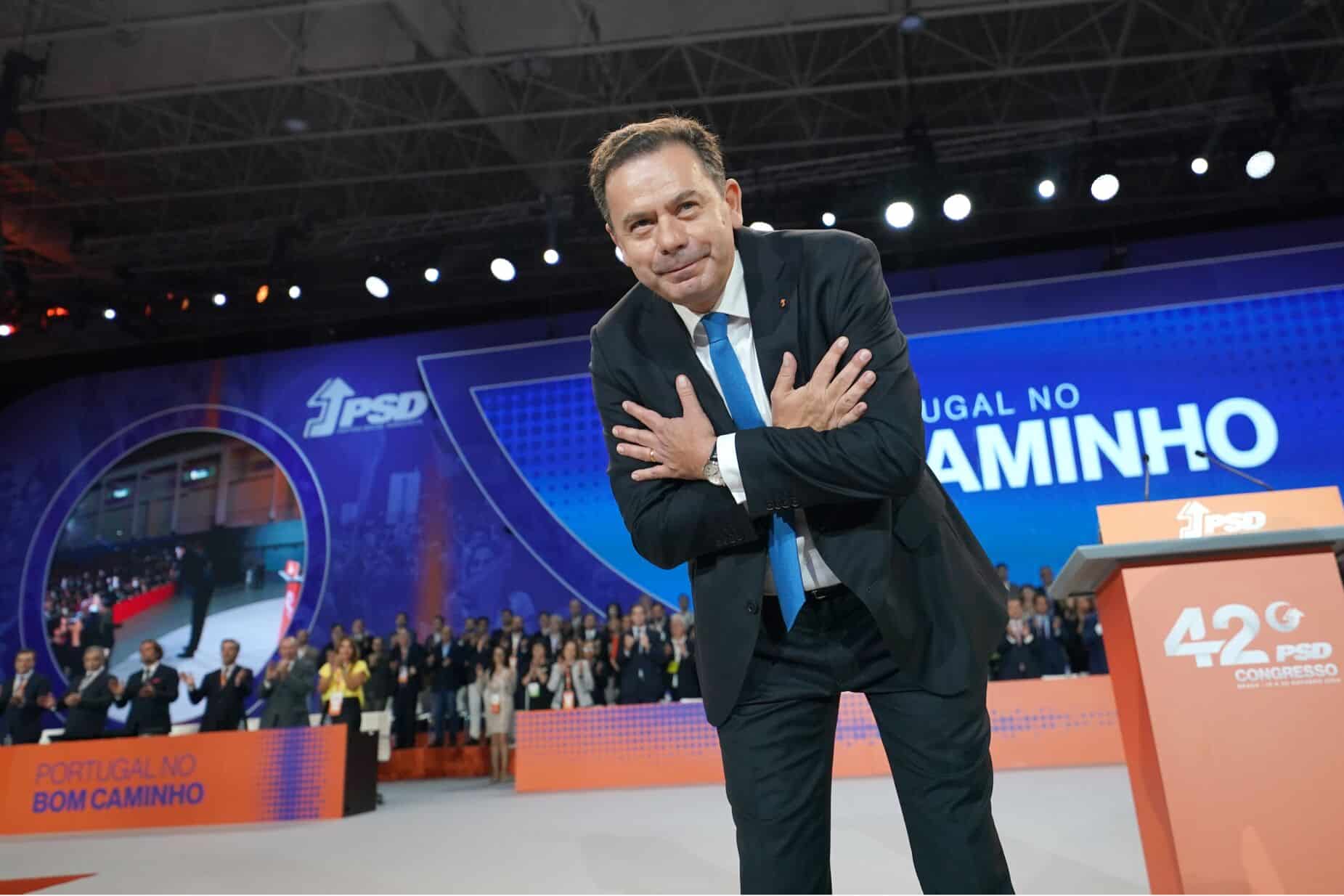
PM concludes congress outlining seven key ‘new decisions’
The PSD’s 42nd congress in Braga this weekend concluded with the prime minister presenting a form of 7-point plan, as opposition parties registered their mounting ‘discontent’: PS parliamentary leader Alexandra Leitão accused the party of being ‘social democrat in name only’, having ‘appropriated the discourse of the extreme right’; ditto LIVRE, while CHEGA appeared to agree, saying the PM “took care to prepare the closing of this congress with a very careful reading of CHGEA’s electoral programme”.
Ideas particularly about security, education and immigration came straight out of CHEGA’s manifesto, says MP Filipe Melo.
Alexandra Leitão added that the weekend’s activity was “what we are used to – announcements and more announcements, even before public evaluation of previous announcements”.
In her opinion, the PM’s speech showed “total absence of the interior, of territorial cohesion”, as well as “isolated and barely comprehensible measures for the city of Lisbon.
“What worries me is the absence of measures that are good for people,” she told journalists, pointing out that it would be better to start with the smallest things, like dealing with the rubbish on the streets of Lisbon.
On the subjects of security and immigration, Leitão believes PSD social democrats have indeed ‘appropriated the discourse of the extreme right’.
So what is the 7-point plan, that saw party faithful rise to their feet in rapturous applause?
Expresso presents a round-up:
1 – Water: agreement with Spain
The first decision Montenegro wanted to announce was related to the agreement he will sign with Spain at the Iberian Summit, which will take place on Wednesday in Faro.
“A historic agreement,” he said, to guarantee “minimum daily flows in the Tejo river, ecological flows in the Guadiana and payment for the water from Alqueva as part of its use by Spanish farmers”. Montenegro also promises ‘a major programme of water infrastructure (…) to guarantee its urban, agricultural and tourist uses for decades”.
2 – Security: police more visible on streets
In terms of security, Montenegro guarantees that the police will be more ‘visible’ on the streets and that video surveillance systems will be more widespread, in addition to the reinforcement of neighbourhood policing.
“According to the Prime Minister, teams will be set up with members of the PJ, PSP, GNR, ASAE, ACT and the Tax Authority, under the coordination of the internal security system, with the aim of going into the field to ‘relentlessly combat violent crime, drug trafficking, illegal immigration and the trafficking and abuse of human beings”.
3 – Domestic violence: more support
“We’re going to double the amount of support for the autonomy of victims of this crime: we’re going to invest a further €25 million in teleassistance and transport tools for victims and we’re going to guarantee that women who are taken into shelters outside their area of residence will have immediate access to healthcare in host localities,” said the Prime Minister.
4 – Urban regeneration: Lisbon, Lisbon and the South Bank
Luís Montenegro announced the launch of a major regeneration project for the Lisbon Metropolitan Area (AML), which aims to “create a vibrant and homogeneous metropolis” on both banks of the Tejo.
To this end, he announced the creation of the Sociedade de Gestão Reabilitação e Promoção Urbana, which the government will name Parque Humberto Delgado, and which “will be the instrument for thinking, designing and organising the Arco Ribeirinho Sul in the municipalities of Almada, Barreiro and Seixal”.
There will be a second centre – the Ocean Campus – between Vale do Jamor and Algés, in the municipalities of Lisbon and Oeiras, while a third will take advantage of land that will be freed up with the end of the current Humberto Delgado airport, in the municipalities of Lisbon and Loures.
“With the integrated development of these three hubs, we want to create a synergy together with all the municipalities involved capable of raising a project of innovation, revitalisation of culture, housing and environmental sustainability,” he said.
This redevelopment will make it possible to provide “quality of life, a horizon for economic activity and the capacity in terms of public services to take advantage of natural resources” in this region, and not just concentrate all investments in the centre of Lisbon.
5 – Education: reviewing ‘citizenship’
As the Secretary of State has already announced in interview with Expresso, the government wants to review the programmes for all subjects. A review that Montenegro brought to this congress, but emphasising the changes to the subject known as Cidadania (Citizenship).
“We’re going to reinforce the cultivation of constitutional values and free this subject from the ties of ideological and factional projects,” announced Montenegro, in the most applauded passage of his speech.
In terms of education, the PSD leader also announced an increase in the “public contribution per classroom to guarantee universal access to pre-school education” and new association contracts.
‘We intend to expand the public, private and social offer, even testing new association contracts in pre-school education, looking at the interests of children – not at any ideological blockade that frustrates everyone’s access to an opportunity starting in the first cycle of education, which should be from 0 to 6 years old, in nursery and pre-school”.
6 – Health: easier access to medicines
Montenegro presented a measure that he himself admitted ‘seems small’, but considered will be “very relevant to the lives of tens and tens of thousands of Portuguese”, especially those who live further away from hospital centres. “We’re going to give around 150,000 patients the chance to receive their medicines at their local pharmacy instead of having to travel 100, 200 or 300 kilometres to pick them up at their hospital,” he promised.
7 – Immigration: more integration and training
The PM announced two temporary settlement centres in Lisbon and Porto to take in cases of illegal or irregular immigration (much more on this will presumably be explained in due course: what does the oxymoron ‘temporary settlement’ actually mean?)
“At the same time, we will launch a programme to attract talent from abroad to companies and higher education institutions, which will include simplifying administrative procedures, guaranteeing housing conditions and professional training (…) If we do this, we will be able to overcome one of the most structural problems, which is the prospect of losing competitiveness due to a lack of human capital,’ said the PM.
Source material: Expresso