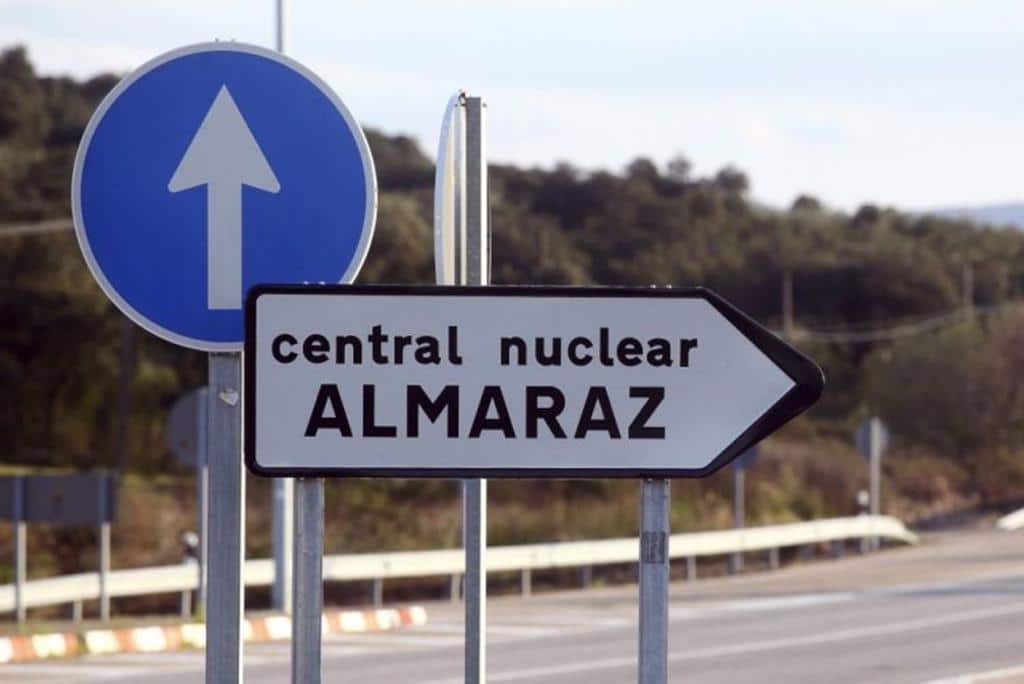
Warehouse at Almaraz Nuclear Power Plant deemed illegal by former environment minister
The construction of a new warehouse for the Almaraz Nuclear Power Plant, to deposit highly radioactive waste 100 kms from the border, is under public consultation until September, Portuguese Environment Agency (APA) announced today.
Spanish authorities guarantee that “there is no impact” on Portugal from the construction of the new individualised temporary storage facility (ATI), which will be located next to the River Tejo, approximately 100 kms, as the crow flies, from the border, writes Lusa.
However, after analysing initial documentation, APA considered “the project could have significant environmental effects on national territory” and asked to be a part of the Environmental Impact Assessment (EIA) procedure.
Elements sent by the Spanish authorities are thus available for public consultation until September 12, on the Participa portal (https://www.participa.pt). (In other words, this is another fairly crucial exercise, vis-a-vis plans for the environment, taking place during the summer holidays…)
The document sent by Spanish authorities explains that the highly radioactive waste (HRW) generated by the nuclear power station is stored in spent fuel pools.
Spain plans to decommission all its nuclear plants by 2035, but in order to dismantle Almaraz, a new temporary storage facility will have to be built to house the spent fuel, the the highly radioactive waste and the special waste, which is “produced during the entire period of operation of the plant (which cannot be stored in the existing temporary storage facility) and the radioactive waste that may be produced during its dismantling”.
“The Spanish government guarantees that this project has already been submitted to a Strategic Environmental Assessment (SEA) and has a “favourable strategic environmental statement”, says Lusa.
“The spent fuel, highly radioactive waste and special waste will initially be stored in the pools of the nuclear power stations and in an ATI, followed by intermediate storage,” a process that will end with “definitive storage in a Deep Geological Storage (DGS),” says the document to which Lusa has had access.
(“Deep Geological Storage” means burying between 200–1,000 m below the surface of the earth. It is not clear from Lusa’s text where this DGS will be.)
The strategic environmental statement contains measures to be applied in the construction of the new warehouse, guaranteeing that if they are complied with “no significant adverse environmental impacts are expected”.
Also, “no significant transboundary environmental impacts have been identified” during the operation phase of the new warehouse.
“There is no impact of the project on Portugal,” and all the potential “non-radiological” cross-border effects identified have been assessed as “non-significant”, says the document.
Spanish authorities “guarantee that vegetation and fauna will not be negatively affected by the construction and operation of the new warehouse, nor will there be any change in the availability of water as a natural resource or contamination of surface water.
“Nor will the impact on spaces belonging to the Natura 2000 Network due to water consumption or the production of effluents be affected by the construction and operation of the new building.
“The only potential cross-border “radiological” effect identified is the “external irradiation of workers and the public in the vicinity”, but this too is described as being “totally insignificant” for Portugal, says Lusa (clearly, it may not be for the workers or public in the vicinity).
The Spanish studies indicate that the dose rates originating from the new warehouse “decrease rapidly with distance and at a distance of one km the dose rate originating from the ATI 100 represents a very small fraction of the natural background”.
“Given that the minimum straight-line distance (…) to Portugal is 100 kms, the radiological impact of ATI 100 in Portugal is totally insignificant,” the document reads.
How this will go down with environmental associations and activists who spoke out against this waste dump when it was first mooted is what remains to be seen.
At the time, meteorologist Costa Alves stressed that this will be a waste dump with “a semi-active life of centuries and centuries”. In that context, guarantees given now may mean very little in a hundred or so years time.
Source material: LUSA