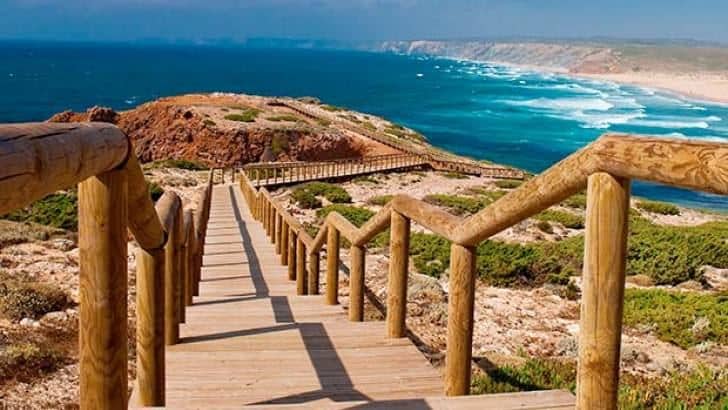
Oil and gas extraction in Portugal, and particularly in the Algarve, is a highly contested issue. Many people realise there is a lot at stake and obviously there are some powerful interests involved. Sure, some people could potentially make a lot of money from oil in the Algarve. But would it benefit the community as a whole? And is it worth the risk?
The moral reason
The Costa Vicentina Natural Park is a valuable and internationally recognised natural reserve. The ecological value of the coastal ecosystem is highly regarded. The park provides a habitat to indigenous and protected species, from insects and birds to marine wildlife including majestic marine mammals such a dolphins and whales. Besides, the numerous visitors to the park appreciate and enjoy the world-class natural beauty of the Costa Vicentina. It is a unique area that well deserves its protected status.
In my view, creating a natural park is like adopting a bit of nature. Like any (adoptive) parent, we would like our child to be protected from danger and thrive. I think we have the moral obligation to apply the same logic to the Costa Vicentina Natural Park. Drilling for oil just outside its perimeter obviously poses a serious risk to the health of the park and should, therefore, be avoided.
The technical reason
The proposed drilling site is just west of the Aljezur continental shelf in deep seas (more than 1000m). As one can imagine, deep-sea drilling is technically more challenging than drilling in shallow seas. The North Sea, for example, has various oil platforms, but the average depth is only 20m and never exceeds 60m. Drilling in the North Sea is not without risk, but the risks are smaller and potential spills are also more easily contained.
The environment Galp/ENI want to explore requires more novel, less-tested drilling technologies. Moreover, the remote location of the well at the bottom of the sea makes it harder to control a potential blowout, as was painfully demonstrated by the Deepwater Horizon oil spill in the Gulf of Mexico. In addition to challenging deep-sea conditions, the area is also close to a vault line and known to be seismically active. Seismic activity contributes to the complexity of the proposed operation and increases the associated risks.
The economic reason
I am not an economist, but this argument appears straightforward to me. Tourism contributed €26 billion to Portugal’s GDP in 2017. That is a lot of money, representing a considerable source of income for the government. The economy of the Algarve is almost solely based on tourism. Directly or indirectly, tourism supports most families in the region.
Obviously, it is yet unknown how much oil may be extracted from the Aljezur basin. However much it is, it is a limited quantity that will probably be extracted within 10 years. It is my understanding that the Portuguese government will, at most, receive 4% of the crude oil value. That means that at least 96% of the value of this Portuguese natural resource will not benefit the Portuguese, except for the happy few who work for Galp’s exploration team. That seems like a very poor deal to me. Many countries like Mexico and Norway have practically nationalised the oil business to make sure they stay with most of the profits. Portugal, on the other hand, is practically giving the oil away to private interests.
There are no direct benefits for the residents of the Algarve while they will bear the cost of a potential spill. Oil extraction does not benefit tourism and may hurt it seriously. It may cause irreparable damages to the coast and its ecosystem. In other words, there are only downsides. Many residents in the Algarve are afraid oil extraction may destroy their livelihoods.
The democratic reason
Unfortunately, the government failed to consult the people of Portugal before they awarded the concessions to the oil companies. As far as I understand, there was no legal obligation to do so, but, in hindsight, I hope the politicians recognise that a decision of this calibre deserves a national discussion and a proper independent environmental impact study before any decisions are made.
Recently, many people in Portugal have spoken out against the oil. A petition in 2016 gathered 42,000 signatures of opponents against the drilling. Long story short, the oil issue is testing Portugal’s democracy and exposing potential collusion between representatives of the government and oil companies. The people of Portugal have the right to know how and under what conditions the democratic representatives are selling the nation’s natural resources. Full political transparency is a cornerstone of democracy. And so is accountability. Potential collusion will have to be proven or disproven in a legal court.
Is it ok to drive a petrol car?
I would like to conclude with what appears a moral dilemma: “Is it ok to drive a petrol car and bring forward reasons against oil drilling ‘in our backyard’? My short answer is yes, that is ok. But the oil must come from somewhere. Sure. Isn’t it unfair and unreasonable to use oil and oppose its extraction? I think it is not. For two reasons. First, deep-sea oil extraction is more risky than extraction from many already-operational fields. Second, it is about time we, as a global society, transition to renewable energy.
Fossil fuels are running out and contribute to dangerous levels of CO2 in our atmosphere causing global warming. Most people would agree we need to move towards cleaner technologies. Therefore, I would encourage every community, anywhere in the world, to oppose risky oil extraction in their vicinity. Making it harder for oil companies to drill may be an incentive for these companies to reconsider their business strategies and start shifting towards renewable technologies*.
To sum up the arguments. Does it make sense for Portugal to extract oil? I would argue it does not because it a) endangers a protected natural area, b) deep-sea drilling has elevated risks, c) the potential financial benefits do not outweigh the potential damages to an already existing multi-billion euro tourism industry, and d) the residents of the Algarve and many other Portuguese do not want an oil rig near their coast.
I admit, this is a bit of wishful thinking. Traditional energy companies sell fuel while the sun provides energy for free, every day, almost everywhere. But the point holds, making it harder for oil companies to extract the last remaining fossil fuels will in effect push alternative energy technologies, including renewables.
By TYCHO HUUSSEN, PhD
Physicist and oceanographer
Resident of Lagos