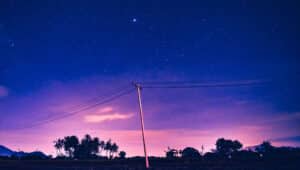
Welcome to the May night sky. The planet Venus dominates the early evening sky by shining brightly over in the west just after sunset.
Through a small telescope, Venus can be seen as a crescent shape and is so bright because it is covered with an atmosphere of dense sulphuric acid clouds that reflect the light of the sun. These clouds are so thick that we can never see the true surface of Venus with a telescope from Earth. On the night of the 15th, the thin crescent Moon will be seen close to Venus.
The ringed planet Saturn is in the constellation of Virgo and, through a small telescope, the rings are easily visible even though they are at a shallow angle to us at the moment. On the night of the 22nd, the moon will be close.
The month of May was expected to have an interesting meteor shower on May 4, 5 and 6. The Eta Aquarid’s, as it is called, should have seen some bright meteors over in an easterly direction. This meteor shower was discovered in the year 401 by Chinese astronomers and it is, in fact, dust left over from the tail of Halley’s Comet.
The ancient Chinese astronomers went to a lot of trouble to record all comets that were visible in the heavens. The emperors truly believed that the future could be predicted by the shape, size and motion of these objects. If an astronomer missed a comet, he may well have had his head chopped off.
The red planet Mars is still visible in the constellation of Leo. Mars is very dim now and easy to overlook, but its reddish colour is helpful in locating it. During May, Mars moves closer to the bright star Regulus and, by the end of the month, is just to the west (right) of this star. The contrast in colours should be noticeable with Regulus being brilliant white and Mars dull red. The moon will be close on the 20th.
The constellation of Orion has now disappeared below the western horizon to be replaced by the grand constellation of Scorpius over in the southeast. The summer Milky Way runs close to Scorpius and this part of the night sky is in the south at midnight giving us starlit spring and summer nights.
The sky in Portugal is normally clean and clear due to the wind, which blows predominately from the south west, this air is pollution free and allows the sunshine to pass easily, warming the ground and giving us the fine weather we usually have in the summer time.
If you travel northwards just a few hundred miles, the weather patterns change and the low pressure areas from the north Atlantic dominate and bring the wet and windy conditions that are so familiar in the UK.
The recent volcanic ash plume from Iceland was caught up in this turbulent weather system and spread all over northern Europe and into Russia. Eventually, it will spread right around the globe and slightly reduce the transparency of the atmosphere predominately in the northern hemisphere above 45 degrees north. This has happened before in the past when Icelandic volcanoes have erupted and may well have contributed to very poor summers and cold winters in the 18th and 19th century.
In the year 1783, an eight month long eruption of the Icelandic volcanic Laki destroyed the climate in the northern hemisphere and caused some of the coldest winters ever recorded with ice being seen as far south as the Gulf of Mexico, and the river Mississippi freezing in New Orleans. Also, millions of tons of sulphur dioxide were put into the atmosphere and may have been responsible for tens of thousands of deaths through respiratory diseases.
Also, the year 1816 is known as the year without a summer throughout the whole world after the 1815 eruption of mount Tambora in Indonesia.
The situation we have in Europe at the moment is nowhere near as bad as it could be, so we should still have clear skies this summer in Portugal.
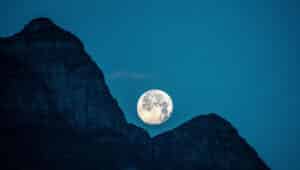
The Moon is at First Quarter on the 6th, full on the 14th, Last Quarter on the 20th and New on the 27th of May.
Clive Jackson is the Director of the Observatory and the Camera Obscura (next to the Castle in Tavira), specialising in education and public outreach. Tel 281 322 527, Fax 281 324 688, email cdepa@mail.telepac.pt or visit www.cdepa.pt