Dunas Livres association wants to avoid “irreversible damage to landscape and ecosystems”
An association contesting various tourist projects planned for Tróia in the Setúbal district argues “construction must stop to avoid irreversible damage to the landscape and ecosystems.
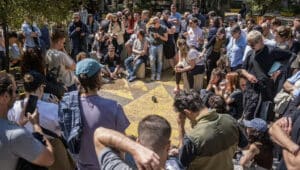
“We’re talking about four plots of land on the Troia Peninsula that haven’t yet been built on and could be safeguarded”, Maria Santos, from the Dunas Livres association, told parliament’s Environment and Energy Committee, in Lisbon yesterday.
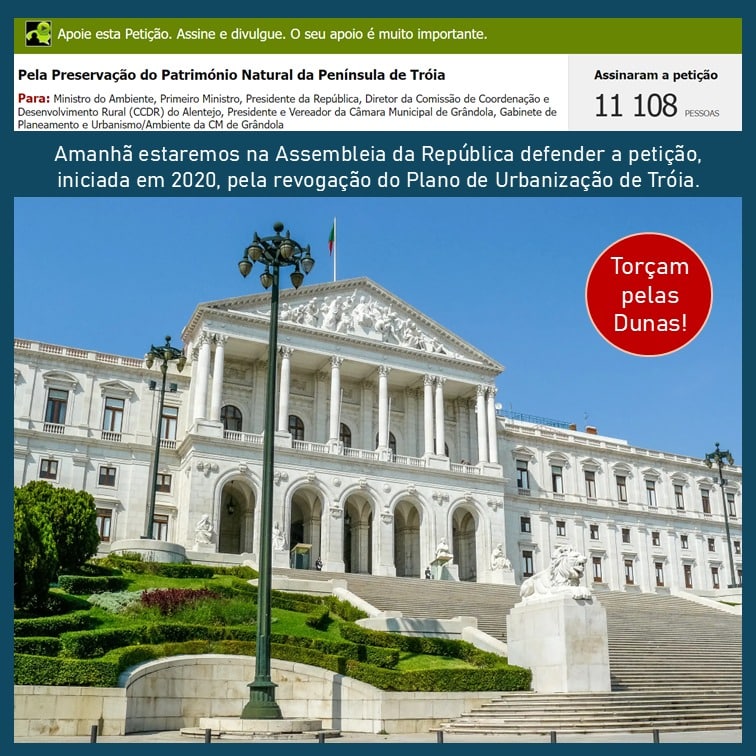
Delivering the 11,108-strong petition ‘For the Preservation of the Natural Heritage of the Troia Peninsula’, she stressed: “It is the last minute to do this”.
Maria Santos told MPs “these are habitats that will never return“, where “species that are completely at risk of extinction” live.
“And all of this should already be protected by the Natura (2000) Network or (by the protection instruments of the) Sado Estuary Nature Reserve”. Destruction “is going to be irreversible and the government is not taking care of the situation”.
The Dunas Livres (Free Dunes) association members pointed the finger at communist CDU-run Grândola Town Council considering that, a few years ago, it could have changed the Municipal Master Plan (PDM) to limit the development of tourismn the municipality.
Maria Santos also criticised the Alentejo Regional Coordination and Development Commission (CCDR), saying that it “approves some projects on the spur of the moment and without any logic”, giving the example: “An Environmental Impact Study says that a (certain) project has negative environmental and social impacts and the conclusion that comes from the Alentejo CCDR is that, taking all this into account, their opinion is positive”.
Santos also stressed that the Institute for Nature Conservation and Forests (ICNF) and the Portuguese Environment Agency (APA) “are entities with huge responsibilities”, but “their resources are being reduced.
“They have no resources, there are no technicians, there isn’t even a vehicle for the field (in the Alentejo), yet these organisations are responsible for giving opinions on projects covering thousands of hectares that are irreversibly destroying the territory”.
According to Santos, the heads of the organisations that issue opinions “are appointed as political positions and are completely incompetent”: so often the technicians write one thing, and whoever is in charge “decides completely the opposite”.
“The ICNF was the only entity that gave unfavourable opinions on these projects,’ she explained, saying that she knows that “the technicians are under constant pressure and threats to give other opinions”.
For this to have been said, in a parliamentary committee, and printed in newspapers, is a hugely important step: it exposes the rot at play in so many hugely damaging projects in this country.
The Dunas Livres association advocates an urgent end to the classification of projects as “a Project of National Interest (PIN)”; it also calls for an end to “all the country’s efforts to get out of non-compliance with the Habitats Directive and the Birds Directive.
“We (meaning Portugal) are paying fines of thousands of euros to the European Union because we have not implemented directives properly”, Maria Santos went on.
“The MPs acknowledged the need for more supervision and possibly an adaptation of the tourism projects in question”, writes Lusa.
“Still, some recognised that reversing what had already been authorised would be difficult”.
At the end of the hearing, however, it was made clear that the petition will be analysed in parliament – and the affirmations of Maria Santos will now be difficult to muffle. She said what so many people have said in private before, but not in parliament.
Source material: LUSA