Vancouver just doesn’t need to try! The Pacific Ocean stretches in front and snow-capped mountains rear seductively behind. In between lies perhaps the world’s most liveable city, replete with cafés, restaurants, boutiques and a range of attractions to suit all tastes.
Tourism in Vancouver, however, is not a modern phenomenon as, over a century ago, the author Rudyard Kipling was entranced by the laid-back ambience of this west coast gem. He wrote: “A great sleepiness lies on Vancouver as compared with an American town; men don’t fly up and down the streets telling lies, and the spittoons in the delightfully comfortable hotels are unused; the baths are free and the rooms are unlocked!”
Coastal Indian tribes were the first inhabitants of this part of British Columbia as early as 5,000 BC and the first European to arrive was the Spanish sailor José Navéz in 1791, followed by the English explorer Captain George Vancouver.
In 1858, the Fraser River gold rush brought fortune hunters and a small settlement was established, which rapidly grew. A massive boom followed the construction of Canada’s transcontinental railway and the first train from Montreal arrived in 1887.
Vancouver soon became the most important town in Western Canada, with thousands of Chinese immigrants settling in the region after they had come to assist railway construction. Although many British Columbians regarded these Chinese with contempt, it heralded the beginning of an Asian immigration trend that has continued ever since. Greater Vancouver now has a population of 2.5 million with over 50% of its residents speaking a first language other than English! Roughly 30% of the city’s inhabitants are of Chinese heritage.
The hop-on hop-off buses conveniently travel through central Vancouver’s highlights – Stanley Park, Gastown, Granville Island, Chinatown, Science World and the Canada Place waterfront. Gastown is named after a 19th century entrepreneur called ‘ Gassy Jack’, whose nickname was derived from his talkative nature rather than his digestive system! It is shamelessly tourist-orientated and its cobbled streets are lined with cafés and tawdry gift shops. There is an unusual steam-powered clock in its central square. We were fortunate to have some good friends who expertly guided us through the city’s finest attractions, our favourites being:
Central Vancouver – Stanley Park and Granville Island
Created in 1888, Stanley Park is one of the world’s great urban parks. Sometimes called ‘the lungs of Vancouver’, it has 400 hectares of west coast rainforest, manicured lawns, lush gardens, sports fields and peaceful trails, stunning sea views, a picturesque lake and beautiful beaches. This superb green oasis is just a short drive from downtown so is amazingly accessible to local residents.
We toured the park by car but, with more time, could have enjoyed more of its beauty and bounteous wildlife, by following the many trails and old logging roads on foot, by bicycle or on horseback. We particularly liked the terrific views from Prospect Point towards the Coastal Mountain Range. The creation of this stunning park was an act of great vision by the city’s forefathers.
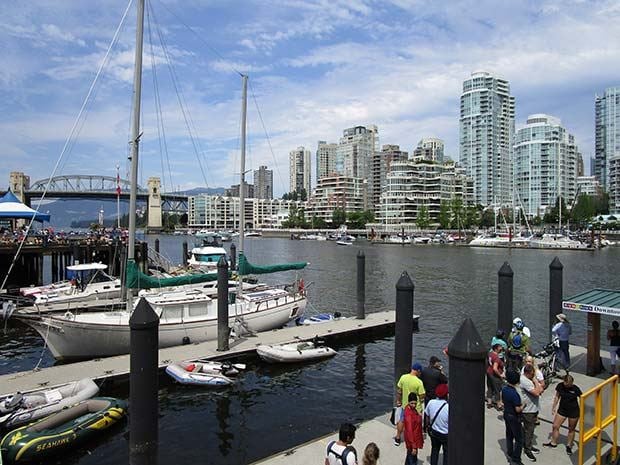
Granville Island is on False Creek and sits slap bang in the middle of downtown Vancouver. The original mud flats of this creek were the fishing grounds of the native Squamish people but, in the 19th century, were ruined by the arrival of heavy industry and accompanying pollution. Happily for today’s residents, the federal government completely redeveloped the island in the 1970s.
Granville is now a bustling community with a labyrinth of converted warehouses, up-market shops, galleries, a brewery, street entertainment and its enticing centerpiece – the public market. Like excited children in a candy store, we explored the market’s treasure trove of stalls, which perfectly reflected the wide cultural diversity of the city itself. Our eager eyes soon spotted a purveyor of an impressive range of Canada’s favourite sticky ‘sugar fix’ for sale – delicious maple syrup!
South Vancouver – Steveston and the UBC Garden
Lovely old-fashioned Steveston is a harbour town on the Fraser River south of the city, founded upon a salmon canning industry that employed thousands of people in its heyday. Its museum, the Gulf of Georgia Cannery National Historic Site, offers visitors a rewarding peep into the past. Inside the old cannery building, the original equipment is still in place and allowed us to immerse ourselves into the sights and sounds of Canada’s West Coast fishing history. The canning line, herring reduction plant and vitamin oil manufacturing all remain intact.
Steveston still maintains the character of a quaint fishing village and each day hundreds of people arrive to purchase fresh seafood from the public wharf. We watched long queues of cheerful, chattering Vancouverites patiently waiting to buy fresh shrimps, cod, hake, salmon, halibut and even sea urchins (a Chinese and Japanese delicacy). We couldn’t resist having lunch nearby – fish and chips, of course!
The UBC (University of British Columbia) Point Grey Campus is a 30-minute drive south of downtown. In addition to student facilities and fine museums, the campus also has an outstanding botanical garden, first created a century ago, and a haven for horticulturalists. It has alpine and woodland gardens, Carolinian and BC rain forests, colourful herbaceous borders and, our personal favourite, the Asian garden. This has secretive winding paths through hundreds of rhododendrons, and thousands of plants from China, Korea and Japan, all under a picturesque canopy of cedar, fir and hemlock.
North Vancouver – Grouse Mountain
North America’s largest aerial tramway lifted us 1,200m up scenic Grouse Mountain, north of Vancouver. It is a ski resort in winter but, in summer, becomes an adventure playground and wildlife refuge – a fun day out for all ages.
Youngsters enjoy mountain biking, paragliding and zip lines whilst oldies can ascend sedately by chairlift to the mountain’s summit or take guided eco-walks. Family entertainment includes a lumberjack show, a grizzly bear enclosure and a ‘birds of prey’ demonstration.
Unfortunately, the lumberjack show was embarrassingly awful and the timid grizzly bears hid amongst the trees! However, the majestic Bald Eagle, the lightning fast Peregrine Falcon, the Barn Owl and the Great Horned Owl utterly captivated an appreciative audience with their beauty and aerial skills. Supported by a knowledgeable commentary, this demonstration was a masterful exercise in educating the public about the wonders of bird-life.
We were very impressed with this splendid cosmopolitan city. The residents are friendly, but, unlike in Kipling’s time, there is little evidence of a ‘great sleepiness’. Men don’t ‘fly up and down the streets telling lies’ but huge numbers of them do fly up and down the highways in their large gas-guzzling SUVs. Happily, there was no evidence of spittoons – used or unused!
By Nigel Wright
|| features@algarveresident.com
Nigel Wright and his wife Sue moved to Portugal 13 years ago and live near Guia. They lived and worked in the Far East and Middle East during the 1980s and 90s, and although now retired, still continue to travel and seek out new cultural experiences. His other interests include tennis, gardening and photography.