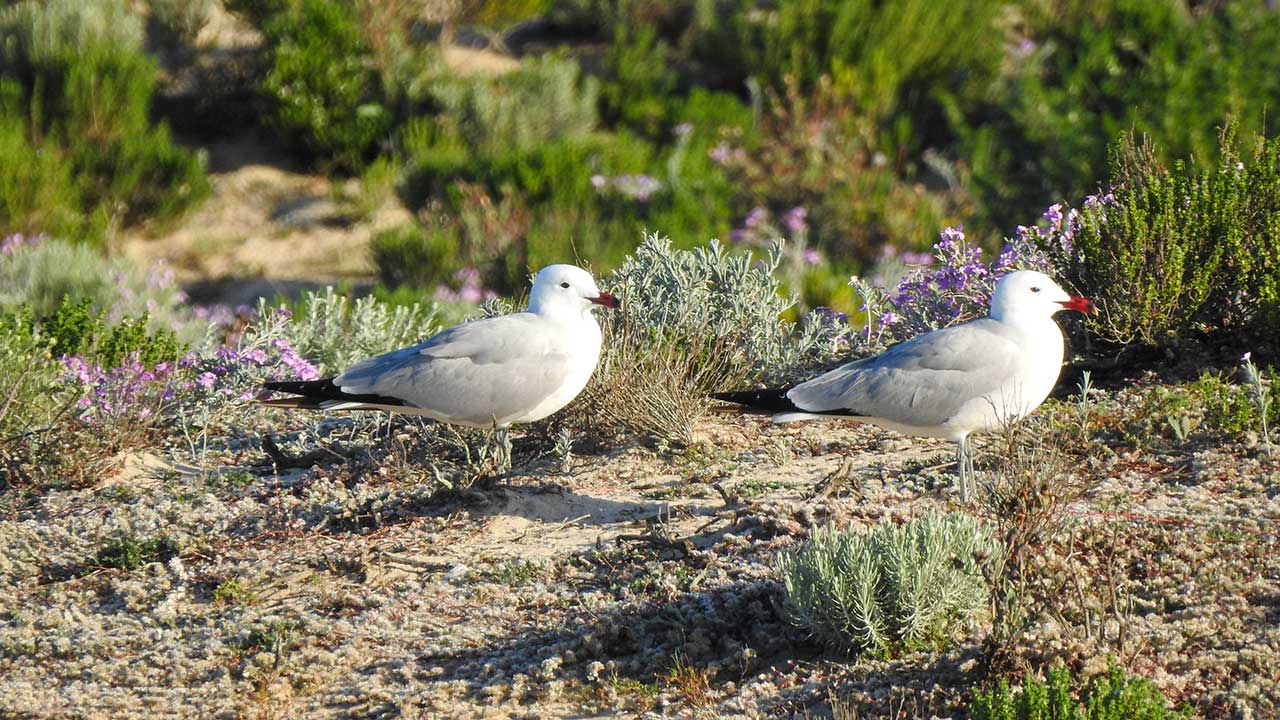
In decline around the world, the endangered species is contradicting the trend in Portugal, with already over 7000 nests in the Ria Formosa.
The Audouin’s gull is in decline around the world, but the Portuguese population is bucking this trend. This threatened species has increased year-on-year since settling in the Ria Formosa around a decade ago. This year, specialists from the LIFE Ilhas Barreira project counted more than seven thousand nests of the species, almost three times more than at the beginning of the project in 2019.

“The fact that we have the largest colony in the world when the Audouin gull is disappearing from other places shows the importance of nature conservation and also brings us additional responsibility,” says Joana Andrade, coordinator of the LIFE Ilhas Barreira project and the marine conservation department of the Portuguese Society for the Study of Birds (SPEA).
This elegant grey-legged gull is identified by its red bill. Unlike other species of gulls, the Audouin gull continues to feed mainly on fish, taking advantage of fishery discards, and rarely consumes waste from skips, bins or other types of human waste.

Worldwide, this species only breeds in a small number of colonies, which leaves it especially vulnerable to threats such as terrestrial predators and human disturbance.
In Portugal, the LIFE Ilhas Barreira project, funded by the European Union’s LIFE programme, has minimised these threats in the species’ main breeding colony, the Ilha Deserta/Barreta. The results are visible: the annual count of the breeding population of Audouin’s gull in the Ria Formosa, carried out within the scope of the project and coordinated by the ICNF and MARE/University of Coimbra with help from the SPEA, has increased every year. And since 2022, the species has expanded to the neighbouring Ilha da Culatra, which has also improved noticeably.

“The new Audouin gull colony in Culatra provides more security for the future. These islands are delicate ecosystems. It is crucial to protect potential areas, even if birds do not currently inhabit them, because of the fragility of island ecosystems. By safeguarding these areas, we guarantee that the species has alternative places to nest in case of disturbances or environmental changes”, emphasises Joana Andrade.
Experts stress the need to revise the international conservation plan to safeguard the Audouin gull species in Portugal and beyond. They also stress the significance of establishing a national strategy to protect these birds, both on land and at sea. With this aim, the LIFE Ilhas Barreira project proposes expanding the Ria Formosa Special Protection Zone towards the sea to protect feeding areas for this and other seabirds.

LIFE Ilhas Barreira is coordinated by the Portuguese Society for the Study of Birds (SPEA) and has as its partners Animaris, RIAS/Aldeia, ICNF, CCMAR/UAlg, CIMA/UAlg and Ecotop-MARE/University of Coimbra.
Photos: Ana Almeida/ SPEA