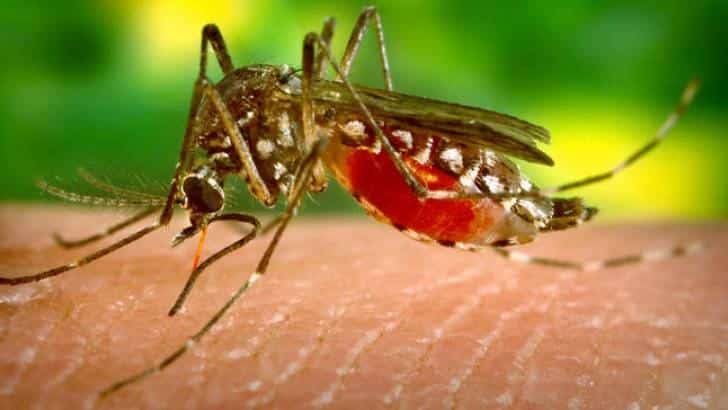
With this year’s stultifying temperatures continuing into October, news from Spain is that the Asian Tiger mosquitoes responsible for various viral diseases – particularly Zika, Chikungunya and Dengue – is “at Portugal’s doors”.
Eggs have been discovered in two boroughs of the Spanish Extremadura which borders the Beira Baixa and Alentejo regions.
For now, this is simply an alert.
The sting from these flying bugs that have been spreading throughout Europe since 2004 can provoke serious reactions.
There is a risk of death in one in a thousand cases – but experts stress that not every mosquito will be infected with disease.
The Zika virus prompted a worldwide panic in 2015 after a wave of babies was born in north eastern Brazil with seriously reduced head-circumferences.
These “shrunken heads” were linked directly to mothers carrying the virus, but since then fears that Zika would go on to affect many more babies throughout the world appear to have been unfounded.
Asian Tiger mosquitoes – Latin name: Aedes albopictus – do not just carry Zika. They spread a number of viral diseases, some of which are said to be incurable.
Spanish health authorities blame the rapid spread of the mosquito on climate change, the migration of people and the bugs’ own resistance to insecticides.
Environmental changes “provoked by deforestation and the clearing of endemic species” have also played a part in the scenario which is now being closely monitored.
Spanish authorities warn that people should be aware of the “ease” with which this mosquito can travel in cars, buses and lorries.
Service stations on the A5 motorway between Madrid and Portugal as well as the A66, between Gijon and Seville, now have ‘active points of vigilance’, as well as tyre sales outlets and centres running delivery trucks.
Elsewhere, traps have been set in cemeteries in the towns of Cáceres, Badajoz, Merida and Plasencia.
Asian Tiger mosquitoes first entered Europe in tyres imported from Asia.
In appearance, they are ‘striped’ and between 5-10 mms long.
These bugs survive in high temperatures (best between 25-30ºC).
Their periods of ‘greatest activity’ are from May to November, early morning and around sunset.