Twenty years ago this month, the Via Algarviana/Algarve Way was walked for the first time. So, what is it and how did it come about?
In AD 303, Vincent, a devout and active Christian from Saragossa in Spain, was tortured and martyred for his beliefs in Valencia, under the orders of the Roman Emperor Diocletian. Sometime later, he was canonised and became St. Vincent.
Two or three centuries later, the Christians of Valencia took his body and set sail westwards out of the Mediterranean. They sailed as far as Sagres where his body was buried, possibly at the time just temporarily, near to the Cape that bears his name. There it lay for several centuries, however, during which time a steady trickle of Moçarabe pilgrims made their way across Iberia to pay homage to him.
They crossed the River Guadiana at Mértola and set off from Alcoutim across what was then Al Garbe, the western part of Al-Andalus, heading for the Cape, the Promontorium Sacrum as it was then called, already a religious site and the end of the known medieval world.
St. Vincent’s body remained at the Cape until 1173, when as a symbolic gesture to mark the reconquest of Lisbon from the Moors, it was taken to Lisbon by ship, guided by ravens as tradition has it, where King Afonso Henriques appointed him as patron saint of that city.
To this day, his remains lie within a casket in the Treasury of Lisbon’s Sé. He is, sadly, a little recognised saint. Even many Portuguese are not aware that he is the patron saint of their capital, although the city coat of arms does depict the ship and ravens. He is also, perhaps almost as important to some, the Patron Saint of Winemakers.
Until recently, when a modern statue in his memory was erected at the Cape through the patient efforts of a Finnish historian, there was little there to remember him.
Little was done to record or perpetuate this pilgrims’ trail in the way of that of St. James (Santiago) in Northern Spain, until a Portuguese group called the Associação Caminus did some research in the 1980s, and in 1990 published a study and map of the route under the title “Moçárabe em Peregrinação a S. Vicente”.
The Portuguese environmental association Almargem was obviously fully conversant with this and had some ideas as to how it could be better exploited.
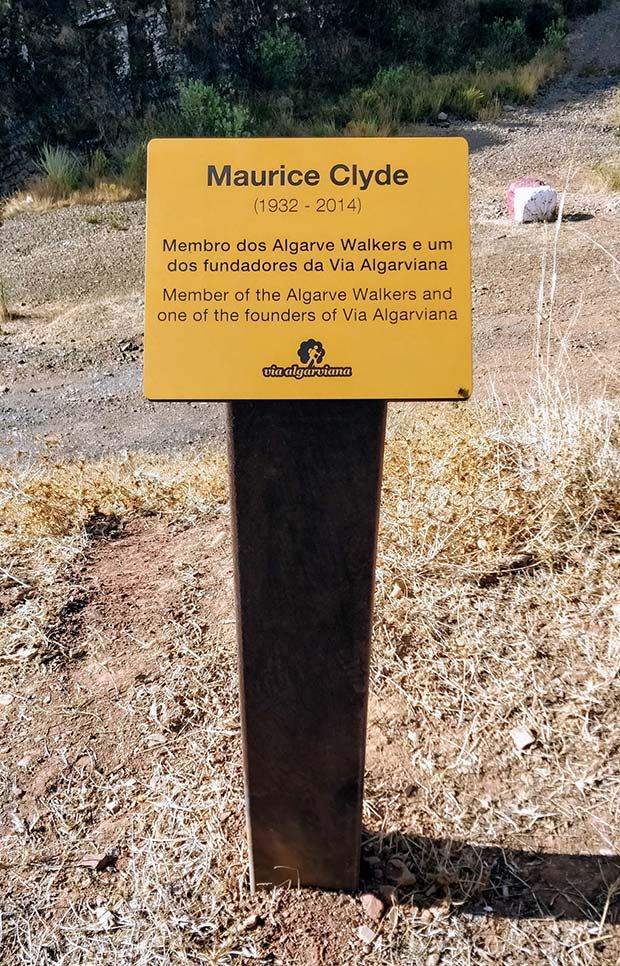
So how did this become the Via Algarviana/ Algarve Way? In 1996, the Algarve Wednesday Walkers (AWW), a group of quite energetic countryside ramblers, was founded by one Maurice Clyde.
Apart from exploring the magnificent Algarve countryside, he had a dream of creating a cross-Algarve long distance walking route to link in with one of the Trans-European walking routes (the GR13/E4 already existing through to SW Spain). What better than to base this on the old St Vincent’s pilgrims’ trail as described by Caminus?
From the outset, Maurice Clyde was in close consultation with Almargem and regular meetings with the AWW were established. At the time, Almargem was heavily involved in many other important environmental issues and had few physical resources to allocate to this project, but they gave much moral support and behind the scenes were using their experience, knowledge and influence to further the project.
The AWW, with more people and time on their side, became the physical face. Members of the AWW then spent many months walking the Algarve, developing and reconnoitering a route.
Much of the original route, rather inevitably, had become tarmac roads and urban areas, so to avoid these stretches and to include some of the other lovely parts of the Algarve interior, a number of modifications were made. The route also had to have a name, of course, and to give equal weight to foreign and national users, it was christened, jointly at the time, “Via Algarviana” and “Algarve Way”.
By 1997, the route was developed enough to have some test walks. In May of that year, the eastern half, from Alcoutim to Messines, was undertaken by a small group from the AWW and, in October, the western half, from Messines to Cape St. Vincent, was completed.
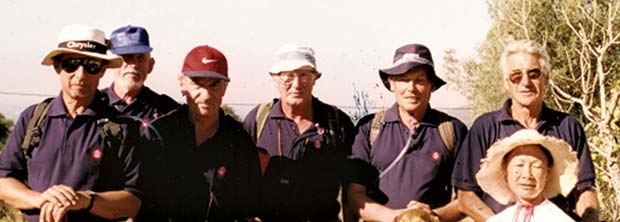
In October 1998, to much fanfare, the first full 250km trans-Algarve crossing was accomplished in 11 consecutive days by a group of seven AWW members: Maurice Clyde, Ian Cooper, Mark Harman, Tony Webster, Myriam Lo Isaac, Roderick Frew and Ian Angus, plus four dogs, with much logistical help from other members. This was also done partly as a charity project to raise funds for the APAA animal protection group.
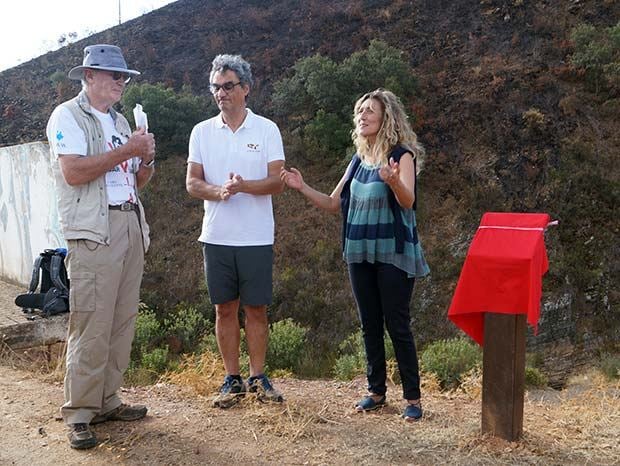
In 1999, the walk was completed in reverse from the Cape to Alcoutim. This was undertaken by Maurice Clyde, Myriam Lo, Paul Akehurst, Lindsey Henley-Welch, Neil McCabe, Simone Childs and two walkers from a Spanish Club, Paco Terrero and Mercedes Ramos. At the end of this crossing, a post marking the start of the trail was erected in Alcoutim. This still stands there today.
In the course of the next few years, the route was traversed in a number of different formats and with different objectives. AWW walker Ian Cooper led two partial crossings for an Irish-based cancer charity, with most of the participants suffering most bravely with terminal cancer.
In 2000, the trail (slightly modified for horses) was first covered by horse rider groups led by AWW Roderick Frew and was also covered by Karen Yates and Tony Barry on mountain bikes.
In 2002, the crossing was first achieved by a visiting individual, American Kevin Nawn, following the rather rudimentary route description only then available.
In 2007, the route was covered as a major charity project (raising €35,000 for Riding for the Disabled and PSP, a form of motor neuron disease) by a large group of horse riders, half of whom came from the UK, led again by AWW Roderick Frew.
All this time, Almargem had been pursuing the project from a political and organisational point of view so that the project could gradually be elevated to a national level, culminating in a formal presentation of the project at a National Walking Conference held in Silves in 2001.
Up to that time, little had been done to actually map and record the route. In 2005, however, David Littlewood and Terry Ames, both experienced long-distance walkers in the UK, came to the Algarve, joined the AWW and set about mapping, describing and way-marking the route. This was, of course, greatly facilitated by the advent of user-friendly GPS systems.
This very considerable achievement, published then through www.algarveway.com, was under the Algarve Way name, waymarked with a white cistus flower emblem. Terry Ames walked the mapped route in 2006, much of it solo, in what must be a walking record eight days. Since then he has guided many enthusiasts along this spectacular route.
By then, Almargem was in a position to become more physically involved and be more pro-active in the project. They were able to attract some much-needed EC and local funding, which gave more visibility and publicity to the route as well as investment in permanent way-marking and route facilities.
They have now become the prime movers of the route, with modifications under the Via Algarviana name, and produced a fully mapped information website www.viaalgarviana.org, which is now the gold standard map and description.
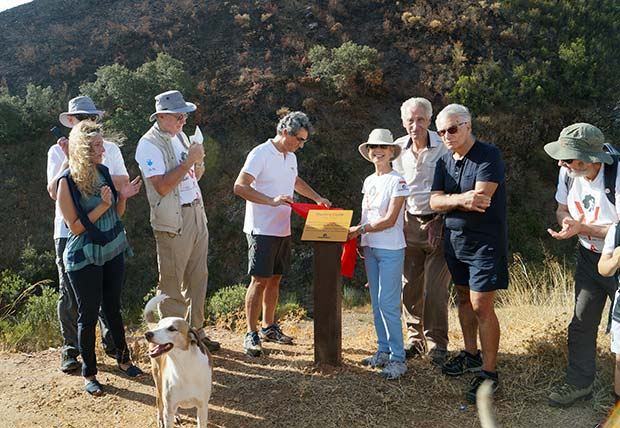
So, 20 years later, Maurice Clyde’s dream lives on. It has now become a well-recognised route which can be followed readily by anyone downloading the website. What of those AWW members who put so much time and effort into the early research and crossings?
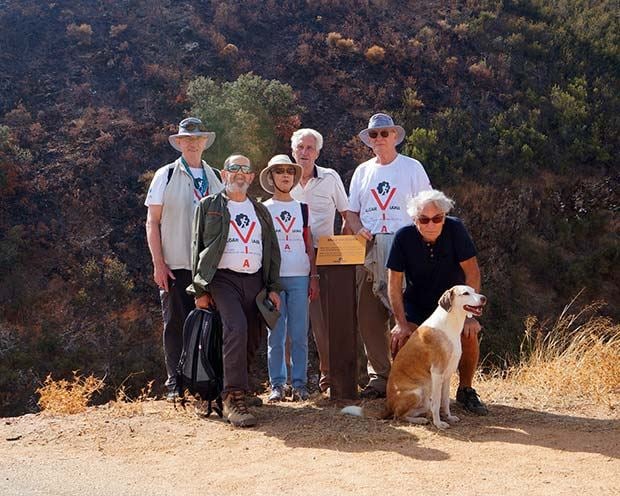
Of the original seven who made the first crossing, Myriam Lo and Roderick Frew still walk regularly, Tony Webster walks occasionally but spends more time playing bridge. Ian Angus, although never an AWW, resides in Spain and still walks regularly. Mark Harman resides in Lagos but is sadly incapacitated. Maurice Clyde and Ian Cooper both eventually returned to the UK where sadly both succumbed to illness.
Of the other AWW members who participated in the first reverse walk, Paul Akehurst and Lindsey Henley-Welch still walk regularly, David Littlewood, now secretary of the AWW, and Terry Ames walk regularly and will happily assist and impart their knowledge of the route to any prospective walkers.
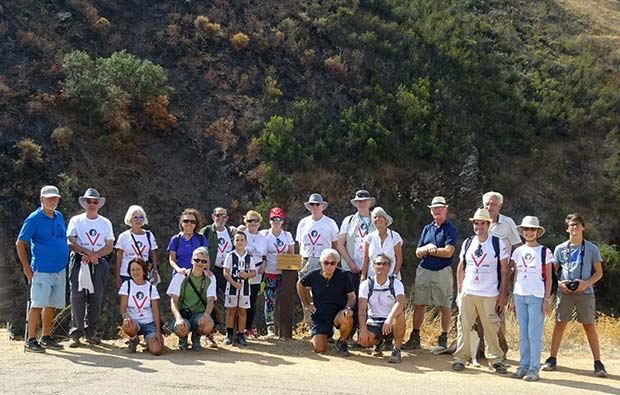
The route, now fully administered by Almargem under Via Algarviana waymarks and website, is regularly covered in part or as a whole by latter-day “pilgrims”.
It is a magnificent walk through the original Algarve, much of which has never changed. You will see Algarve countryside and villages which you would never dream exist. It is well worth the effort to walk parts, or even all of it, before golf courses, electricity pylons and wind turbines take further toll. It will, however, continue to require regular funding for maintenance and publicity, especially after this year’s fires which have caused so much damage. Let us hope it will not be forgotten.
By Roderick Frew