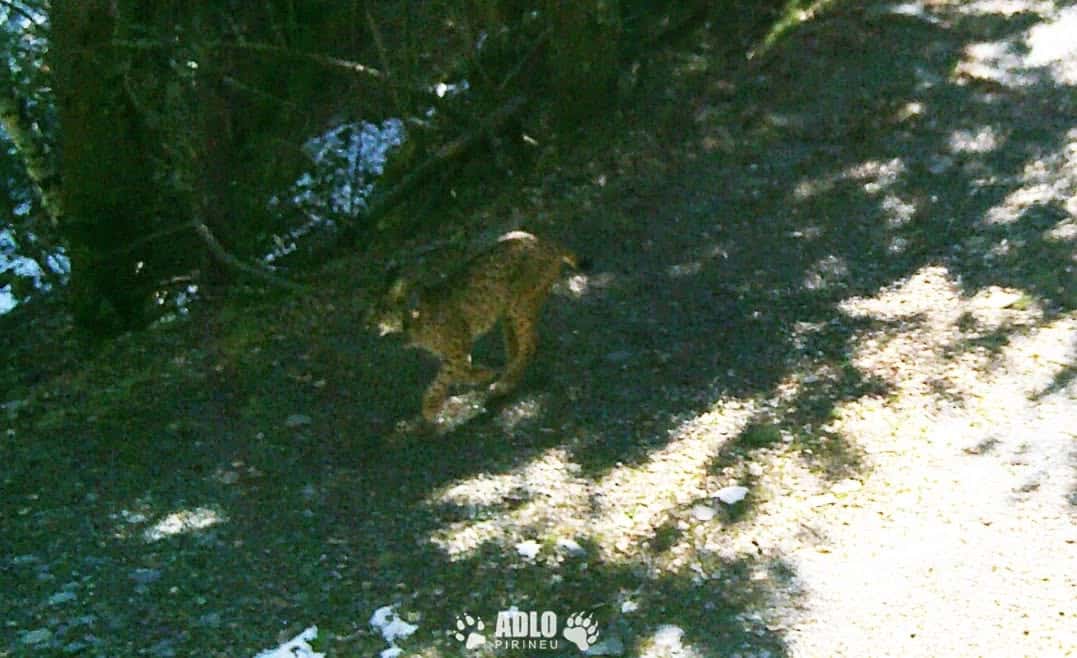
An Iberian lynx born in captivity in Portugal’s Algarve region has made history after becoming the first of its species ever recorded in the Pyrenees, near the French border.
The animal was identified as a four-year-old male nicknamed ‘Secreto’, born at the National Centre for the Reproduction of the Iberian Lynx (CNRLI) in Silves in 2021. Secreto was released into the wild in the spring of 2022 in the mountains north of Seville, southern Spain.
“For the first time, one of our tracking cameras – installed with official authorisation to monitor brown bears and wolves – has recorded the presence of an Iberian lynx (Lynx pardinus) in the Pyrenees, near the French border,” said the Association for the Defence of Wolves and Bears in the Pyrenees (ADLO Pirineo) in a statement. “Until now, there was no documented evidence of the presence of this species in the Pyrenees,” the association added.
To reach the Pyrenees, the lynx travelled several hundreds of kilometres – nearly 1,000 kilometres in a straight line from his release point near Seville — one of the longest known journeys by the species.
According to ADLO Pirineo, the animal was recorded by the association’s camera in April, but the images were only viewed in the summer. Secreto had already been detected months earlier by cameras belonging to forest rangers in Catalonia, in north-eastern Spain, but in an area outside the Pyrenees. ADLO Pirineo confirmed the lynx’s identity thanks to the unique pattern of his coat, it said.
The lynx’s sighting in the Pyrenees also marks “one of the highest altitude sightings of an Iberian lynx in the Iberian Peninsula” – almost 1,750 metres, in an area home to hares, roe deer and other animals.
The group stressed that the sighting “confirms the Pyrenees as a potential habitat” and “reinforces the urgent need” for reintroduction programmes in Catalonia and Aragon.
“In addition to being a symbol of biodiversity, the species has historically played a key role as a natural predator of rabbits, which represent about 90% of its diet. This offers an ecological and sustainable alternative to the problem of rabbit overpopulation” in several areas, the association argued.
ADLO Pirineo also condemned the continued use of poisons to control wildlife, calling it unacceptable in the 21st century.
The Iberian lynx (Lynx pardinus) was once on the verge of extinction, with fewer than 100 animals surviving in the early 2000s. Thanks to conservation projects – many funded by the European LIFE programme – populations have rebounded to more than 2,000. In 2024, the species was reclassified from “endangered” to “vulnerable” on the IUCN Red List. According to the latest census, numbers grew by 19% in 2024 to 2,401 lynxes, including 1,557 adults and 470 breeding females. In Spain, there are populations in Castile-La Mancha (942 animals), Andalusia (836), Extremadura (254), and Murcia (15), some of which are already interconnected. In Portugal, 354 lynxes were counted in the Guadiana Valley, up from 291 in the previous year.
The Silves breeding centre alone has provided a refuge for the birth of 170 lynxes since it opened in 2009, with 110 reintroduced into the wild by the end of 2024. The wider recovery project involves both public and private partners in Portugal and Spain, coordinated nationally by Portugal’s Institute for Nature Conservation and Forests (ICNF).
Conservationists say that for the lynx to reach a truly “favourable conservation status,” the population must grow to between 4,500 and 6,000 animals, including at least 1,100 breeding females – a goal that may still seem far away, but which is significantly more achievable than it looked two decades ago.