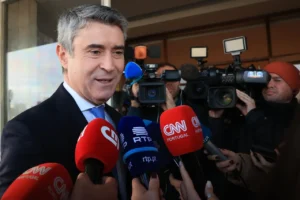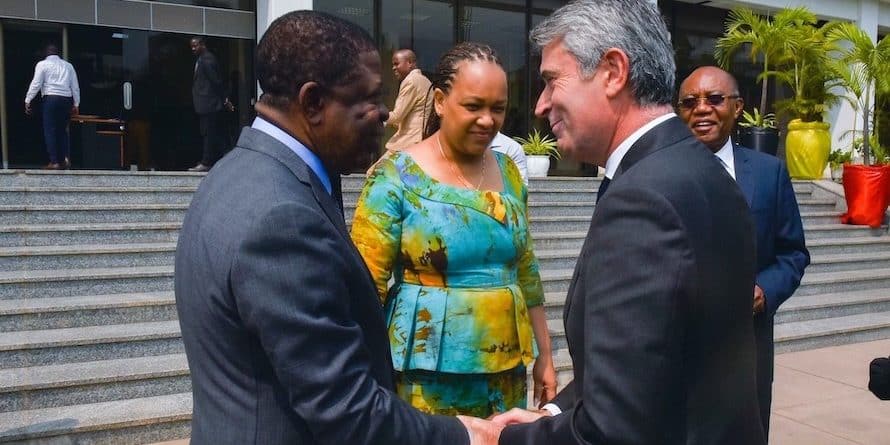
José Luís Carneiro, leader of the Portuguese Socialist Party (PS), said today, on arrival in Lisbon, that the Angolan authorities with whom he had contact in Luanda do not understand the changes to the nationality law proposed by Portugal’s social democrat government.
Mr Carneiro had a lightning visit to the former Portuguese colony for meetings with president João Lourenço, as well as contacts with civil society, the Portuguese community and Angolan businesspeople.
He told Lusa that Angolan authorities expressed “incomprehension at the fact that Portugal wanted to change nationality legislation without prior political dialogue on the objectives to be achieved with the proposed changes.
“The amendment to the law on foreigners, particularly on family reunification and access to justice, has caused perplexity in many social, business and political sectors in Angola,” he stressed.
The changes to the law presented by the Portuguese government will be discussed in October and the PS is willing to accept improvements to the legislation, says Carneiro.
But, in his opinion, the country needs “to ensure that the privileged relations with Portuguese Language Countries, which are the guidelines of Portuguese foreign policy, are guaranteed.”
After the contacts in Angola, José Luís Carneiro said he would be holding similar meetings in September with other capitals of the Community of Portuguese Language Countries (CPLP), stressing that this is a “sensitive” subject closely related to the principle of reciprocity – in particular – in the treatment of Portuguese citizens living in CPLP countries (of which there are quite a few).
According to the PS, 130,000 Portuguese live in Angola and 60% have dual nationality: Portuguese and Angolan.
Equally, there are 2,000 Portuguese companies in Angola and there are 5,000 Portuguese exporters who do business with Angola.
In this sense, Mr Carneiro believes relations ‘should flow with confidence’, maintaining contacts that should not be “jeopardised”.
All this being said, Angola is in the middle of a great deal of social, economic, political and judicial turbulence right now. Expresso reports that Mr Carneiro’s visit (which only begun on Tuesday and has already ended) played out against a moment of “strong protests in Angola. Oil production has fallen to less than a million barrels a day – the lowest level in more than two years – inflation on even basic household items is weighing heavily on families; there has been violence in the streets: unemployment is running at 30% and “instability has also hit the judicial system”.
In other words, changes to the nationality law are possibly the last thing on political leaders’ minds right now – which is another reason why they may not understand them.
Regarding the positions of Luís Montenegro’s government – which recently stated that it had no preferred parties for negotiating the next state budget – José Luís Carneiro considered this to be an unfounded statement.
“In fact, the government has had a preferred partner. The government reached an agreement on the Foreigners’ Law with right wing CHEGA and established an agreement on income tax (…) Now we’ll see if this agreement is structural and lasting or if it was a move that can be directed.”
Source: LUSA