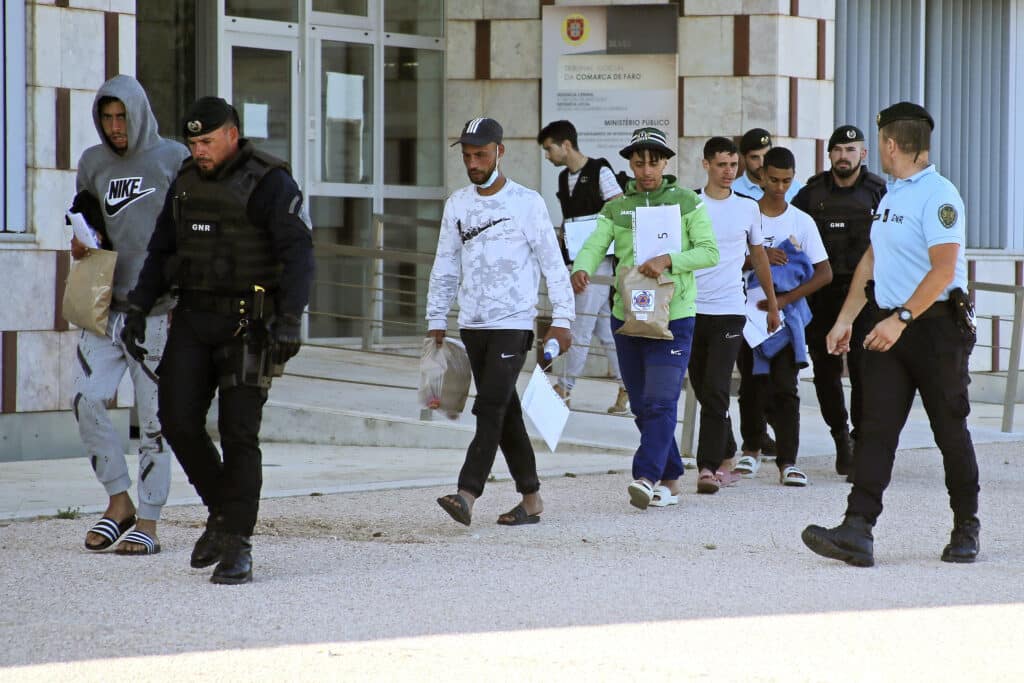
Portuguese authorities have rejected 34 of the asylum applications from the group of 38 Moroccan migrants who arrived at dusk in the Algarve on August 8.
Four further applications from unaccompanied minors (teenagers) are still to be assessed.
According to a source from AIMA, the Agency for Integration, Migration and Asylum, the 38 migrants applied for international protection (reportedly for political and economic reasons, as well as because of sexual orientation) but authorities considered 34 of the applications – including those made by adults accompanied by their children – to be unfounded.
The 34 have already been notified of these decisions and the deadline for lodging an appeal (ten days) is underway.
On August 9, the judge on duty at Silves Court ordered the forced removal of the migrants and their transfer to temporary accommodation centres (in Porto and Faro). If the migrants do not express their intention to return voluntarily, their forced removal has a legal deadline of 60 days.
So far, “no (migrant) has expressed a desire to return to their country of origin,” explained a Public Security Police (PSP) source. In this case of voluntary return, the deadline for this (20 days) has already expired.
According to the PSP, “only four of the 38 citizens were in possession of, or later presented, an identification document”.
The group of 38 – made up of 25 men, six women and seven minors – arrived at Boca do Rio beach, in the parish of Burgau, in the district of Vila do Bispo, in the western Algarve, in a rickety wooden boat at around 8.05pm on August 8.
Until they were transferred to temporary accommodation centres, the migrants – some of whom were treated in hospital – were housed in a sports pavilion in Sagres provided by the Civil Protection Service of Vila do Bispo’s local council.
According to the information given at the time by the PSP, 14 people were then placed in the Porto Temporary Installation Centre (Unidade Habitacional de Santo António), 15 in the Espaço Equiparado a Centro de Instalação Temporária (EECIT) in Faro, and nine in the EECIT in Porto.
source: LUSA